Why Won't My Seeds Germinate? Causes and Fixes for Beginner Seed Detectives
Beginner's case file — open the file on seeds that haven't come up
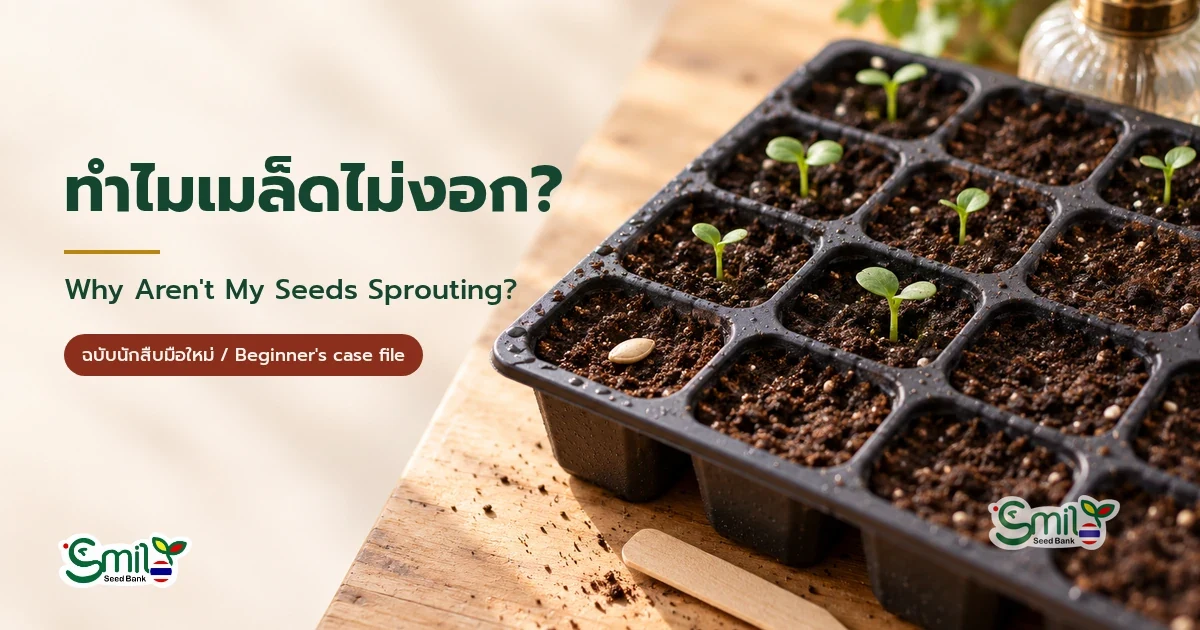
Picture this (it's a made-up story, but I bet plenty of us have been "Tony"): Tony sows a tray of seeds with great care. He waters morning and evening, peeks three times a day and gives every cell a name. Days go by and the surface stays as smooth as an empty car park on a Sunday. Tony reaches his verdict: "These seeds are duds."
Hold on. More is happening under the surface than meets the eye. A seed that hasn't come up might be waiting for something, might be blocked by something, or might not be at fault at all. Let's open the case file and work through it one suspect at a time.
First clue: what a seed needs before it "wakes up"
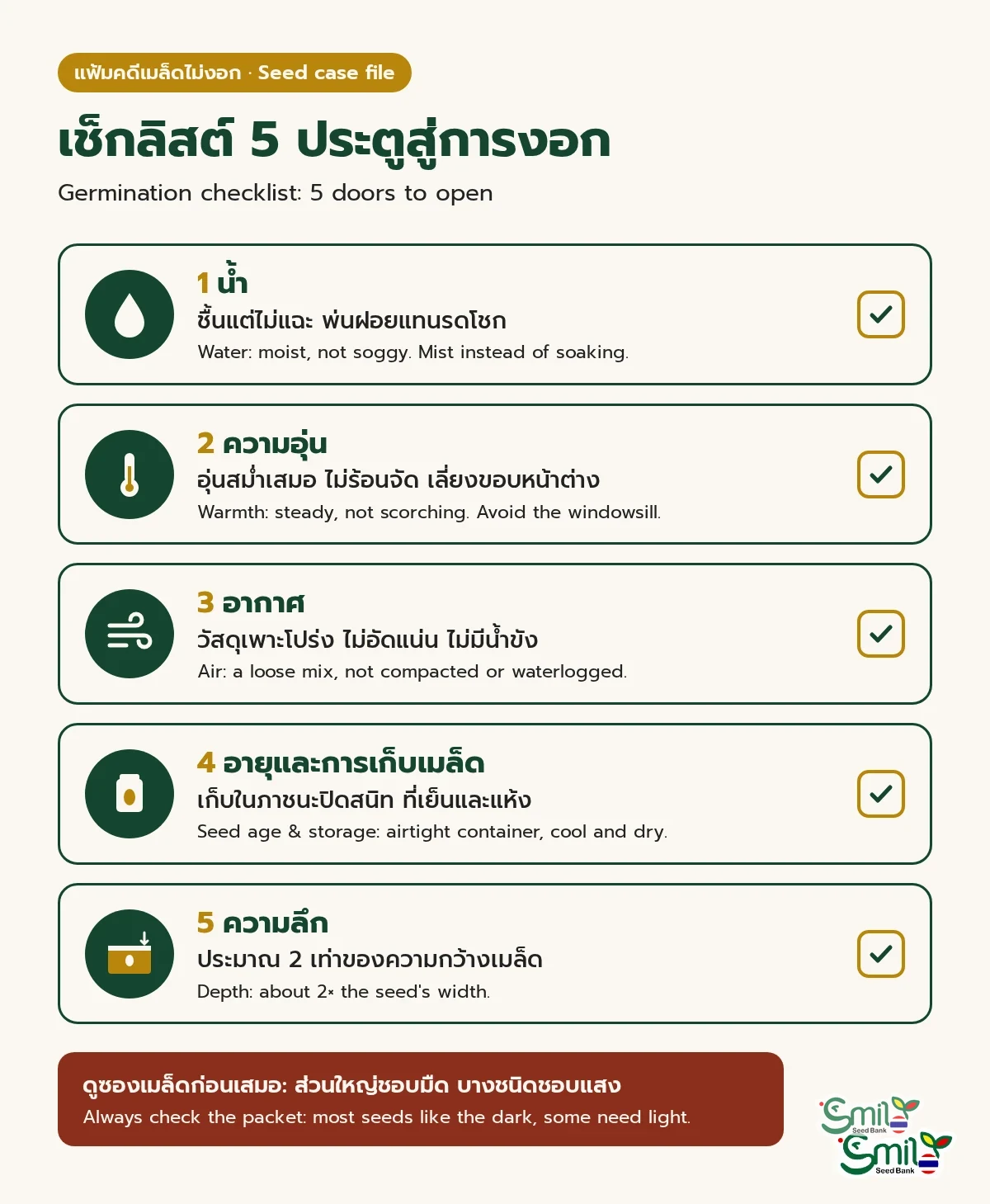
A seed needs only a few things to germinate: water, oxygen and a favourable temperature. Interestingly, CSU Extension points out that good conditions for storing seed (dry and cool) are the exact opposite of good conditions for germinating it. Think of a seed in its packet as asleep, with water, air and warmth as its alarm clock.
Source: CSU Extension – Storing Vegetable and Flower Seeds
Scientifically, germination begins when the dry seed starts taking up water and is complete when the first root (the radicle) pushes through the seed's covering. Besides water, oxygen and temperature, some seeds are also sensitive to other factors such as light.
Now let's line up the suspects.
Suspect #1: Water (too much drowns, too little dries)
Too little: the seed dries out mid-journey
Germinating seeds are very sensitive to drying out. Clemson Extension recommends covering seed flats with plastic wrap or a germination dome to hold in moisture until all the seeds have germinated. UMN Extension says to keep the mix moist throughout germination, and warns that misting only the surface can let the rest of the container dry out without you noticing.
Source: Clemson HGIC – Starting Seeds Indoors · UMN Extension – Starting seeds indoors
Too much: a flooded bedroom
The other extreme is just as risky. UC IPM recommends keeping the mix "moist but not saturated". After the first watering, gently mist the surface instead of soaking it; misting avoids saturation and stops seeds being pushed too deep. UMN Extension also advises draining any water left standing in the tray.
Source: UC IPM – Damping-off Diseases in the Garden · UMN Extension – Starting seeds indoors
Suspect #2: Air (yes, seeds breathe too)
UMD Extension explains that seeds need both air and moisture to germinate, and that cloddy, compacted soils or soils that crust when dry can prevent germination and emergence. UMaine Extension likewise notes that compacted or crusted soil blocks the free flow of air and water that seeds need.
Source: UMD Extension – Poor Germination of Vegetable Seeds · UMaine Extension – Why did my seeds not germinate?
My guess: I think of water and air as competing for the same gaps in the soil, so the longer the mix stays soggy, the less room is probably left for air. That's my own interpretation, not something stated directly by the sources above.
Suspect #3: Temperature (steady warmth, not scorching heat)
UMN Extension says most seeds need consistently warm soil to germinate, and advises against windowsills, which can be the coldest spot in the house at night and the hottest during the day. Excess heat can also dry out the mix and kill seedlings. UMD Extension adds that high soil temperatures are a problem for some seeds, such as spinach and lettuce.
Source: UMN Extension – Starting seeds indoors · UMD Extension – Poor Germination of Vegetable Seeds
On the cold side, UC IPM explains that seedlings growing slowly in cold, wet soil are more likely to become infected.
Source: UC IPM – Damping-off Diseases in the Garden
My guess: in Thai homes, I suspect the more common problem is the "hot and drying fast" side (a tray sitting in a sunny window, for example) rather than cold, although air-conditioned rooms may also make temperatures swing. I don't have data to confirm this.
Suspect #4: Depth and light
Too deep or too shallow
If you're unsure, UMN Extension's rule of thumb is to plant a seed about twice as deep as its width (UMD says about 2–3 times), and always check the seed packet first. UMD explains that seeds planted too deep may not germinate or emerge, while seeds planted too shallow may wash away, fail to germinate or be eaten by wildlife. Seed can go deeper in light, sandy soil and shallower in heavy clay.
Source: UMN Extension – Starting seeds indoors · UMD Extension – Poor Germination of Vegetable Seeds
Light: some seeds like it dark, some like it bright
This is where many beginners slip up. UMaine Extension says light inhibits germination in most seeds, which mostly prefer the dark. But UMD notes that celery and lettuce seed germinates best in light and should be left uncovered. UMN suggests covering light-needing seeds with a thin layer of fine vermiculite that lets light through, and keeping dark-needing seeds covered until they sprout.
Source: UMaine Extension – Why did my seeds not germinate? · UMD Extension – Poor Germination of Vegetable Seeds · UMN Extension – Starting seeds indoors
Suspect #5: Seed age and storage
UMN Extension notes that fewer and fewer seeds from a packet will germinate over time, and recommends storing leftovers in an airtight container somewhere cool. UMaine adds that older seeds can lose viability quickly under poor storage, and that even new seed occasionally comes from a bad batch.
Source: UMN Extension – Starting seeds indoors · UMaine Extension – Why did my seeds not germinate?
CSU Extension states that seed moisture and storage temperature are the two most important factors in how long seed keeps, and that relative humidity affects the seed's moisture content if it isn't stored in a moisture-proof container. (My own note: that's worth extra attention in a humid climate like Thailand's.)
Source: CSU Extension – Storing Vegetable and Flower Seeds
Suspect #6: Soil pathogens that rot seeds before they sprout
This culprit is the sneakiest. UC IPM explains that damping-off diseases don't only kill seedlings that have already emerged; they can also rot seeds before they germinate. Dug up, such seeds are soft and mushy, dark brown, and may have soil clinging to them because it is woven together with fine, threadlike growth of the pathogen. Damping-off is most common when soil is compacted, wet and cool.
Source: UC IPM – Damping-off Diseases in the Garden
UC IPM's prevention tips include using clean pots and mix (wash and sanitise reused trays first), not overwatering, avoiding unfinished compost (which holds water and promotes disease), and not overfertilising with nitrogen. UMN Extension adds that low light, overwatering, high salts from overfertilising and cool soil are all associated with more damping-off.
Source: UC IPM – Damping-off Diseases in the Garden · UMN Extension – How to prevent seedling damping off
My guess: if you use a rich organic mix such as Super soil, I'd let it go through the soil cook step until the organic matter is well broken down, and sow seeds in a lighter layer such as Base soil. I'm connecting this myself from the warnings above about unfinished compost and overfertilising; I don't have a study that tests it directly.
Off-radar suspects: small animals and rain
Sometimes seeds haven't failed to germinate; they've simply gone missing. UMD Extension notes that birds and small animals may dig out and eat seeds, and heavy rain can wash seeds away, especially small ones. UMaine Extension also lists wildlife among the main causes.
Source: UMD Extension – Poor Germination of Vegetable Seeds · UMaine Extension – Why did my seeds not germinate?
Symptom table: what you see, who to suspect, what to try
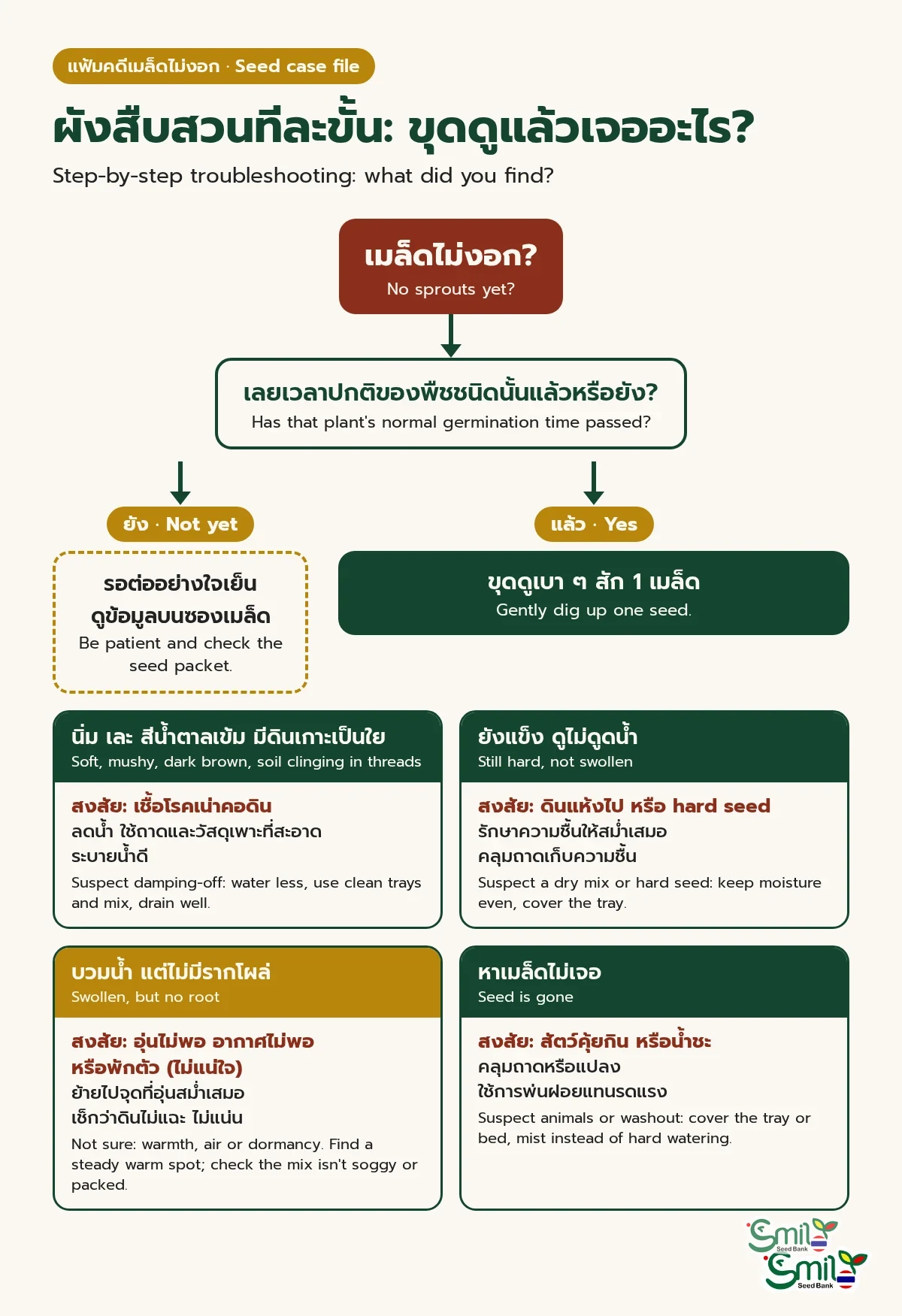
What you see | Suspect | Try this |
|---|---|---|
The plant's normal germination time hasn't passed yet | It may simply be too early (some species are naturally slow) | Check the seed packet and wait patiently |
Dug-up seed is soft, mushy, dark brown, with soil clinging in threads | Damping-off pathogens (rot before germination) | Water less, use clean trays and mix, ensure good drainage |
Seed is still hard and doesn't look swollen | Mix too dry, or seed over-dried into "hard seed" | Keep moisture even; cover the tray to hold humidity |
Seed has swollen but no root has appeared | Temperature or air not right, old seed, or dormancy (not sure; case by case) | Move to a steadily warm spot; check the mix isn't soggy or compacted |
Seed can't be found at all | Eaten by animals or washed away | Cover the tray or bed; mist instead of watering hard |
Some cells came up, others didn't | Uneven depth or uneven moisture | Sow about twice the seed's width deep; check moisture across the whole tray |
Source: UC IPM – Damping-off Diseases in the Garden · CSU Extension – Storing Vegetable and Flower Seeds · UMD Extension – Poor Germination of Vegetable Seeds · UMN Extension – Starting seeds indoors · Clemson HGIC – Starting Seeds Indoors
Common beliefs (that aren't always true)
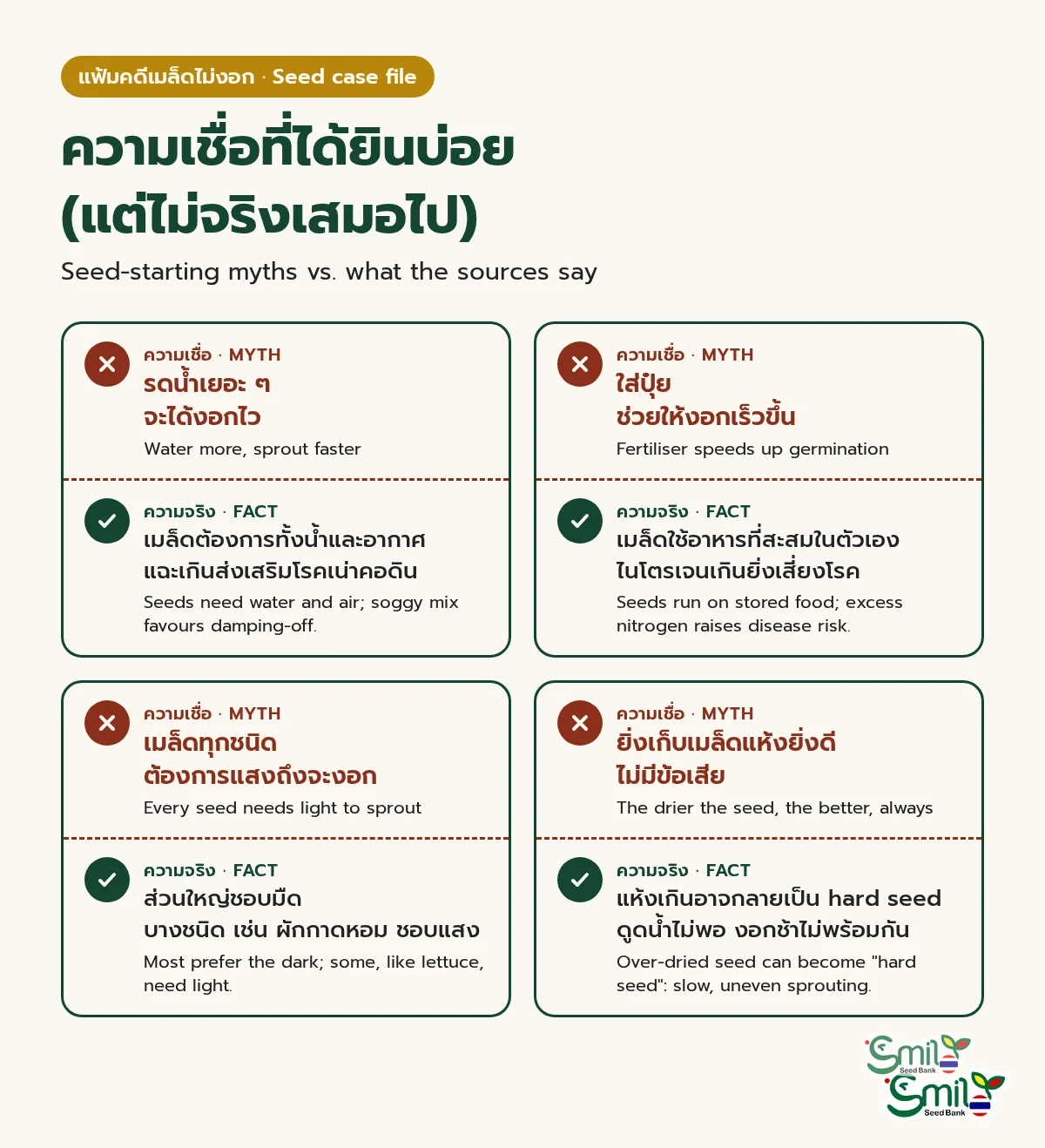
"Water more and they'll sprout faster"
Not true. Seeds need both water and air, and overly wet conditions are exactly what drives damping-off. Moist doesn't mean soggy.
Source: UMD Extension – Poor Germination of Vegetable Seeds · UMaine Extension – Why did my seeds not germinate?
"Fertiliser helps seeds germinate faster"
UMaine Extension explains that soil nutrition doesn't have much impact on germination, because seeds rely on their internal stores until they sprout and begin to photosynthesise. UMN Extension says seedlings don't need fertiliser until they have several sets of true leaves, and UC IPM warns that excess nitrogen produces tender growth that is susceptible to damping-off.
Source: UMaine Extension – Why did my seeds not germinate? · UMN Extension – Starting seeds indoors · UC IPM – Damping-off Diseases in the Garden
"All seeds need light to germinate"
No. Most seeds prefer the dark; some, such as lettuce, germinate best in light. The seed packet is your best guide.
Source: UMaine Extension – Why did my seeds not germinate? · UMD Extension – Poor Germination of Vegetable Seeds
"The drier you store seeds, the better, with no downside"
Almost. CSU Extension says the drier the seeds, the longer they keep, but over-drying can produce "hard seed": seed that resists germination even in favourable conditions because it doesn't absorb enough water, and then trickles up slowly over an extended period. Beans and peas are particularly prone to this.
Source: CSU Extension – Storing Vegetable and Flower Seeds
Frequently asked questions (FAQ)
Q1: How long does germination normally take?
There's no single answer for all plants. UMD Extension gives examples of slow germinators, such as lima bean, parsley, watermelon and okra, which take roughly 10–21 days at typical spring soil temperatures (in a Maryland, USA context). The seed packet is your best clue, and before deciding seeds have failed, check whether that plant's normal germination time has actually passed.
Source: UMD Extension – Poor Germination of Vegetable Seeds
Q2: Should I soak seeds first, and can you soak them too long?
It depends on the seed. UMD Extension says some slow-to-germinate seeds, such as fava bean and okra, can be soaked for 12 to 24 hours to soften the seed coat, but elsewhere warns not to pre-soak bean and corn seed, because it makes them more susceptible to soil pathogens. As for soaking too long, I'm not sure there's a fixed limit; my guess is that it relates to the seed's need for oxygen.
Source: UMD Extension – Sowing Vegetable Seeds Outdoors · UMD Extension – Poor Germination of Vegetable Seeds
Q3: Do seeds need light or sun while germinating?
For most seeds, no, since they prefer the dark. But the moment seedlings emerge, they need plenty of light: UMN Extension says lack of light is the major cause of elongated, skinny stems (we'll cover this in our leggy-seedlings article).
Source: UMaine Extension – Why did my seeds not germinate? · UMN Extension – Starting seeds indoors
Q4: How can I tell if old seed is still alive?
UMD Extension suggests a paper-towel test: place seeds on a moistened paper towel, roll it up, put it in a plastic bag with some holes, set it on top of the refrigerator (UMD's suggested spot), then check back for roots. It shows you whether that batch is still "awake" before you commit it to soil.
Source: UMD Extension – Poor Germination of Vegetable Seeds
Q5: When should I dig one up, and what should I look for?
Once the plant's normal germination time has passed, gently dig up a seed. If it's soft, mushy, dark brown with soil clinging in threads, UC IPM describes this as a seed attacked by damping-off pathogens before germinating. If it's still hard, or swollen without a root, go back and check water, air, temperature and depth from the case file above.
Source: UC IPM – Damping-off Diseases in the Garden
Case closed... or should it stay open?
By now Tony probably wants a single answer, like "it was the water", and be done. Seed research tells a messier story. Finch-Savage and Leubner-Metzger describe dormancy as an innate seed property that defines the conditions in which a seed is able to germinate, and that status keeps changing with time and environment. The same review notes that just one unmet environmental factor is enough to prevent germination, and that not all seeds in a population respond the same way.
So a seed that "didn't germinate" may be perfectly alive, with just one door still shut. Was that door closed by us, or did the seed close it on purpose? I'm honestly not sure how cleanly you can tell the two apart at home. If you've ever had a stubborn seed sit silent for ages and then suddenly pop up, what do you think it was waiting for?
Sources
University of Minnesota Extension. Starting seeds indoors. https://extension.umn.edu/planting-and-growing-guides/starting-seeds-indoors
University of Minnesota Extension. How to prevent seedling damping off. https://extension.umn.edu/garden-and-home/yard-and-garden/gardening-in-minnesota/yard-and-garden-problems/how-to-prevent-seedling-damping-off
University of Maryland Extension. Poor Germination of Vegetable Seeds. https://www.extension.umd.edu/resource/poor-germination-vegetable-seeds
University of Maryland Extension. Sowing Vegetable Seeds Outdoors. https://extension.umd.edu/resource/sowing-vegetable-seeds-outdoors
University of Maine Cooperative Extension (2024). Will a soil test determine why my seeds did not germinate? https://extension.umaine.edu/gardening/2024/09/13/will-a-soil-test-determine-why-my-seeds-did-not-germinate/
UC Statewide IPM Program. Damping-off Diseases in the Garden. https://ipm.ucanr.edu/home-and-landscape/damping-off-diseases-in-the-garden/
Colorado State University Extension. Storing Vegetable and Flower Seeds (Fact Sheet 7.221). https://extension.colostate.edu/resource/storing-vegetable-and-flower-seeds/
Clemson Cooperative Extension HGIC. Starting Seeds Indoors (HGIC 1259). https://hgic.clemson.edu/factsheet/starting-seeds-indoors/
Finch-Savage, W. E., & Leubner-Metzger, G. (2006). Seed dormancy and the control of germination. New Phytologist, 171(3), 501–523. DOI: 10.1111/j.1469-8137.2006.01787.x. Record: https://wrap.warwick.ac.uk/id/eprint/33271/
This article is for educational and general-information purposes only, covering seed starting. Information is based on the cited sources at the time of writing and may change.