How to Store Cannabis Seeds: Dark, Dry, Cool
Dark, Dry, Cool
Before you read: This is general information on storing seeds for collection and study. No method can tell you for certain how long a seed will stay alive, because seed quality depends on many factors, including what happened before it reached you.
Plenty of collectors keep seeds from several overseas brands, and some packs are limited releases you can't get any more. The question I hear most is "how do I store them so they last?", especially in Thailand, where it's hot and humid nearly all year.
The good news: research and genebank standards are fairly clear here, and the principle is simple. Three words: dark, dry, cool. Let's look at the reasoning behind each one, and how much of it you can realistically do at home.
Meet the Seed: Cannabis Seeds Are "Orthodox"
Seed scientists group seeds by how they behave in storage. Orthodox seeds tolerate drying and cold well. FAO's genebank standards explain that their lifespan increases as storage moisture and temperature go down, within sensible limits.
A study by Parihar et al. (2014) in The Indian Journal of Agricultural Sciences tested hemp (Cannabis sativa) seed at different moisture levels and temperatures for up to 36 months. It concluded that the seeds are tolerant of both drying and chilling, and therefore orthodox, which makes them suitable for genebank storage. That's the foundation the dark, dry, cool rule rests on.
Rule 1: Dry. Moisture Is Enemy Number One
What the research shows
Cockson et al. (2025, Agrosystems, Geosciences & Environment) stored hemp seed at different seed moisture levels (6%, 8%, 10% and 14%) in sealed packets, at −20, 4, 10 and 21°C, for up to 24 months, testing seed quality at intervals. In short:
Seeds with higher moisture (10% and 14%) declined in quality over time, faster at warmer temperatures.
The combination of high temperature and high moisture gave the worst results.
For intermediate storage, the team recommends seed moisture below 8% and storage at 4–10°C.
What to do at home
Measuring seed moisture yourself is hard, but you can control the air around the seeds.
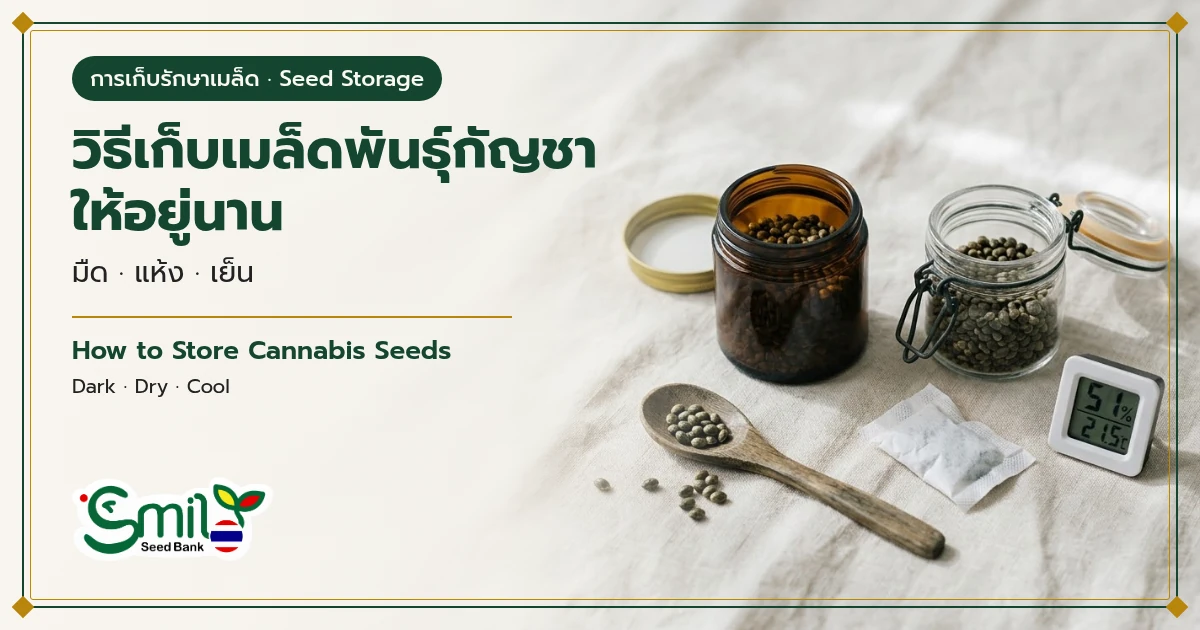
Store seeds in an airtight container, such as a sealed glass jar or a thick zip bag, then put that inside a box.
Add a silica gel desiccant sachet, kept separate so it doesn't touch the seeds directly.
If you use colour-changing silica gel, check it now and then, and replace or re-dry it as the maker instructs once it's saturated.
Keeping seeds in the original brand pack is fine. Just put the whole pack inside the moisture-proof container. The original pack also helps prove where the seeds came from.
Rule 2: Cool, Not Extreme
Why cold helps
A seed is alive, with very low internal activity. Heat speeds up its ageing. Seed science has a long-used rule of thumb known as Harrington's rule, which sums up the idea that lowering storage moisture and temperature (within each species' safe range) lengthens seed life. FAO's standards cite Harrington's work on this point, but stress that drying beyond a certain point adds no benefit and may even speed up ageing.
Reference numbers
FAO Genebank Standards (2014) set medium-term (active collection) storage under refrigeration at 5–10°C and 15 ± 3% relative humidity. Long-term storage uses sub-zero temperatures, which require carefully controlled seed drying.
The hemp study by Cockson et al. recommends 4–10°C for intermediate storage.
Is a home fridge good enough?
At home, the main (non-freezer) compartment of a fridge is the closest match to those ranges. But fridges are set differently, so use a small thermometer to check whether yours actually sits within 4–10°C. Put the container towards the back of a shelf where the temperature is steadier, not in the door.
What about the freezer?
Sub-zero storage is used in genebanks where seeds are dried precisely. At home we can't measure seed moisture, and household freezers get opened often. For most collectors, I'd recommend the fridge over the freezer.
Rule 3: Dark. Light and Heat Travel Together
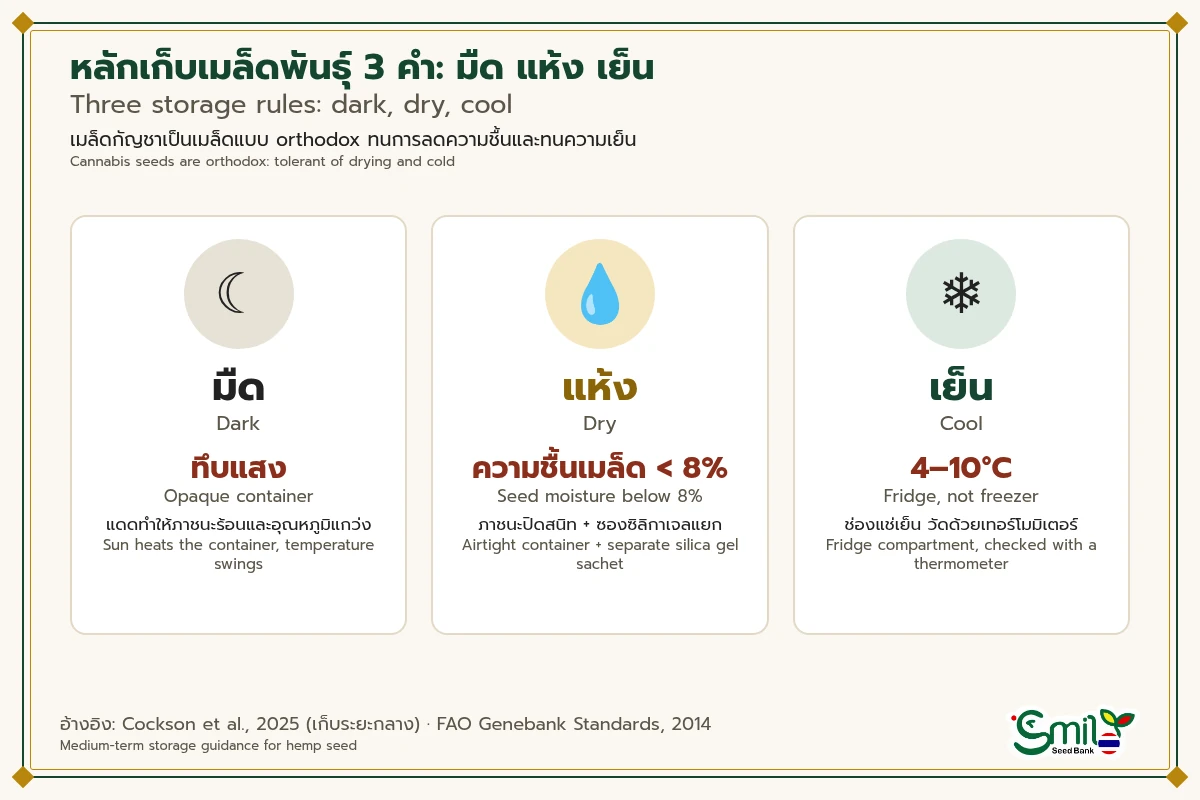
Direct sunlight heats containers and makes temperatures swing. An opaque container or closed box cuts both light and temperature changes. Even inside a fridge, which is dark already, an opaque box is worth using: it adds protection from knocks and another layer against moisture.
Storage Conditions Compared
Storage condition | What the sources say | Suitability for home collectors |
|---|---|---|
Room temperature, hot and humid, container not sealed | High temperature combined with high moisture causes the fastest decline (Cockson et al., 2025) | Not recommended |
Room temperature, moisture-proof container + silica gel | Drier seeds decline more slowly than moist ones (Parihar et al., 2014; Cockson et al., 2025) | OK short-term; keep somewhere dark and not hot |
Fridge compartment, moisture-proof, opaque container | Hemp research recommends 4–10°C with seed moisture below 8%; FAO uses 5–10°C for medium-term storage | Recommended; check the real temperature with a thermometer |
Freezer | Genebanks use it only with seeds dried under controlled conditions (FAO, 2014) | Not recommended for most people |
Common Misconceptions
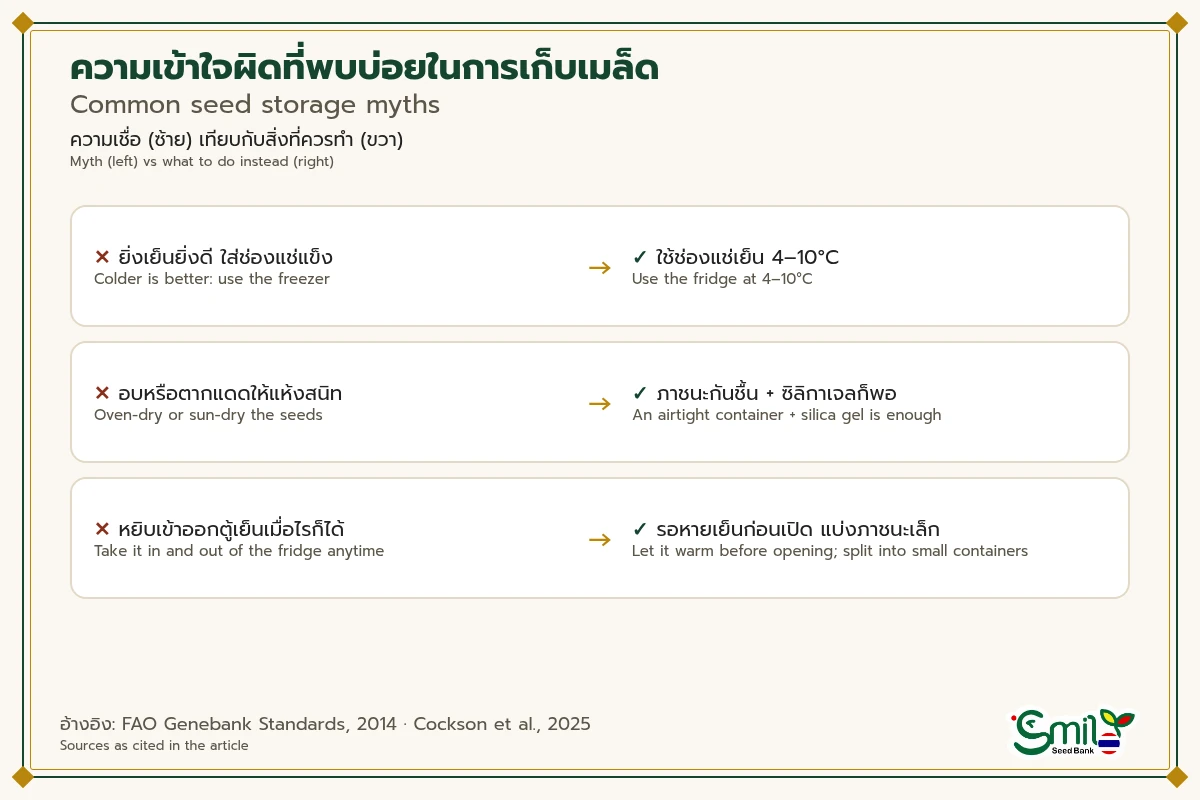
Misconception 1: "Colder is always better, so use the freezer."
Reality: Genebanks pair sub-zero storage with controlled seed drying. At home it's hard to control seed moisture, so the fridge is the safer choice.
Misconception 2: "Drier is always better, so dry the seeds out completely."
Reality: FAO's standards note that drying beyond a certain point adds no benefit and may speed up ageing. Don't bake seeds or leave them in the sun; an airtight container with silica gel is enough.
Misconception 3: "Once they're in the fridge, I can take them in and out whenever I like."
Reality: Open a cold container in warm, humid air and water condenses on it instantly. Always let the closed container warm to room temperature before opening, and split seeds into small containers so you never open the whole collection.
Misconception 4: "Stored properly, seeds last forever."
Reality: Good storage only slows decline. Each lot's starting quality, shipping and storage before it reached you all play a part. Nobody can give an exact lifespan.
A Collector's Storage System
Labels and records
Label every container: cultivar, brand, type (auto/photo, fem/regular), date received, and date it went into cold storage.
Keep a collection log: a simple spreadsheet tells you how long each pack has been stored.
Read the brand's advice: many overseas brands give storage instructions on the pack or website. Treat the source's guidance as the main reference.
Quick checklist
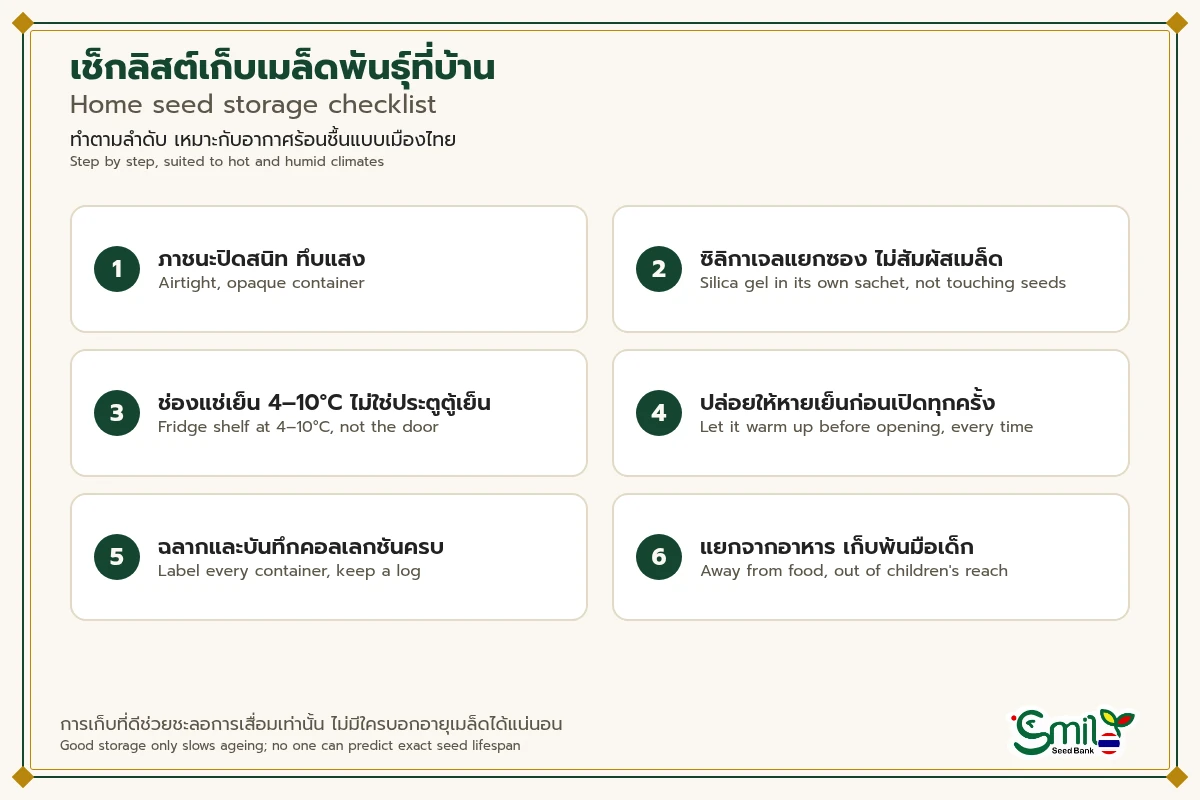
Airtight, opaque container
Silica gel in a separate sachet, not touching seeds
Fridge compartment (checked with a thermometer), not the door
Let it warm to room temperature before every opening
Labels and log up to date
Kept away from food and out of children's reach
FAQ
Q1: Can I really store seeds in the fridge?
Yes. Research on hemp seed recommends 4–10°C with seed moisture below 8%, so the fridge compartment is a sensible choice, as long as you check the real temperature, use a moisture-proof container and let it warm up before opening.
Q2: Is the freezer better than the fridge?
Sub-zero storage works in genebanks where seeds are dried precisely, but moisture is hard to control at home. For most collectors, the fridge is the safer choice.
Q3: Do I need silica gel?
Recommended, especially in Thailand's humid air. Keep it in a separate sachet in the same container so it doesn't touch the seeds.
Q4: If I store seeds correctly, how many years will they last?
There's no figure anyone can confirm. It depends on the lot's starting quality and its storage history. Good storage only slows deterioration as much as possible.
Q5: Can I keep seeds in the original brand pack?
Yes, and it helps confirm where they came from. Just put the pack inside an opaque, moisture-proof container.
Summary
Cannabis seeds are orthodox, tolerating drying and cold, so storage comes down to dark, dry, cool: an airtight, opaque container with silica gel, kept in a fridge compartment you've checked is within the range research recommends, no freezer, and always warmed up before opening. Good storage reduces risk a lot, but nobody can tell you exactly how long a seed will last.
Sources
Cockson, P., Webb, A., Martinez-Ochoa, N., Moffitt, A., Pearce, W., & Chakrabarti, S. (2025). Impact of seed moisture and temperature on hemp seed germination. Agrosystems, Geosciences & Environment, 8(2). doi:10.1002/agg2.70129. https://scholarworks.utrgv.edu/ibcs_fac/93/
Parihar, S. S., Dadlani, M., Lal, S. K., Tonapi, V. A., Nautiyal, P. C., & Basu, S. (2014). Effect of seed moisture content and storage temperature on seed longevity of hemp (Cannabis sativa). The Indian Journal of Agricultural Sciences, 84(11). https://epubs.icar.org.in/index.php/IJAgS/article/view/44551
FAO (2014). Genebank Standards for Plant Genetic Resources for Food and Agriculture. Rome: FAO. https://www.fao.org/4/i3704e/i3704e.pdf
FAO (2022). Practical guide for the application of the Genebank Standards for Plant Genetic Resources for Food and Agriculture: Conservation of orthodox seeds in seed genebanks. Rome: FAO. https://openknowledge.fao.org/server/api/core/bitstreams/62d6d5d3-f7a3-47f3-abaf-9d2d5e230e51/content
ECPGR – AEGIS Genebank standards. https://www.ecpgr.org/aegis/aquas/genebank-standards
Smile Seed Bank shop rules
- Seeds sold by our shop are for collection and educational purposes only.
- We sell only to customers aged 20 and over.
- Buyers must learn and follow the laws of their own area or country before any growing.
- The shop accepts no responsibility for any growing or other activity that breaks local law.