How to Transplant Seedlings Without Shock: A Timeline for Before, On the Day and After
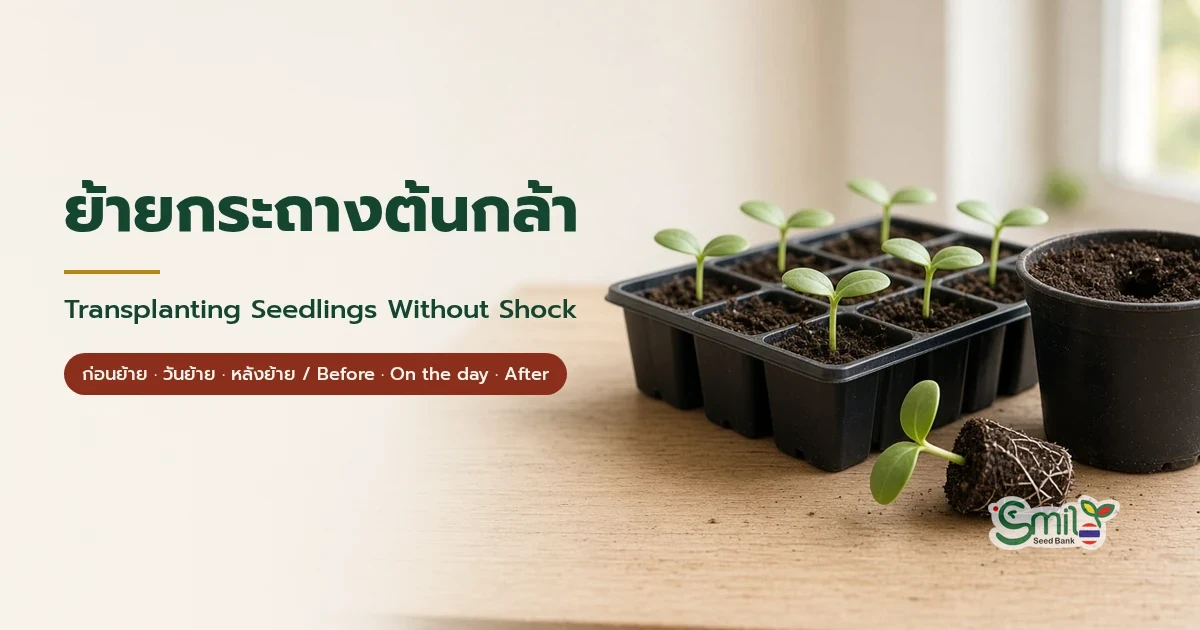
How to Transplant Seedlings Without Shock: A Timeline for Before, On the Day and After
The seedlings you've raised for weeks look great in their tray. One day after moving them into new pots, the leaves droop and curl as if they're sulking. Growers call it "transplant shock."
The good news is that most shock isn't caused on transplant day. It gets "set up" days before, and "made worse" in the days after. So this article doesn't start on moving day. It's a timeline: the countdown before, the day itself, and the first week after. It ends with something two sets of sources still disagree on: should you transplant in the morning or in the evening?
Before the countdown: potting up isn't the same as planting out
"Potting up" means moving a seedling from a tray or small cell into a bigger container, still in the same spot. "Planting out" means moving it outdoors or into a bed, which needs hardening off first. USU Extension treats these as separate steps, and says how many times you pot up depends on the starting container, how fast the plant grows and how long until it goes outside.
Source: USU Extension – Starting Vegetable Seeds Indoors: IV. Seedling Culture and Transplanting (PDF)
Before: read the signs that it's time
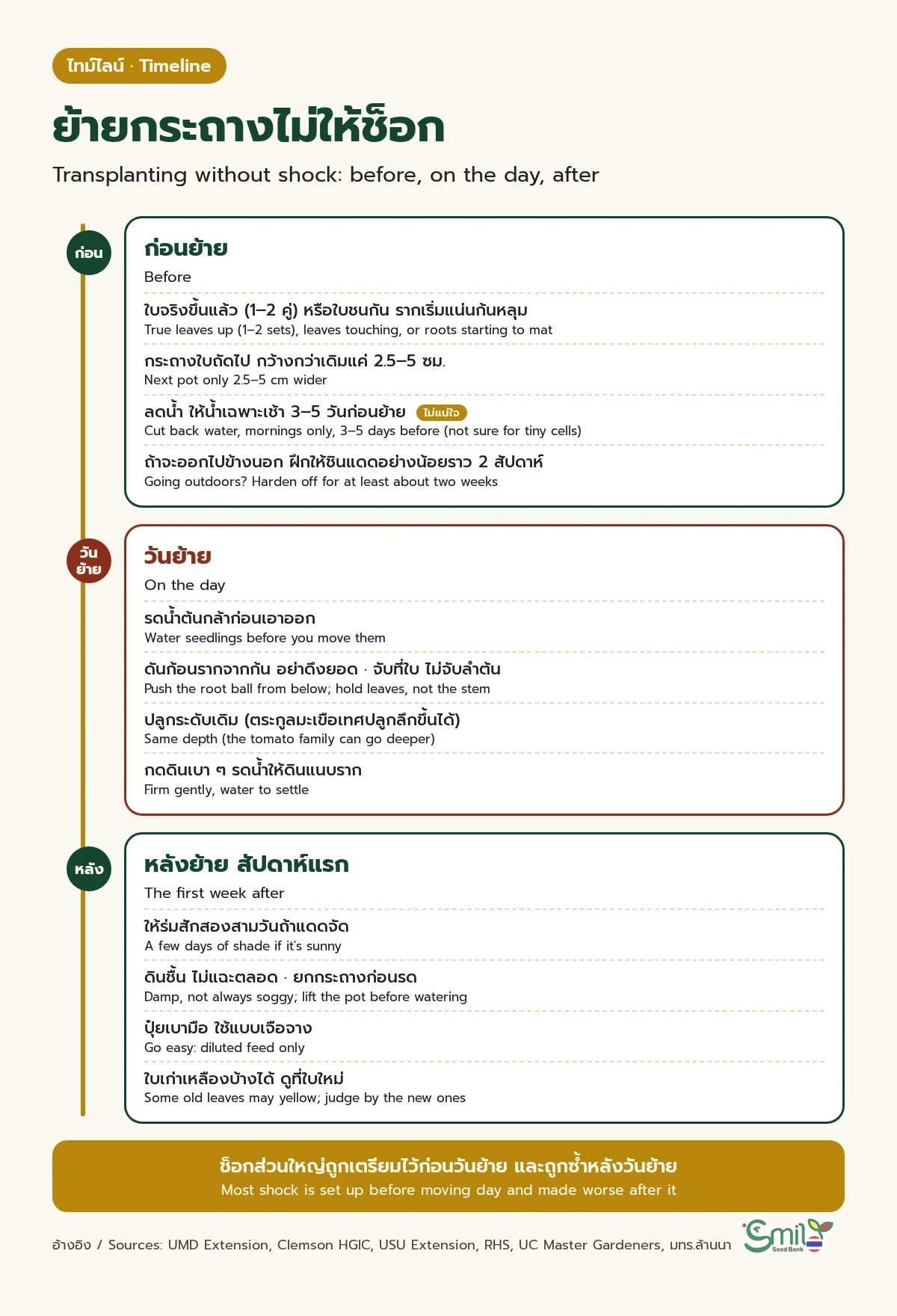
Sign 1: true leaves are up
UMD Extension says the ideal time is while seedlings are small and there's little risk of setback from root shock, usually around when the first true leaves appear above the seed leaves. It also calls leaving seedlings in the flat too long one of the most common mistakes. Clemson Extension says to transplant when one or two sets of true leaves appear.
Source: UMD Extension – Care of Vegetable Seedlings · Clemson HGIC – Starting Seeds Indoors
Sign 2: leaves touching, or roots matting the bottom
USU says seedlings are ready when their leaves start overlapping their neighbours, or when roots get so dense they form a thick mat at the bottom. It suggests gently lifting a seedling by its leaves to check. Its figure caption: pot up when a healthy number of roots are visible, but before they form dense mats.
Source: USU Extension – Seedling Culture and Transplanting (PDF)
A UC Master Gardener (Mariposa) column warns that overgrown seedlings may develop bound roots or jump into their reproductive stage after transplanting, dwarfing them, and that small container seedlings transplant better than large overgrown ones.
Source: UC Master Gardeners of Mariposa County – Transplanting Seedlings (PDF)
Plants that dislike being moved
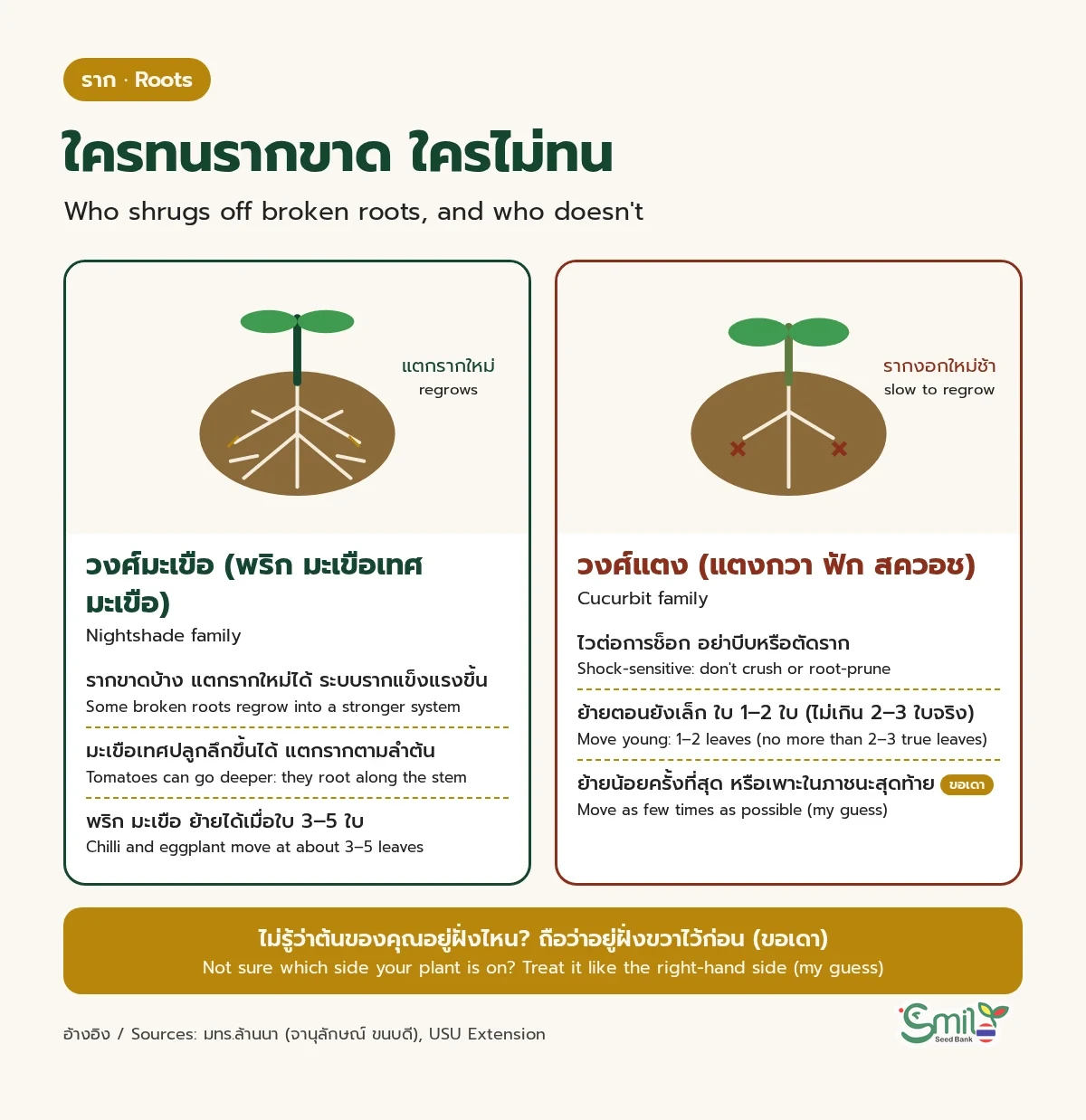
Not every plant tolerates transplanting equally. Assoc. Prof. Dr Janulak Khanobdee (Rajamangala University of Technology Lanna) notes that the cucurbit family doesn't tolerate transplanting well, with cucurbit seedlings ready at about 9–12 days or 1–2 leaves, while chilli and eggplant are ready at about 30–40 days or 3–5 leaves. USU likewise says cucurbits are sensitive to transplant shock and slow to replace roots, so don't crush or root-prune them, and plants should have no more than two to three true leaves at planting.
Source: RMUTL – How to grow vegetables during COVID-19 (part 4) (Thai, PDF) · USU Extension – Cucurbits: Transplant Production
My guess: for short-lived plants or those with touchy roots, the least shocking approach is to move them as few times as possible, for example sowing in a container big enough from the start, or in a pot you can plant whole. USU notes peat pots can be planted without removing the pot, as long as you slit the sides and cover the pot completely with soil.
Source: USU Extension – Seedling Culture and Transplanting (PDF)
Choosing the next pot: only a little bigger
It's tempting to jump straight to a big pot so you never have to move it again. But the RHS (Royal Horticultural Society) explains that overpotting leaves a large volume of new compost sitting wet, cutting air around the roots, so instead of growing out, they rot. Symptoms include yellowing, leaf fall, wilting and stunting. The RHS rule of thumb: go up one size, about 2.5–5 cm (1–2 in) wider and not much deeper.
Source: RHS – Overpotting
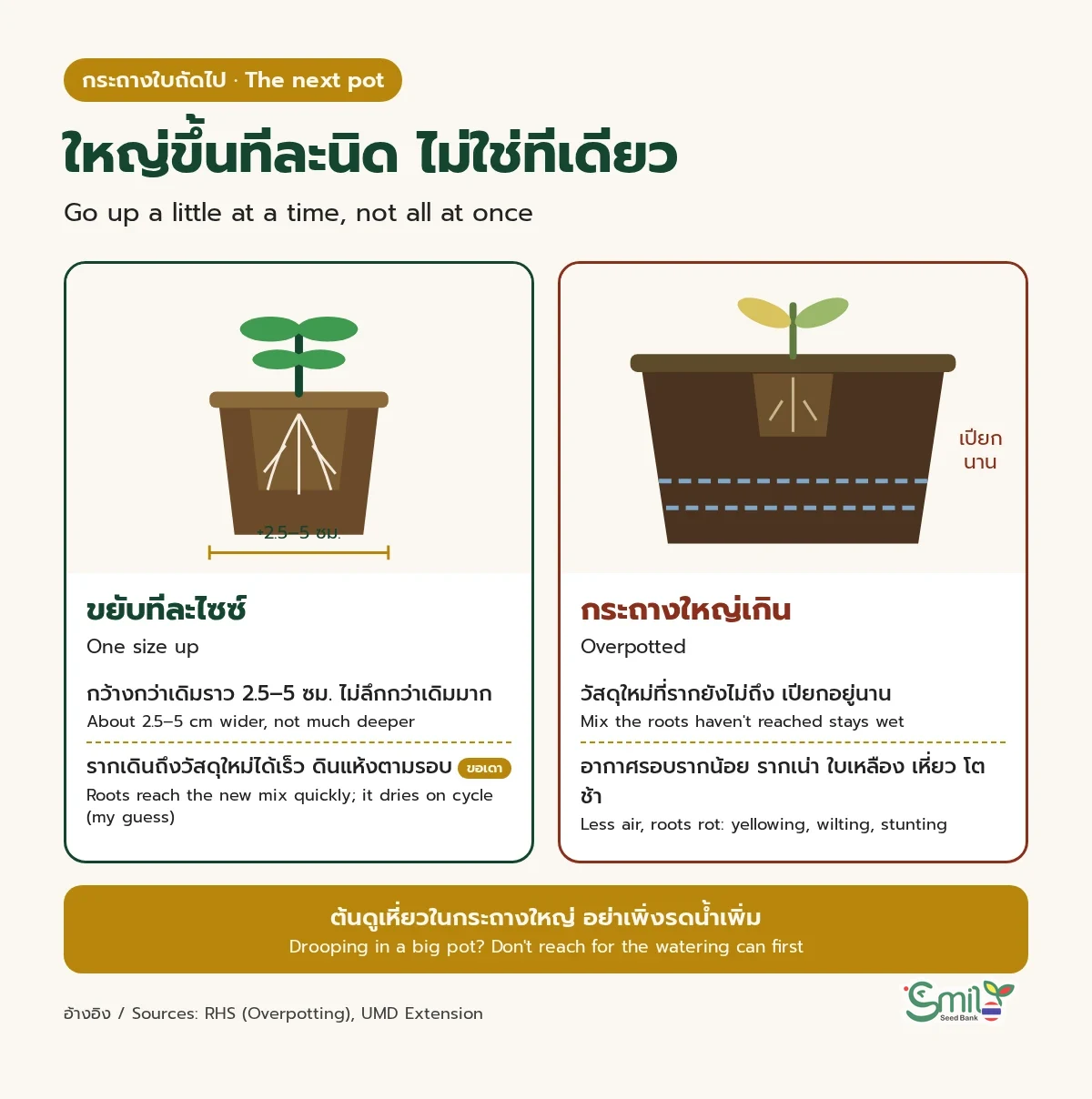
If leaves yellow after moving into a big pot, see Zone 2 in our yellow seedling leaves article.
3–5 days before: toughen the roots a little
Dr Janulak Khanobdee suggests preparing seedlings to settle faster by withholding water for 3–5 days before transplanting and watering only in the morning, so the roots adapt to tolerate some dryness.
Source: RMUTL – How to grow vegetables during COVID-19 (part 4) (Thai, PDF)
Not sure how well this suits very small cell trays, because USU warns a short time without enough water can kill young seedlings. If you try it, my guess is to cut back carefully so the seedlings never wilt, rather than stopping completely.
Source: USU Extension – Seedling Culture and Transplanting (PDF)
The week(s) before going outdoors: harden off
If the new pots will live outdoors, USU says hardening off should begin at least about two weeks before planting out: start in shade for a few hours, then increase time and sun. It adds that some leaves may yellow or dry out along the way, which is normal. Cornell Cooperative Extension (Allegany County) offers a simple plan: first week, out of direct sun, one hour on day one, adding an hour each day.
Source: USU Extension – Seedling Culture and Transplanting (PDF) · Cornell Cooperative Extension Allegany County – Managing transplants to the garden
One more thing for this season: Thailand's Meteorological Department expects thunderstorms and possibly gusty winds on some days in upper Thailand from mid-October to mid-November. My guess: while hardening off, keep a spot sheltered from strong wind.
Source: Thai Meteorological Department – Seasonal forecast (cool season 2026–27)
Transplant day: five steps your roots will thank you for
Water before you move. The UC Master Gardener column says to water seedlings before removing them from their containers; USU says to water cucurbit trays before planting.
Push from below, don't pull from the top. USU suggests a pencil or similar to push the root ball out from underneath, keeping as much mix around the roots as possible.
Hold the leaves, not the stem. Clemson says to hold seedlings by the seed leaves, not the stem, which is fragile; the slightest injury can do permanent damage.
Plant at the same depth (except the tomato family). USU says plant at the same depth, but tomatoes root along the stem and can go deeper (our leggy seedlings article covers this).
Firm gently, then water to settle. USU says gently firm the mix around the seedling, then water.
Source: UC Master Gardeners of Mariposa County – Transplanting Seedlings (PDF) · USU Extension – Seedling Culture and Transplanting (PDF) · USU Extension – Cucurbits: Transplant Production · Clemson HGIC – Starting Seeds Indoors
Is it a disaster if some roots break?
It depends on the plant. Dr Janulak Khanobdee says to avoid breaking many roots, except in the nightshade family such as chilli and tomato, which regrow roots and end up with a stronger, larger root system. USU says that separating seedlings from a shared flat will break some intertwined roots anyway, but cucurbits shouldn't be crushed or root-pruned.
Source: RMUTL – How to grow vegetables during COVID-19 (part 4) (Thai, PDF) · USU Extension – Seedling Culture and Transplanting (PDF) · USU Extension – Cucurbits: Transplant Production
Where sources disagree: three transplant-day questions
Question | One side says | The other side says |
|---|---|---|
What time of day? | RMUTL: late afternoon to evening (any time in mild sun) · LDD: evening, so plants rest overnight | USU: morning, or a cloudy day |
Water straight after? | USU: yes, immediately, to settle soil around the root ball | LDD (planting into a bed already soaked): not yet, to avoid compacting soil and starving roots of air; water again next morning |
How big should seedlings be? | UMD: around the first true leaves · Clemson: one or two sets of true leaves | RMUTL: chilli and eggplant at 3–5 leaves · cucurbits at 1–2 leaves |
Source: RMUTL (Thai, PDF) · Land Development Department (Thai, p. 43) · USU Extension (PDF) · UMD Extension – Care of Vegetable Seedlings · Clemson HGIC – Starting Seeds Indoors
My guess: the watering disagreement probably comes from different situations. LDD is describing a bed that was soaked beforehand; USU is describing planting into a hole generally. For pots, I think that if the new mix is already evenly moist, a light watering to settle it against the roots is enough. No need to soak it.
After: the first week is recovery
Give a few days of shade
The UC Master Gardener column suggests a few days of shade for new transplants on sunny days and keeping the root zone moist. USU says new transplants need water more often until established, but warns against overwatering: soil should be damp, not perpetually soggy.
Source: UC Master Gardeners of Mariposa County – Transplanting Seedlings (PDF) · USU Extension – Seedling Culture and Transplanting (PDF)
Watch the watering in a new pot
A new pot holds lots of mix the roots haven't reached yet. The RHS explains this stays wet for a long time, and that overpotted plants are often watered more, not less, which makes things worse. UMD warns that saturated containers stop root growth and that damping-off fungi can quickly kill a container of seedlings.
Source: RHS – Overpotting · UMD Extension – Care of Vegetable Seedlings
If the stem base pinches, turns water-soaked and falls after transplanting, see our damping-off article.
Feeding: go easy
The UC Master Gardener column says that if a transplant needs a boost, use only diluted liquid fertiliser or compost tea for the first few weeks, because young roots burn easily.
Source: UC Master Gardeners of Mariposa County – Transplanting Seedlings (PDF)
My guess: if you're moving seedlings into a rich mix like Super soil, let the Super soil go through บ่มดิน (cook) first, and let the young roots meet a layer of Base soil on top before they reach the Super soil below (more in our Super soil recipe).
Lower leaves yellowing after the move or during hardening
USU says some leaves may yellow or dry and brown during hardening off, which is normal. The goal is new leaves and shoots adapted to bright conditions, not keeping every old leaf.
Source: USU Extension – Seedling Culture and Transplanting (PDF)
Myths you hear a lot (that aren't always true)
"Go straight to a big pot so you only move it once"
The RHS explains that an oversized pot keeps new mix wet long enough for roots to rot, and recommends going up one size at a time.
Source: RHS – Overpotting
"The bigger the seedling, the easier the move"
UMD says the ideal time is while seedlings are small, and the UC Master Gardener column says small container seedlings transplant better than overgrown ones.
Source: UMD Extension – Care of Vegetable Seedlings · UC Master Gardeners of Mariposa County – Transplanting Seedlings (PDF)
"Break a single root and it's doomed"
Not always. RMUTL says the nightshade family regrows roots after some breakage, while cucurbits are far more sensitive (USU).
Source: RMUTL (Thai, PDF) · USU Extension – Cucurbits: Transplant Production
"Drooping after the move means it needs more water"
The RHS says overpotted plants are often watered more instead of less, making it worse. Lift the pot or touch the mix before you water.
Source: RHS – Overpotting
FAQ
Q1: How do I know the roots have filled the cell?
USU suggests gently lifting the seedling by its leaves. Plenty of roots but no dense mat at the bottom is the sweet spot. If roots already circle in a thick mat, USU says a few shallow vertical cuts or gently teasing the roots apart when planting out often helps.
Source: USU Extension – Seedling Culture and Transplanting (PDF)
Q2: How big should the next pot be?
The RHS suggests about 2.5–5 cm (1–2 in) wider and not much deeper. For cells, UMD suggests about 1–2 in (2.5–5 cm) for greens and 2–3 in (5–7.5 cm) for cucumber, squash and cabbage (metric conversions ours).
Source: RHS – Overpotting · UMD Extension – Care of Vegetable Seedlings
Q3: What about plants that hate being moved?
RMUTL says cucurbits don't tolerate transplanting and should move young (1–2 leaves); USU says don't crush or root-prune them. My guess: for short-lived or root-sensitive plants, sowing straight into the final container, or moving only once, is safest.
Source: RMUTL (Thai, PDF) · USU Extension – Cucurbits: Transplant Production
Q4: How do I separate seedlings grown together in one tray?
USU suggests digging them up with a pencil or knife and gently teasing them apart; some intertwined roots will break. Have a hole ready in moist mix, plant at the same depth, hold by the leaves, and water.
Source: USU Extension – Seedling Culture and Transplanting (PDF)
Q5: My seedling is already in shock. What now?
Not sure there's a proven way to speed recovery in our sources. What they agree on: a few days of shade if it's sunny, keep the root zone moist but not soggy, go easy on feed (UC Master Gardener, USU), and judge by the new leaves.
Source: UC Master Gardeners of Mariposa County – Transplanting Seedlings (PDF) · USU Extension – Seedling Culture and Transplanting (PDF)
An ending that isn't finished: morning, or evening?
By now most of the timeline is agreed, except the simplest-sounding question: what time of day should you transplant?
Both Thai sources choose evening. The Land Development Department's reason: the plant rests overnight and recovers faster. USU, writing for Utah's very different climate, chooses morning or a cloudy day.
Source: Land Development Department (Thai, p. 43) · RMUTL (Thai, PDF) · USU Extension (PDF)
My guess: the two sides may not really conflict. Both are trying to dodge strong sun right after the move; the climates just differ. But I haven't found a direct test of how much faster pots in a Thai home recover when moved in the evening versus early morning.
If you have several seedlings to move at once, try splitting them: half at dawn, half in the evening. See which group's leaves stand back up first, and tell us.
Sources (full list)
University of Maryland Extension. Care of Vegetable Seedlings (updated 20 Feb 2023). https://www.extension.umd.edu/resource/care-vegetable-seedlings
Clemson Cooperative Extension HGIC. Starting Seeds Indoors. https://hgic.clemson.edu/factsheet/starting-seeds-indoors/
Crump, W., Beddes, T., Caron, M., & Oliveira, M. (2025). Starting Vegetable Seeds Indoors: IV. Seedling Culture and Transplanting. Utah State University Extension. https://extension.usu.edu/yardandgarden/research/starting-vegetable-seeds-indoors-seeding-culture-and-transplanting.pdf
Utah State University Extension. Cucurbits: Transplant Production. https://extension.usu.edu/vegetableguide/cucurbits/transplant-production
Royal Horticultural Society. Overpotting. https://www.rhs.org.uk/prevention-protection/overpotting
Cornell Cooperative Extension Allegany County. Managing transplants to the garden. https://allegany.cce.cornell.edu/gardening/food-gardening/vegetable-garden/managing-transplants-to-the-garden
David, B. (2020). Transplanting Seedlings (Over the Garden Fence). UC Master Gardeners of Mariposa County. https://ucanr.edu/sites/default/files/2020-04/323586.pdf
Khanobdee, J. (2021). How to grow vegetables during COVID-19: quality, safe and on track (part 4) (in Thai). Agricultural Technology Research Institute, Rajamangala University of Technology Lanna. https://e-cms.rmutl.ac.th/assets/upload/files/2023/06/20230607085928_26714.pdf
Land Development Department (Thailand). Green manure and rice-stubble incorporation with bio-extract to raise yields... Ubon Ratchathani (in Thai, p. 43). https://e-library.ldd.go.th/library/flip/bib9838f/files/basic-html/page43.html
Thai Meteorological Department (2026). Cool-season outlook for Thailand 2026 (issued 9 Oct 2026). https://www5.tmd.go.th/forecast/seasonal
This article is for education and general information about raising seedlings only. Information is based on the sources listed as of the time of writing and may change.