Soil and Water pH: Why Well-Watered Seedlings Still Stall
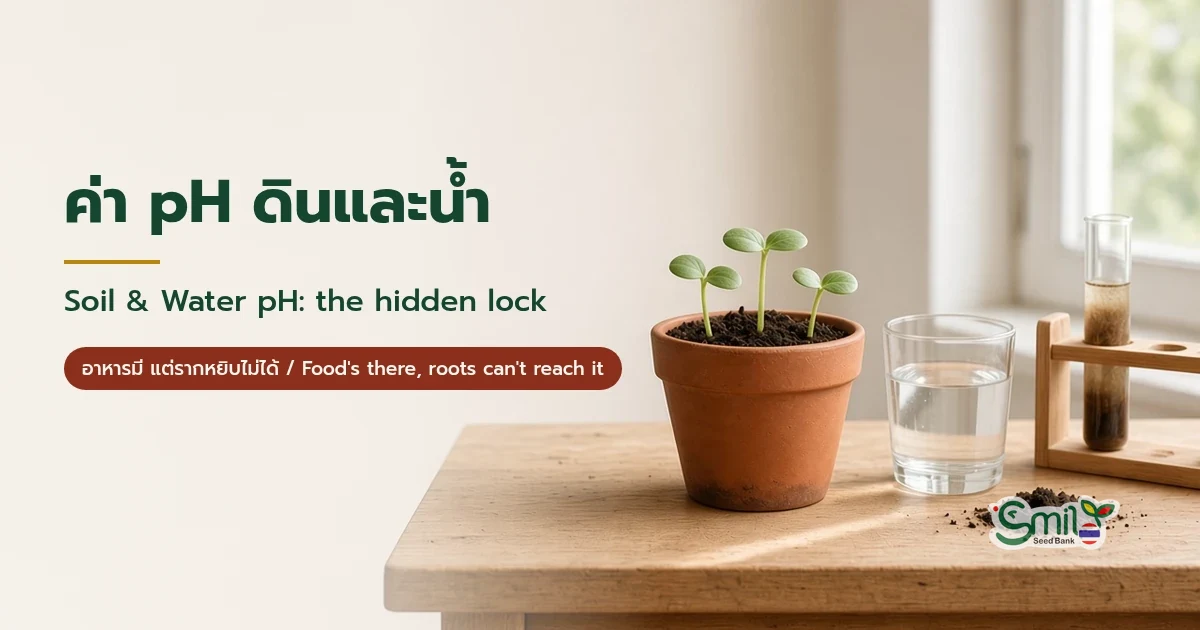
You water on time. You lift the tray every morning to check its weight. The mix is not soggy and not dry. You have even fed. Yet the seedlings sit still, and the new leaves come out pale, as if the plants were hungry.
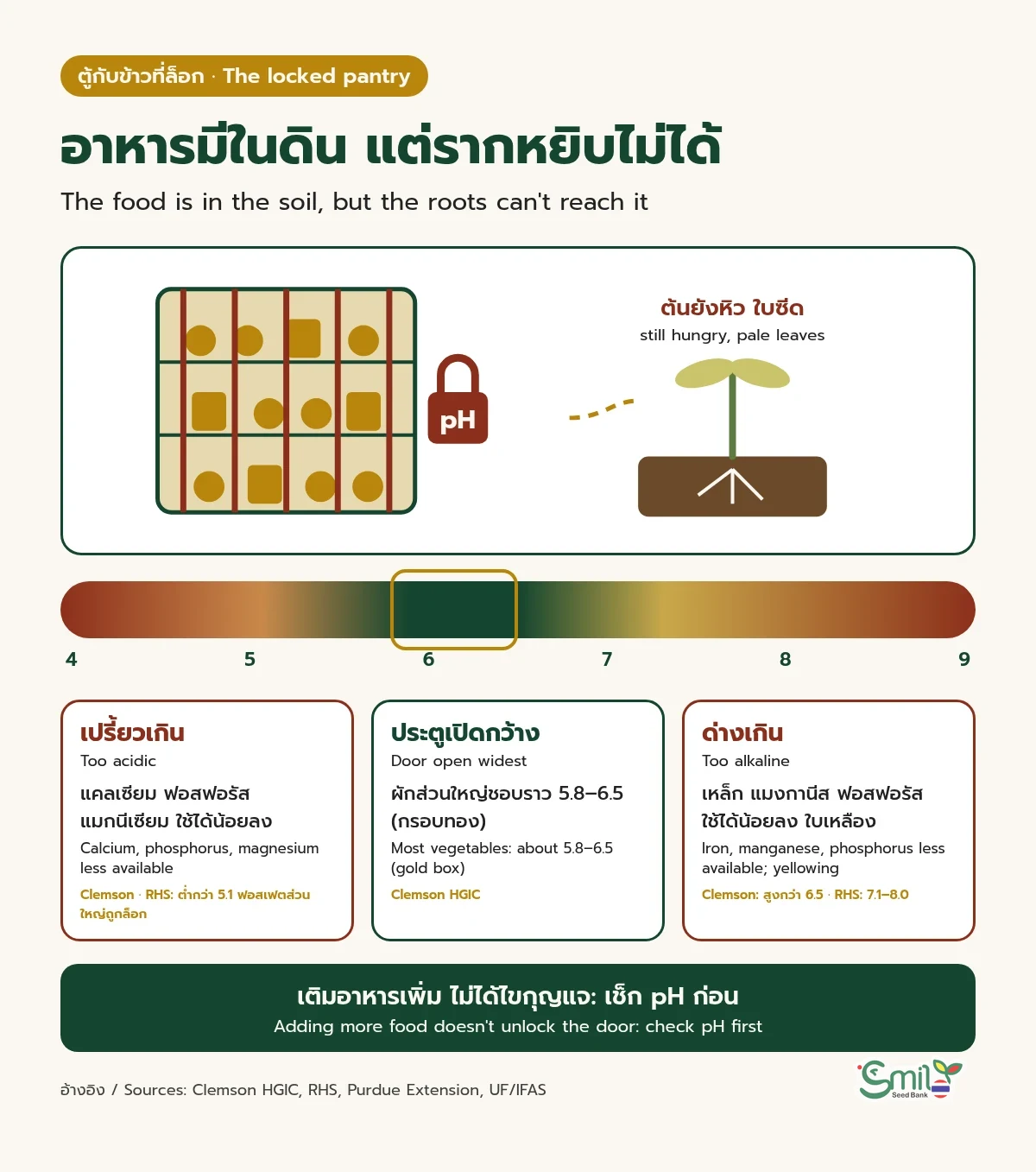
Picture a pantry full of food with the door locked. The family inside can still go hungry. Soil can work the same way: the plant's food may all be there, but the roots cannot reach it, and one key people often forget is pH. This article looks for why that door locks, and how to find out before guessing.
What pH means (the simple version)
pH tells you how "sour" (acidic) or alkaline soil or water is. The scale runs from 0 to 14. 7 is neutral, below 7 is acidic, above 7 is alkaline. Oregon State University Extension explains that the scale is not even: soil at pH 6.0 is ten times more acidic than soil at pH 7.0. A small change in the number is not a small change in the soil.
Source: Oregon State University Extension – Living on The Land: Managing Soil pH (EC 1657, PDF)
Oregon State adds that pH affects many things in soil: which nutrients plants can use, disease risk, and the life in the soil. Clemson HGIC calls soil pH one of the most important environmental factors in plant growth, because it directly controls how available nutrients are.
Source: Oregon State University Extension (PDF) · Clemson HGIC – How to Change Soil pH
How the door locks while the food is still there
Purdue Extension says it plainly: growers often assume pale, yellow leaves mean a nutrient shortage. Sometimes that is true. In other cases the nutrients are present in the growing mix, but a high pH makes them unavailable to the plant. That is the "locked door".
Source: Purdue Extension – HO-242: Alkalinity Management in Soilless Substrates (PDF)
The RHS uses almost the same word: extreme soil pH, acidic or alkaline, "locks up" certain nutrients.
Source: RHS – Nutrient deficiencies
The too-sour side (low pH)
Clemson says that at low pH, calcium, phosphorus and magnesium are less available, and in highly acidic soil aluminium and manganese become more available and can be toxic.
The RHS says that below pH 5.1 most phosphates are locked up, and calcium, potassium, magnesium and copper become more soluble and are easily washed away.
UF/IFAS says acidic soils reduce the availability of potassium, calcium and magnesium.
Source: Clemson HGIC · RHS – Soil: Understanding pH and Testing · UF/IFAS – Soil pH and the Home Landscape or Garden (SS480, PDF)
The too-alkaline side (high pH)
Clemson says that above pH 6.5, phosphorus and most micronutrients become less available.
The RHS says that in alkaline soil (pH 7.1–8.0) iron and manganese become less available, leading to yellowing (lime-induced chlorosis).
UF/IFAS says alkaline soils are commonly short of iron, manganese, zinc and boron.
Source: Clemson HGIC · RHS – Soil: Understanding pH and Testing · UF/IFAS (PDF)
So the door can lock from both sides. Too sour locks it. Too alkaline locks it. They just lock different nutrients.
Where the door opens widest
This table pulls three sources together to show what happens across the pH range (every number comes from the source named).
pH range | What happens | Source |
|---|---|---|
Below 5.1 (acid soil) | Most phosphates locked up; calcium, potassium and magnesium easily washed away | RHS |
5.4–6.2 (soilless mixes such as peat) | All nutrients readily available, though each plant has its own best range | Purdue |
5.8–6.5 | Range most vegetables and ornamentals prefer | Clemson |
About 6.5 (garden soil) | Major nutrients at their most available; bacteria and earthworms most active | RHS |
Above 6.5 | Phosphorus and most micronutrients start to become less available | Clemson |
7.1–8.0 (alkaline soil) | Iron and manganese locked up; yellowing leaves | RHS |
Source: RHS – Soil: Understanding pH and Testing · Purdue Extension – HO-242 (PDF) · Clemson HGIC (summarised by us)
Notice that Purdue's range for soilless mixes sits a little lower than the RHS figure for garden soil. We will come back to that at the end.
Clues that the door may be locked
New leaves yellow first, especially between the veins. Purdue says the most common deficiency caused by high pH is iron deficiency: yellowing between the veins, especially on new leaves. Plants cannot move iron from old leaves to feed new ones, so new growth shows it first. The RHS also says iron deficiency affects the youngest leaves most.
Yellowing that looks like nitrogen shortage. Clemson says iron chlorosis looks similar to nitrogen deficiency and is common in alkaline soils.
Feeding greens it up briefly, then the yellow comes back. Purdue says iron chelates can "green up" plants quickly but do not solve the root problem, high pH. If pH is not corrected, iron deficiency will reappear.
Source: Purdue Extension – HO-242 (PDF) · RHS – Nutrient deficiencies · Clemson HGIC
If the yellowing climbs from the lower leaves upward, that usually points to mobile nutrients instead, which we covered in our article on yellowing seedling leaves.
A caution: the RHS warns that problems with growing conditions can look like deficiencies. Wet or dry soil limits root function and nutrient uptake. Before blaming pH, rule out watering (see the checks in our overwatering vs underwatering article).
Source: RHS – Nutrient deficiencies
Your watering can holds a key too
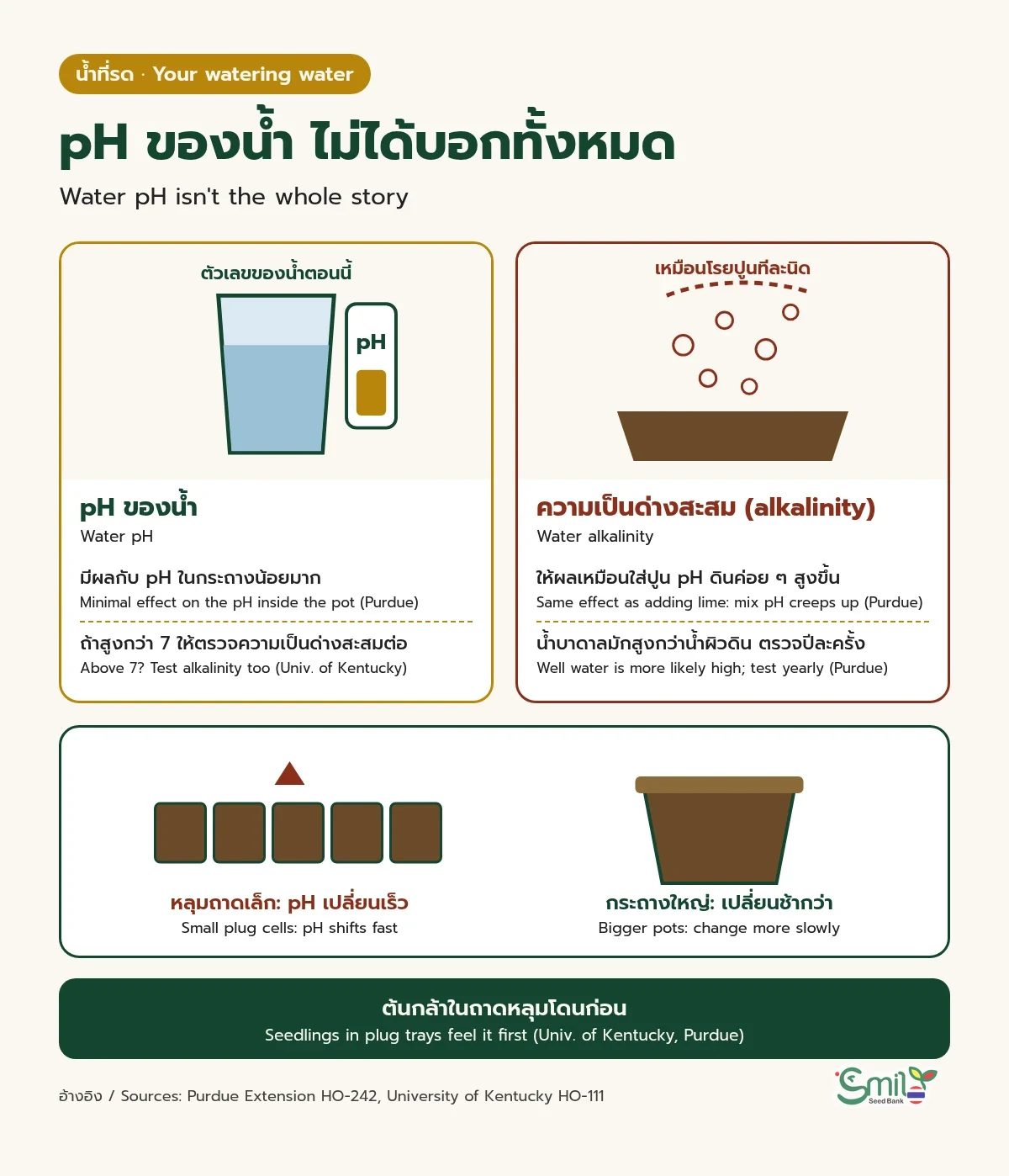
This is where most people get it wrong. The University of Kentucky calls it a common misconception that the pH of the water will determine the pH of the growing mix. In most cases, what matters more is the water's alkalinity: how much dissolved material it carries that neutralises acid.
Source: University of Kentucky – HO-111: Understanding Irrigation Water Test Results (PDF)
Purdue gives a picture: watering with high-alkalinity water has the same effect as adding lime to the mix, while the water's pH has a minimal effect on the pH inside the pot. High pH does not always mean high alkalinity, although the two often go together.
Source: Purdue Extension – HO-242 (PDF)
Why seedlings in plug trays feel it first
The University of Kentucky says plug production is very sensitive to high alkalinity, because the tiny volume of mix in each cell has little buffering capacity, so pH can change fast. Bigger containers change more slowly. Purdue agrees: in small containers, high-alkalinity water can quickly affect the pH of the mix.
Source: University of Kentucky – HO-111 (PDF) · Purdue Extension – HO-242 (PDF)
Purdue adds that water alkalinity is not constant; it can change with the seasons or over time. Well water is more likely than river or lake water to be high in alkalinity, and water should be tested at least once a year.
Source: Purdue Extension – HO-242 (PDF)
I'm guessing: growers who water small plug trays with well water probably need to watch this more than those using tap or rain water. We have no data on water in each part of Thailand, so we are not sure what your water is like. A water test is the clearest answer.
Check before you fix: don't assume it's pH
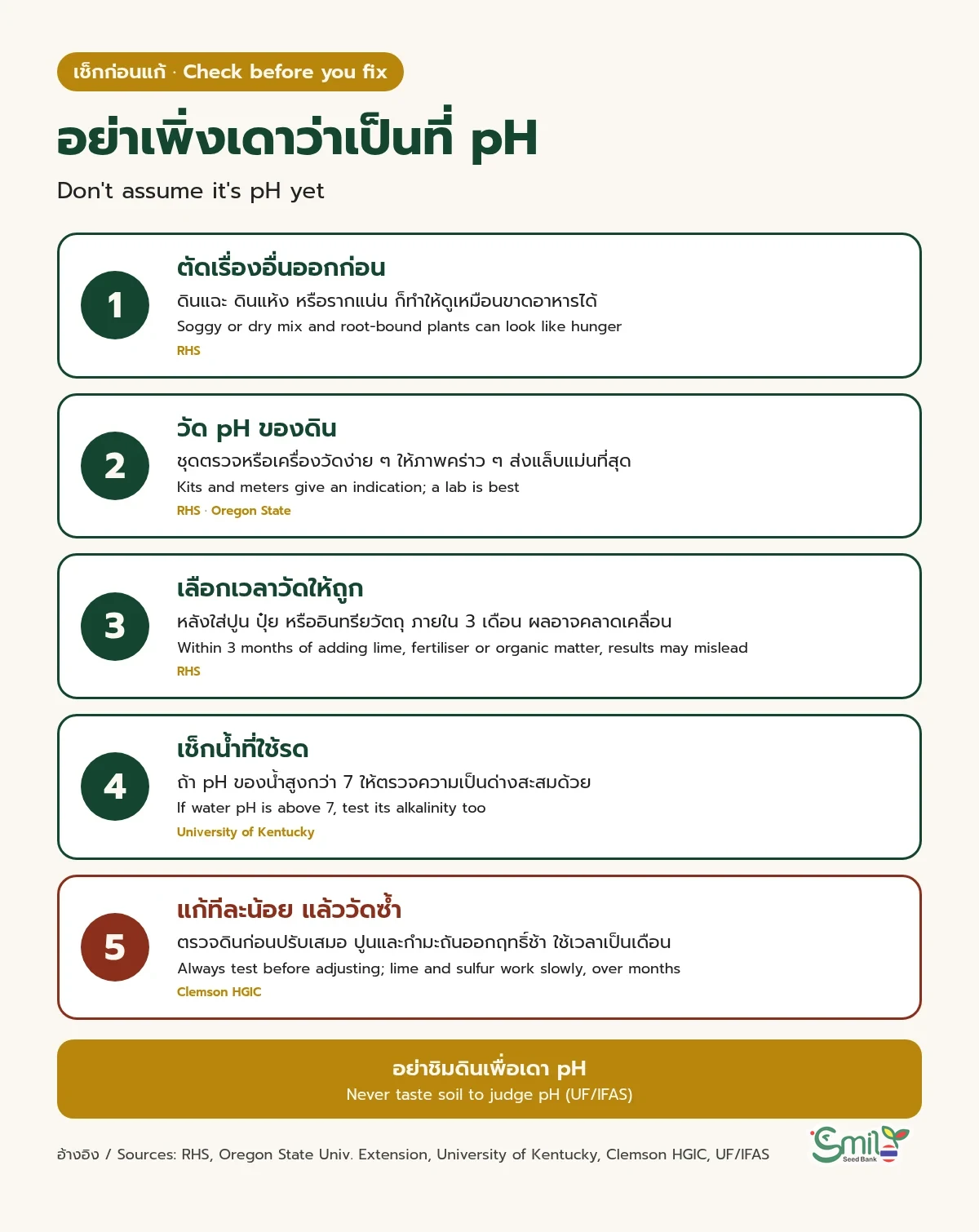
Rule out the other suspects first. Soggy or dry mix and root-bound plants can look like hunger (RHS). If seedlings have sat in their cells long enough to fill them with roots, see our article on transplanting seedlings.
Measure soil pH. Oregon State and the RHS say simple kits or meters give a good indication, but for the best results send a sample to a laboratory.
Pick the right time. The RHS warns that testing within three months of adding lime, fertiliser or organic matter may give misleading results. Oregon State notes that soil seldom has the same pH at all depths; repeated fertiliser can make the layer where it is applied more acidic.
If your water's pH is above 7, test its alkalinity too. That is the University of Kentucky's advice.
Source: RHS – Nutrient deficiencies · RHS – Soil: Understanding pH and Testing · Oregon State University Extension (PDF) · University of Kentucky – HO-111 (PDF)
And don't taste the soil. UF/IFAS writes that it strongly advises against tasting soil to judge its pH.
Source: UF/IFAS (PDF)
Turning the key slowly
Clemson's most important step: always test the soil before adjusting pH. Then choose a method.
Too acidic: Clemson says the usual approach is ground agricultural limestone. It needs moisture to react and is best applied two to three months before planting.
Too alkaline: Clemson says elemental sulfur lowers pH gradually because soil bacteria have to convert it, and this can take several months.
Wood ash: Clemson warns it can raise pH significantly in sandy soils and should be kept away from germinating seedlings and roots.
Soils differ: Clemson says sandy soils change pH more easily than clay; clay and soils high in organic matter resist change more.
Source: Clemson HGIC – How to Change Soil pH
This article deliberately gives no amounts. Clemson says soil test results should decide how much lime is needed, and Oregon State says the amount depends on many factors, including current pH, the crop and the soil.
Source: Clemson HGIC · Oregon State University Extension (PDF)
I'm guessing: if you use Super soil, or soil that has been through บ่มดิน (cook), with lots of organic matter, I think its pH probably moves more slowly than a light seed-starting mix, since Clemson says soils high in organic matter resist pH change. Young seedlings usually start in Base soil or a lighter mix, which may shift faster (more in our Super soil recipe). I have not found a source that measures this directly.
Our rain turns the key too
Clemson explains that rainwater passing through soil washes out calcium and magnesium, so soils formed under high rainfall tend to be more acidic than those in dry areas, and fertilisers containing ammonium or urea speed up acidification.
Source: Clemson HGIC
I'm guessing: outdoor beds in areas with many months of heavy rain may drift more acidic year by year, while seedling trays watered with well water may face the opposite, a slow drift upward. I have no Thai field data to confirm this. Testing before and after each growing season, as Oregon State suggests, will tell you more.
Myths to drop
Myth 1: Measure the water's pH and you know the soil's pH
The University of Kentucky calls this a common misconception; water alkalinity affects the mix more than water pH does.
Source: University of Kentucky – HO-111 (PDF)
Myth 2: Yellow leaves always need more fertiliser
Purdue says the nutrients are sometimes already there, but pH keeps the plant from using them. Adding more does not unlock the door.
Source: Purdue Extension – HO-242 (PDF)
Myth 3: pH 7 is best because it's neutral
Clemson says most vegetables prefer slightly acidic soil, about 5.8–6.5, and Oregon State says each plant has its own range.
Source: Clemson HGIC · Oregon State University Extension (PDF)
Myth 4: Lime or sulfur changes pH right away
Clemson says lime is best applied two to three months ahead and sulfur can take several months. I'm guessing: adding more because nothing seems to happen may overshoot the target; that part is our view, not from a source.
Source: Clemson HGIC
FAQ
Q1: What pH should seedlings be in?
There is no single number. Clemson gives 5.8–6.5 for most vegetables in soil. Purdue says soilless mixes make all nutrients readily available at 5.4–6.2, and each species has its own best range.
Source: Clemson HGIC · Purdue Extension – HO-242 (PDF)
Q2: Are simple pH kits reliable?
The RHS says DIY kits are easy to use and give a good indication, but a lab gives the best results. Not sure how accurate each kit is for the small amount of mix in a plug cell.
Source: RHS – Soil: Understanding pH and Testing
Q3: Does it matter if I use tap, well or rain water?
Purdue says well water is more likely to be high in alkalinity than surface water, and alkalinity can change with the seasons. Not sure about water in each part of Thailand; testing the water you actually use is best.
Source: Purdue Extension – HO-242 (PDF)
Q4: Which yellowing points to pH?
Purdue says the common sign of high pH is yellowing between the veins of new leaves from iron deficiency. The RHS warns that wet or dry soil can also look like a deficiency, so check water and roots first.
Source: Purdue Extension – HO-242 (PDF) · RHS – Nutrient deficiencies
Q5: How fast will plants recover after pH is fixed?
Not sure. Our sources do not give a recovery time for seedlings. Purdue says plants cannot move iron from old leaves to new ones. I'm guessing: leaves that already yellowed may not turn green again, so watch the new growth instead.
Source: Purdue Extension – HO-242 (PDF)
The twist: one key, different doors
By now you may want "the right pH number" to write down. But put these two lines side by side.
The RHS says pH 6.5 is the best general-purpose pH for gardens, with major nutrients at their most available. Purdue says that in soilless mixes all nutrients are readily available between pH 5.4 and 6.2, which is lower.
Source: RHS – Soil: Understanding pH and Testing · Purdue Extension – HO-242 (PDF)
I'm guessing: the "right number" may depend on what is in your pot: real soil, a soilless seed mix, or a blended Super soil somewhere in between. Which number a blended mix should follow, I have not found a source that answers.
If you measure both your soil and your watering water and the numbers surprise you, tell us what you found.
Sources
Clemson Cooperative Extension HGIC. How to Change Soil pH in South Carolina (HGIC 1650, reviewed 13 May 2026). https://hgic.clemson.edu/factsheet/changing-the-ph-of-your-soil/
Duyck, G., Korthuis, E., Kerr, S., et al. (2021). Living on The Land: Managing Soil pH (EC 1657). Oregon State University Extension Service. https://extension.oregonstate.edu/sites/extd8/files/documents/ec1657.pdf
Royal Horticultural Society. Soil: Understanding pH and Testing. https://www.rhs.org.uk/soil-composts-mulches/ph-and-testing-soil
Royal Horticultural Society. Nutrient deficiencies. https://www.rhs.org.uk/prevention-protection/nutrient-deficiencies
Lopez, R. G., Mickelbart, M. V., & Pasian, C. Alkalinity Management in Soilless Substrates (HO-242-W). Purdue Extension. https://www.extension.purdue.edu/extmedia/ho/ho-242-w.pdf
University of Kentucky Cooperative Extension. HO-111: Understanding Irrigation Water Test Results and Their Implications on Nursery and Greenhouse Crop Management. https://nursery-crop-extension.mgcafe.uky.edu/sites/nursery-crop-extension.ca.uky.edu/files/general/ho111.pdf
UF/IFAS Extension. Soil pH and the Home Landscape or Garden (SS480). https://ask.ifas.ufl.edu/publication/SS480/pdf
This article is for education and general information about growing plants and caring for soil only. It is based on the sources cited at the time of writing, and the information may change.