Why Are My Seedling Leaves Turning Yellow? Read the "Yellow Map" Before You Feed
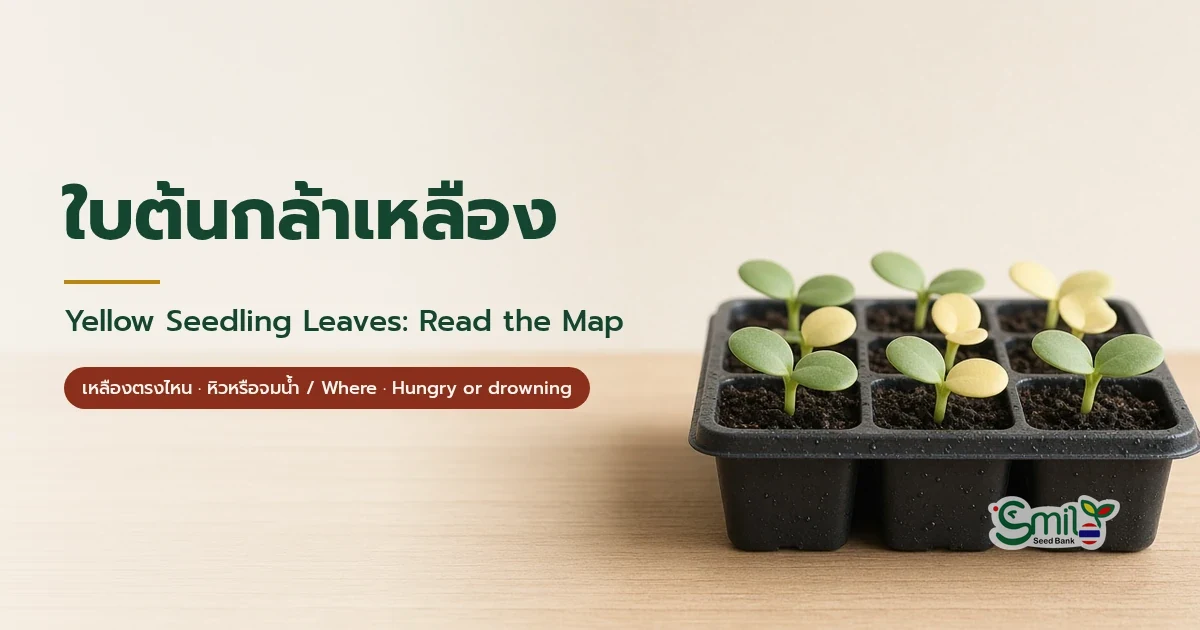
Why Are My Seedling Leaves Turning Yellow? Read the "Yellow Map" Before You Feed
This morning you spot yellow on a seedling that was bright green yesterday, and your hand is already reaching for the fertiliser. Everyone says "yellow leaves = hungry plant."
Hold on. Yellow on a seedling doesn't mean just one thing. Think of it as a map: where the yellow shows up tells you more than the colour itself. Yellow seed leaves, yellow lower leaves, yellow new growth, yellow spots. Each one points somewhere different. Some are perfectly normal, and some are about water rather than food. This article walks the map zone by zone and ends with a question we still can't answer for a Thai rainy season.
Before the map: the one rule to remember
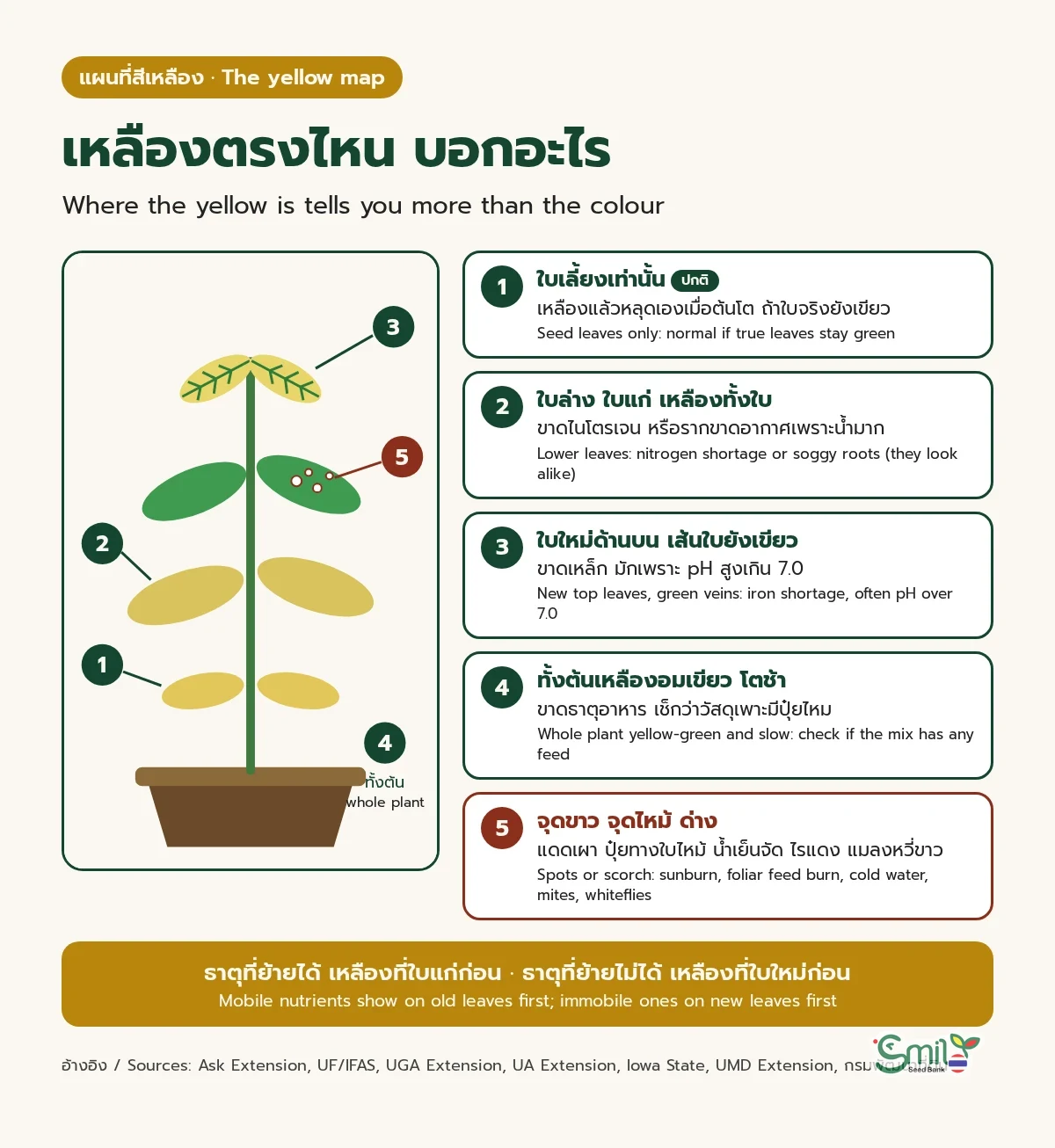
Some nutrients can "move house" inside a plant and some can't. UF/IFAS explains that nitrogen is mobile in the plant, so deficiency shows on the lower leaves first, while iron is immobile, so symptoms start on new leaves. A Thai reference from the Soil and Fertilizer Society of Thailand states the same principle: easily moved nutrients show on old leaves, hard-to-move ones on young leaves.
Source: UF/IFAS – Plant Tissue Analysis and Interpretation for Vegetable Crops in Florida · Soil and Fertilizer Society of Thailand – Soil, Nutrients and Rice Fertilizer (Thai, KU Library, online p. 252)
Put simply: short of a mobile nutrient, the plant robs old leaves to feed the top, so old leaves yellow first. Short of an immobile one, new leaves yellow first. That rule is the compass for the whole map.
Zone 1: only the seed leaves are yellow
Good news. If only the seed leaves (the first round pair) are yellow and the true leaves are still green, an Ask Extension expert explains it's quite normal for cotyledons to yellow and drop as the plant grows. They supplied the first energy for germination and that capacity is limited. As long as the other leaves are healthy, there's no need for concern.
Source: Ask Extension – Yellowing seedling leaves (not only cotyledons)
My guess: if the seed leaves go yellow before any true leaves appear, I don't think that's normal ageing. I'd check the other zones, especially water and the stem base.
Zone 2: yellow lower, older leaves
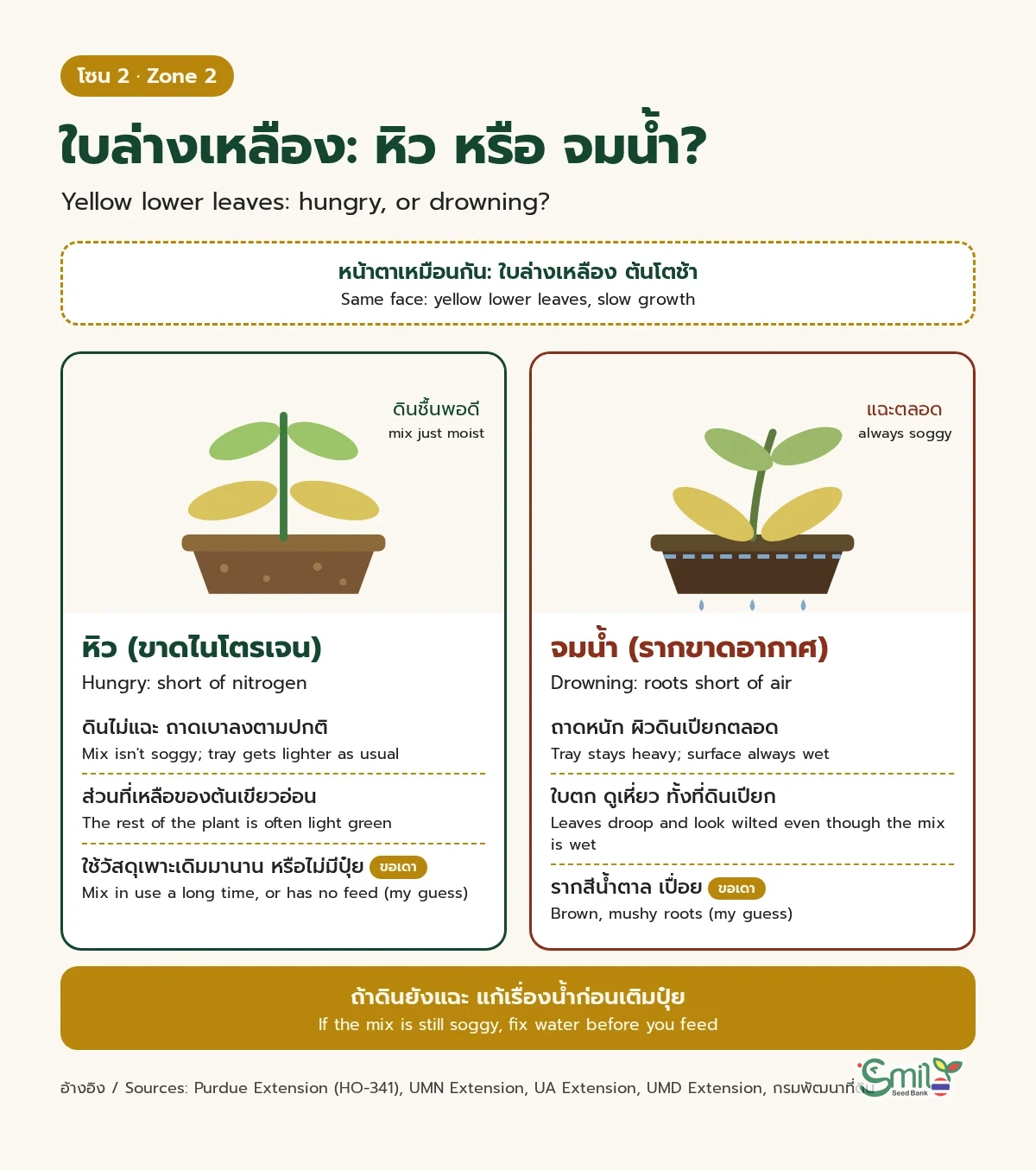
This is the zone where people think "fertiliser" first, with good reason. Thailand's Land Development Department lists nitrogen deficiency as slow, stunted growth, pale yellow lower leaves and early leaf drop. UA Cooperative Extension (Arizona) describes it as general yellowing of older leaves at the bottom of the plant, with the rest often light green.
Source: Land Development Department – Land Development Handbook for Volunteer Soil Doctors and Farmers (Thai, p. 53) · UA Cooperative Extension – Guide to Symptoms of Plant Nutrient Deficiencies
But this zone has a second suspect that looks almost identical: too much water. Purdue Extension explains that when soil is waterlogged, oxygen is pushed out of the pores, roots can't respire and get damaged, and the plant wilts, stalls and yellows, much like drought. Injured roots are also more open to soil pathogens. UMD Extension likewise lists waterlogged soil among the causes of yellowing seedling leaves.
Source: Purdue Extension – HO-341: Water Management for Vegetable Crops on Small Farms · UMD Extension – Vegetable Seedlings or Transplant Leaves Yellowing
One more reason lower leaves yellow that isn't alarming: Ask Extension notes that lower leaves get less and less light as the plant grows, so some yellowing there is expected. If yellow lower leaves come with a thin, stretched stem, check light too, using our leggy seedlings article (my guess is the two can show up together).
Source: Ask Extension – Yellowing seedling leaves (not only cotyledons)
Zone 3: yellow new leaves at the top (veins still green)
If the newest leaves turn yellow while the veins stay green like a net, UGA Extension says that's a sign of iron deficiency, typically on new growth near the top. The most common cause is high soil pH (over 7.0), and over- or underwatering can cause it too. UMD Extension puts the ideal pH for vegetables at about 6.5, with 6.0–7.0 still fine.
Source: UGA Extension – Nutritional Deficiencies in Vegetables · UMD Extension – Nutrient Deficiency of Vegetable Plants
Not sure whether a tiny seedling with one or two pairs of true leaves shows the vein pattern clearly enough to tell. If you can't tell, my guess is that checking the pH of your water and mix is a better starting point than guessing.
Zone 4: the whole plant is yellow-green and slow
Iowa State Extension says indoor seedlings that are yellow-green all over are usually short of nutrients, mainly nitrogen and phosphorus: nitrogen shortage gives yellow-green leaves and stunting, phosphorus shortage gives purplish leaves. UMN Extension adds that very slow growth with yellow leaves likely means nitrogen deficiency, and they have seen batches of potting soil that simply lacked enough nitrogen.
Source: Iowa State Extension – Why are my indoor seedlings yellow-green? · UMN Extension – Troubleshooting seedling issues
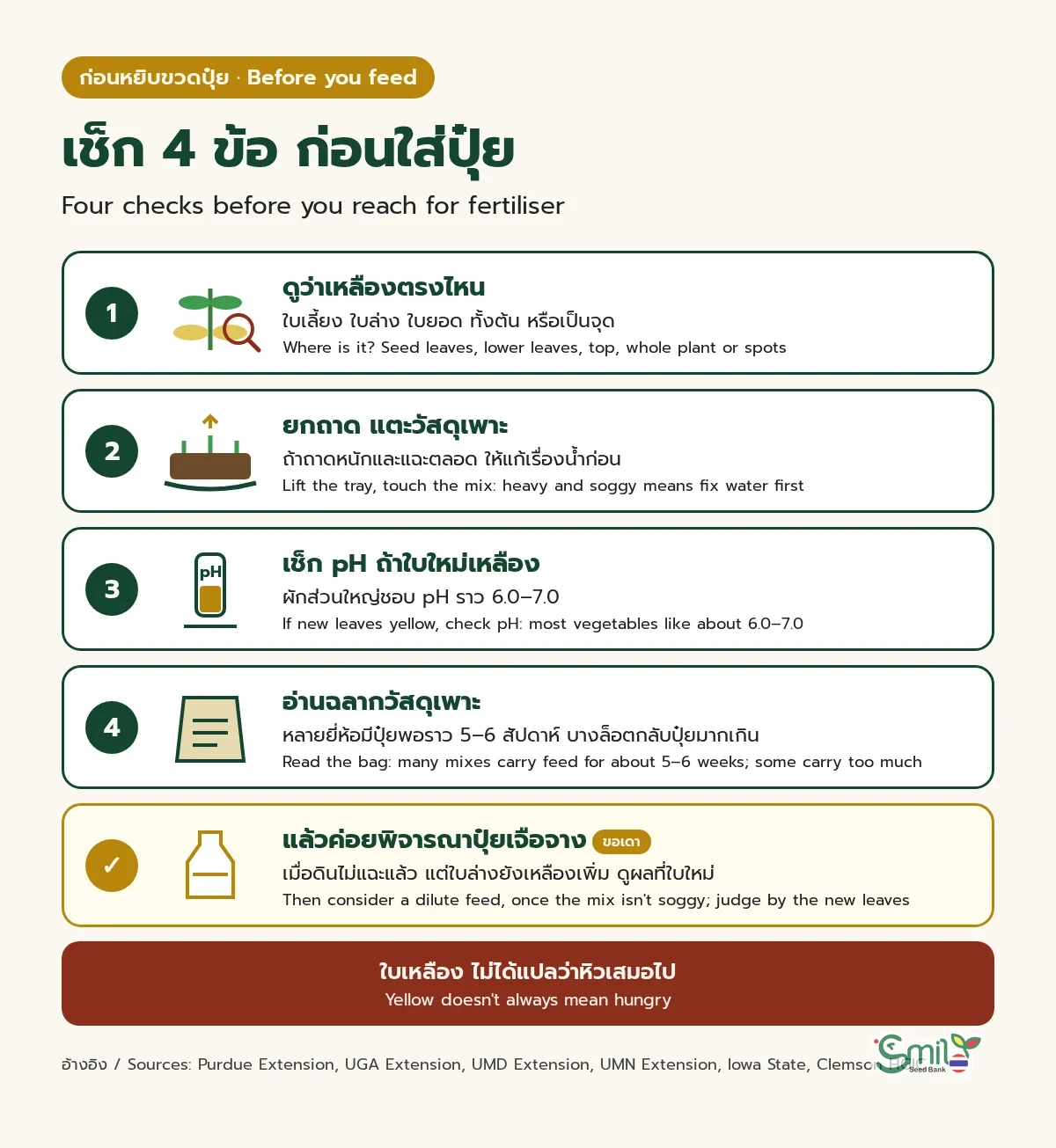
Yet the same UMN post warns that many potting soils have the opposite problem: too many nutrients and high salts. UMD Extension says most potting mixes contain enough fertiliser for a seedling for 5–6 weeks. Those two sides are exactly why we shouldn't reach for fertiliser before checking the other zones.
Source: UMN Extension – Troubleshooting seedling issues · UMD Extension – Care of Vegetable Seedlings
Zone 5: spots, speckles, white or scorched patches
UMD Extension explains that spotted or scorched leaves are often sunburn on plants with weak roots or that weren't hardened off, and can also come from foliar fertiliser burn, cold water sprayed on plants, or spray injury. Healthy plants outgrow it. UMD adds that spider mites leave fine white stipples and yellowing, and whiteflies cause stippling followed by yellowing.
Source: UMD Extension – Vegetable Seedlings or Transplant Leaves Yellowing
The whole map in one table
Where is the yellow? | Likely cause | Check first |
|---|---|---|
Seed leaves only, true leaves green | Normal ageing | Confirm the true leaves are green; do nothing |
Lower, older leaves, whole leaf | Nitrogen shortage, or roots short of air from too much water | Lift the tray, touch the mix; if it's always soggy, fix water before feeding |
New top leaves, veins still green | Iron shortage, often from high pH | Check the pH of your water and mix |
Whole plant yellow-green, slow | Nutrient shortage (nitrogen, phosphorus) | Does your mix contain fertiliser, and how long has it been in use? |
White specks, scorched spots, blotches | Sunburn, foliar feed burn, cold water, spider mites or whiteflies | Look under leaves for pests; did you just move it into sun or spray it? |
Source: Ask Extension – Yellowing seedling leaves · UA Cooperative Extension – Guide to Symptoms of Plant Nutrient Deficiencies · Purdue Extension – HO-341 · UGA Extension – Nutritional Deficiencies in Vegetables · Iowa State Extension – Yellow-green seedlings · UMD Extension – Vegetable Seedlings or Transplant Leaves Yellowing
Why Zone 2 deserves attention right now
Thailand's Meteorological Department expects heavy rain in the South from mid-October to early January. UGA Extension notes nitrogen can be washed out of soil by excess rain, and Purdue explains that newly germinated seedlings and fresh transplants have shallow roots, so they're vulnerable to both overly dry and overly wet topsoil.
Source: Thai Meteorological Department – Seasonal forecast (cool season 2026–27) · UGA Extension – Nutritional Deficiencies in Vegetables · Purdue Extension – HO-341
My guess: for pots sitting out in the rain, yellow lower leaves this season may come from both directions at once, waterlogged roots and washed-out nitrogen, which makes them even harder to tell apart. Mix that stays wet for long also favours damping-off (see our damping-off article).
Myths you hear a lot (that aren't always true)
"Yellow leaves = add fertiliser"
Not always. Seed leaves yellow with age (Ask Extension), soggy soil yellows leaves (Purdue, UMD), and many potting mixes already have too many nutrients (UMN).
Source: Ask Extension – Yellowing seedling leaves · Purdue Extension – HO-341 · UMN Extension – Troubleshooting seedling issues
"Yellow seed leaves mean the seedling is dying"
If the true leaves are green, Ask Extension says it's normal. The seed leaves have done their job.
Source: Ask Extension – Yellowing seedling leaves
"It looks droopy and yellow, so it needs more water"
Purdue explains that too much water can cause wilting, stalling and yellowing that look like drought. UMN also warns that overwatering symptoms can look like wilt, which tempts us to water even more.
Source: Purdue Extension – HO-341 · UMN Extension – Troubleshooting seedling issues
"Rich organic soil means seedlings never yellow"
My guess: a rich mix like Super soil can't prevent yellowing from too much water or wrong pH, and may be too strong for seedlings. So let Super soil go through บ่มดิน (cook) and start seedlings in a lighter layer like Base soil first. This follows from UMN's warning about mixes high in nutrients and salts (more in our Super soil recipe).
Source: UMN Extension – Troubleshooting seedling issues
FAQ
Q1: When should I start feeding seedlings?
Our sources disagree. Clemson Extension says to fertilise seedlings in soilless mixes when the first true leaves appear. Iowa State suggests a dilute fertiliser every two weeks. UMD says hold back, since most potting mixes carry enough for 5–6 weeks. So it depends on whether your mix already contains fertiliser. Read the bag first.
Source: Clemson HGIC – Starting Seeds Indoors · Iowa State Extension – Yellow-green seedlings · UMD Extension – Care of Vegetable Seedlings
Q2: Will yellow leaves turn green again?
Not sure how far an already-yellow leaf recovers. Our sources focus on fixing the cause. For sunburn or fertiliser burn, UMD says healthy plants "outgrow" the injury, which means watching whether the new leaves come in green.
Source: UMD Extension – Vegetable Seedlings or Transplant Leaves Yellowing
Q3: Should I pinch off yellow seed leaves?
Ask Extension says they yellow and drop on their own. My guess: letting them fall is better, as pulling may bruise a soft stem, unless the leaf is rotting.
Source: Ask Extension – Yellowing seedling leaves
Q4: Are yellow leaves linked to damping-off?
They share soggy soil. Purdue says waterlogged, injured roots are more open to soil pathogens. UMD warns that overly wet mix stops root growth and that damping-off fungi can kill a whole tray. If the stem base is pinched and water-soaked, see our damping-off article.
Source: Purdue Extension – HO-341 · UMD Extension – Care of Vegetable Seedlings
Q5: Does checking the roots help?
UMD Extension advises avoiding transplants with brown roots circling the bottom of the container. My guess: if you ease a plug out and see clean white roots, the problem is likely elsewhere; brown, mushy roots point to water rather than food.
Source: UMD Extension – Vegetable Seedlings or Transplant Leaves Yellowing
An ending that isn't finished: hungry, or drowning?
By now most of the map reads fairly clearly, except Zone 2, where two suspects share a face: lower leaves yellow because the plant is "hungry" (short of nitrogen) or "drowning" (roots short of air).
The interesting part is that they may not really be separate. Purdue says roots starved of oxygen are damaged and stop working normally, and UGA says heavy rain washes nitrogen out. If so, feeding while the mix is still soggy might mean serving food to roots that can't eat yet.
Source: Purdue Extension – HO-341 · UGA Extension – Nutritional Deficiencies in Vegetables
I haven't found work that says clearly whether, in a home seedling tray in a Thai rainy season, you should fix water first or feed first, and which works better. If you've had yellow lower leaves in a wet spell, how did you get the new leaves to come in green? Tell us. The answer for our climate might be sitting in your tray.
Sources (full list)
Ask Extension. Yellowing seedling leaves (not only cotyledons). https://ask.extension.org/kb/faq.php?id=628680
UF/IFAS Extension. HS964/EP081: Plant Tissue Analysis and Interpretation for Vegetable Crops in Florida. https://ask.ifas.ufl.edu/publication/EP081
Soil and Fertilizer Society of Thailand; Yongyuth Osotsapar (ed.) (2015). Soil, Nutrients and Rice Fertilizer (Thai; online p. 252, Kasetsart University Library). https://ebook.lib.ku.ac.th/ebook27/ebook/20190063/files/basic-html/page252.html
Land Development Department (Thailand). Land Development Handbook for Volunteer Soil Doctors and Farmers (Thai, p. 53). https://e-library.ldd.go.th/library/flip/bib11056f/files/basic-html/page53.html
University of Arizona Cooperative Extension. Guide to Symptoms of Plant Nutrient Deficiencies. https://extension.arizona.edu/publication/guide-symptoms-plant-nutrient-deficiencies
Purdue Extension. HO-341: Water Management for Vegetable Crops on Small Farms. https://ag.purdue.edu/department/hla/extension/extension-publications-library/ext-pubs/ho-341-w.html
University of Maryland Extension. Vegetable Seedlings or Transplant Leaves Yellowing, Turning White, or are Spotted or Scorched (updated 20 Feb 2023). https://www.extension.umd.edu/resource/vegetable-seedlings-or-transplant-leaves-yellowing-turning-white-or-are-spotted-or-scorched
University of Maryland Extension. Nutrient Deficiency of Vegetable Plants. https://www.extension.umd.edu/resource/nutrient-deficiency-vegetable-plants
University of Maryland Extension. Care of Vegetable Seedlings (updated 20 Feb 2023). https://www.extension.umd.edu/resource/care-vegetable-seedlings
UGA Cooperative Extension. Nutritional Deficiencies in Vegetables (B1569). https://fieldreport.caes.uga.edu/publications/B1569/nutritional-deficiencies-in-vegetables/
Iowa State University Extension and Outreach, Yard and Garden. Why are my indoor seedlings yellow-green? Help! https://yardandgarden.extension.iastate.edu/faq/why-are-my-indoor-seedlings-yellow-green-help
UMN Extension, Fruit and Vegetable IPM blog (2020). Troubleshooting seedling issues. https://blog-fruit-vegetable-ipm.extension.umn.edu/2020/04/troubleshooting-seedling-issues.html
Clemson Cooperative Extension HGIC. Starting Seeds Indoors. https://hgic.clemson.edu/factsheet/starting-seeds-indoors/
Thai Meteorological Department (2026). Cool-season outlook for Thailand 2026 (issued 9 Oct 2026). https://www5.tmd.go.th/forecast/seasonal
This article is for education and general information about raising seedlings only. Information is based on the sources listed as of the time of writing and may change.