Overwatering vs Underwatering Seedlings: Same Droop, Opposite Fix
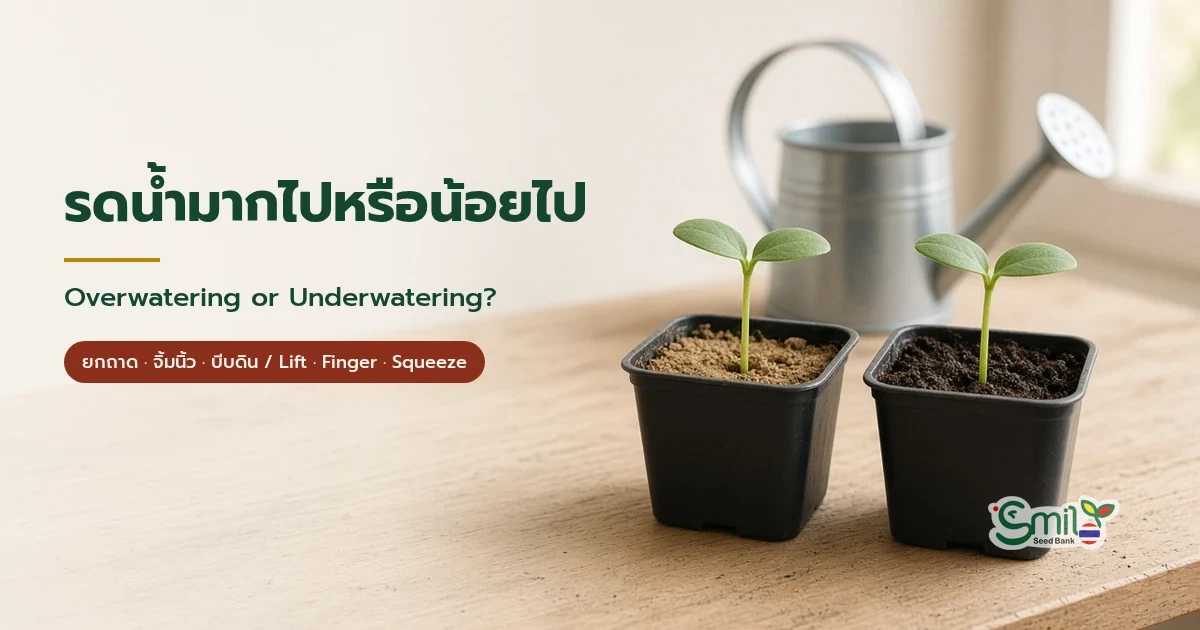
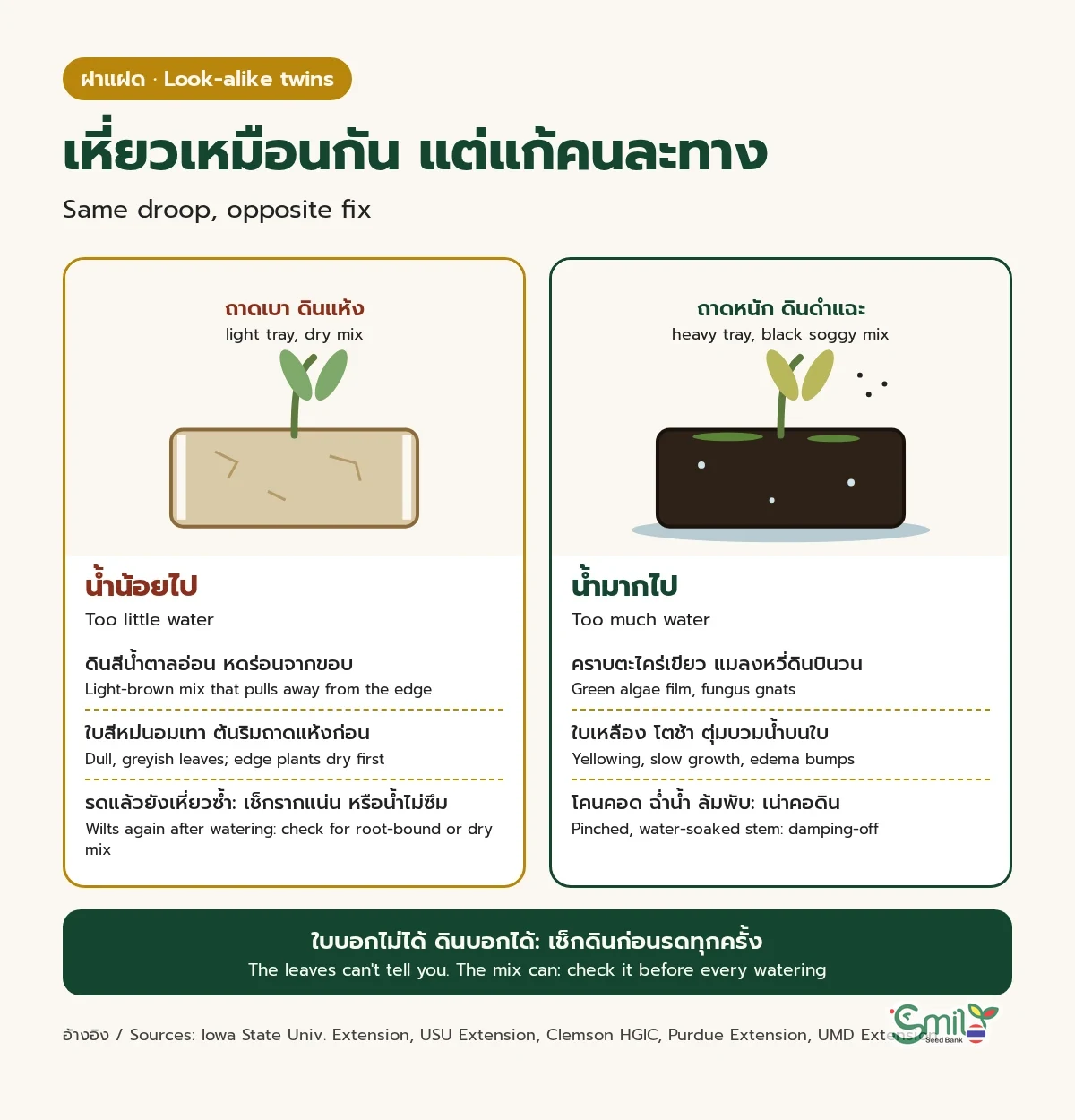
It's 5 pm. Two seedling trays sit side by side, and both have drooping, curling leaves. The first tray is so dry the mix has pulled away from the cell walls. The second is heavy, black and soggy. Look only at the leaves, though, and you can't tell which is which.
These two problems are look-alike twins. Their faces are almost identical, but the cure for one is what hurts the other. This article puts the twins side by side and shows you how to tell them apart with your own hands, without guessing.
Why both can wilt
Most people see a wilting plant and water it straight away. Iowa State University Extension says that's usually right, but overwatered plants often wilt too. The irony is that overwatered plants die partly from a lack of water: when the root zone stays saturated, the roots are damaged and can no longer take water up.
Source: Iowa State University Extension – Watering Plants in Containers and Plug Trays
Clemson HGIC explains it the same way: any injury to the roots, including root rot from too much water, reduces the plant's ability to take up water and causes wilting. Under those conditions, watering can make things worse.
Source: Clemson HGIC – Indoor Plants: Watering
For seedlings, University of Minnesota Extension describes seedlings drooping and folding over from the top. It's caused by ethylene gas when the root zone becomes short of oxygen from overwatering. It looks like wilt, which can tempt you to water even more.
Source: University of Minnesota Extension – Troubleshooting seedling issues
Purdue Extension adds that waterlogged plants show wilting, yellowing and stunted growth. In early drought, the leaf pores (stomata) close to save moisture and photosynthesis stops in most plants. Both roads end in a plant that grows slowly.
Source: Purdue Extension – HO-341: Water Management for Vegetable Crops on Small Farms
Telling the twins apart: three hand tests
The leaves can't tell you. The mix can. Try these three before you pick up the watering can.
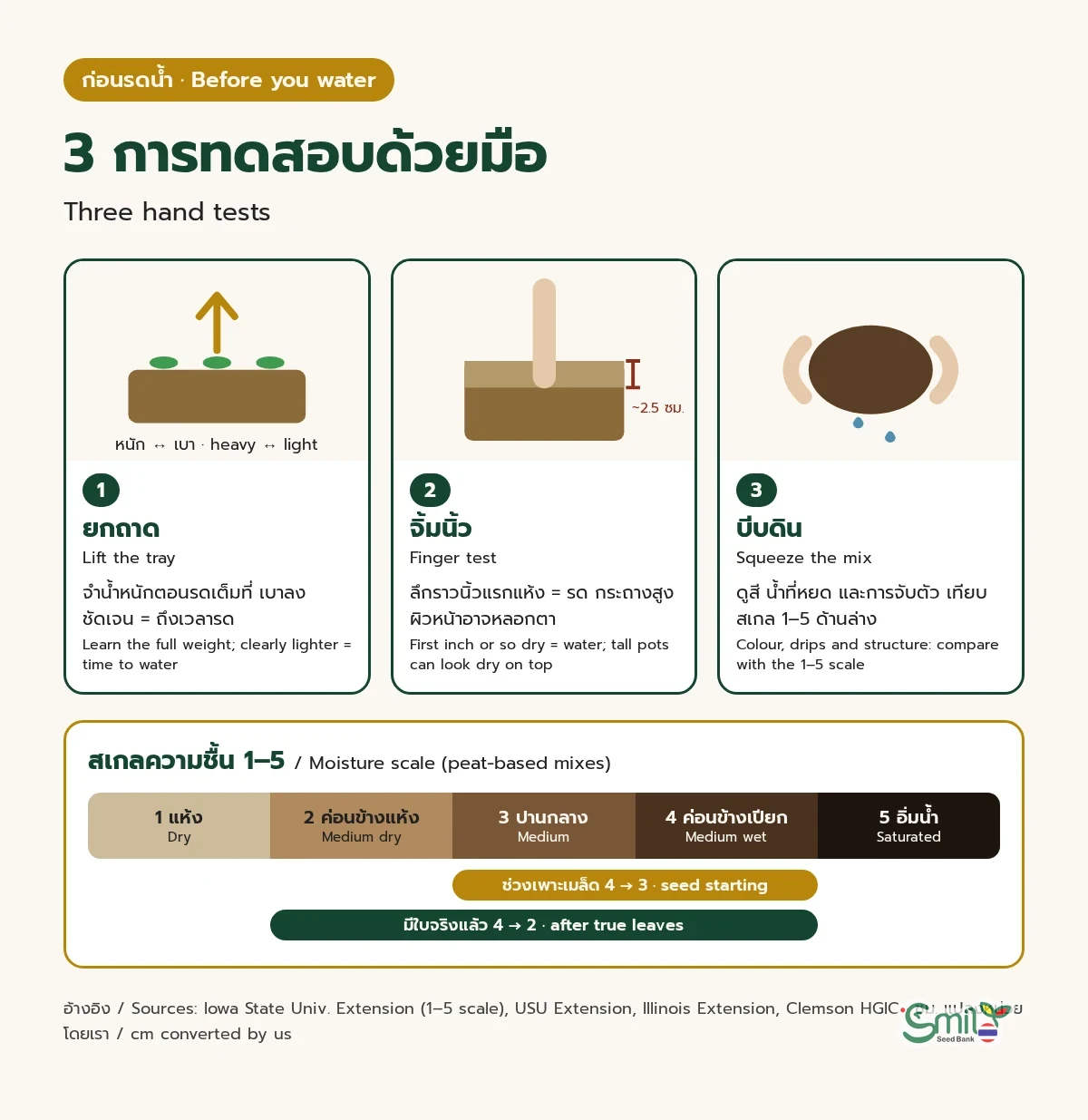
Test 1: Lift the tray
USU Extension suggests noticing the weight of a fully watered pot or tray by hefting it in your hand. When it gets significantly lighter, it's time to water. Iowa State adds that weight is fairly subjective, since plants get heavier as they grow, but lifting before and after watering teaches you what "light enough to water" feels like.
Source: USU Extension – Starting Vegetable Seeds Indoors: IV. Seedling Culture and Transplanting (PDF) · Iowa State University Extension
Test 2: The finger test
Illinois Extension says moisture meters are no substitute for watching the plant and using your finger to feel the soil. If the first inch or so is dry, water.
Source: Illinois Extension – Container Gardens: Watering
Watch out for a dry-looking surface, though. Iowa State says the taller the container, the less the colour at the top tells you, because the bottom holds more moisture. Clemson also notes that larger cells and pots can look dry on top while still being moist inside.
Source: Iowa State University Extension · Clemson HGIC – Starting Seeds Indoors
Test 3: Squeeze the mix and use the 1–5 scale
Iowa State describes a moisture scale for potting media, from 1 (dry) to 5 (saturated), based on colour, squeezing and how the mix holds together. It was written for peat-based mixes, and they caution that colour may be less reliable for other substrates.
Level | Colour | When squeezed | Structure |
|---|---|---|---|
1 Dry | Tan/grey | No water | Dusty, won't form a ball |
2 Medium dry | Light brown | No drips, squeaks | Barely sticks; ball crumbles |
3 Medium | Brown | A single drop | Soft ball that cracks apart |
4 Medium wet | Dark brown | Drips | Easily forms a ball that sticks |
5 Saturated | Black, shiny | Drips freely without squeezing | Loose, semi-liquid ball |
Source: Iowa State University Extension – Watering Plants in Containers and Plug Trays (summarised by us)
Iowa State says we rarely want plants at Level 1 or Level 5. When starting seeds, they generally begin at Level 4 and only let the mix dry to Level 3 early on. Once seedlings have true leaves, they typically water to Level 4 and let it dry to Level 2. USU says something similar: the mix changes from dark brown or nearly black when well watered to light brown when dry, and very dry mix shrinks away from the edge of the pot.
Source: Iowa State University Extension · USU Extension (PDF)
The clues each twin leaves behind
If the tests still aren't clear, look around the plant. The twins don't leave the same evidence.
Clues of too much water
A green film on the surface. USU says the algae layer isn't directly harmful, but it can indicate too much moisture and increase the pathogens behind damping-off. Clemson advises avoiding excess watering when plants are small or algae appear.
Tiny flies around the mix. USU says fungus gnats thrive in high moisture, their larvae can feed on roots and stems, and the best long-term fix is letting the mix dry between waterings.
Small bumps on leaves or stems. USU describes edema, which happens when plants take up more water than they can transpire. They suggest letting the mix dry out more and reducing fertiliser.
Yellowing and slow growth. USU lists waterlogged soil among the causes of stunted seedlings, and Purdue says waterlogged plants can yellow (see our yellow seedling leaves article to tell this apart from hunger).
Source: USU Extension (PDF) · Clemson HGIC – Starting Seeds Indoors · Purdue Extension – HO-341
And the worst clue of all: UMD Extension says that if containers are saturated, roots stop growing and wet-loving fungi can infect the plants. The damping-off fungi can quickly kill a whole container of seedlings. If stems pinch, look water-soaked and fall over, see our damping-off article.
Source: UMD Extension – Care of Vegetable Seedlings
Clues of too little water
Dull, greyish leaves. Iowa State says that in a group of the same plant, those starting to suffer water stress often take on a duller greyish cast, and plants at the edge of a group dry out faster.
Light-coloured mix that shrinks from the edge. As USU describes above.
Wilting again every day, even after watering. USU says plants that are perpetually dry and wilted usually need a bigger pot. Ease the root ball out and check; a dense root mat means it's time to transplant (our transplanting article). Or the mix may have dried so much that top watering no longer soaks the root ball, and bottom watering can help.
Source: Iowa State University Extension · USU Extension (PDF)
Seedlings vs bigger plants: why the frequency differs
Here the sources seem to disagree. Illinois Extension, writing about container plants in general, says containers dry fast and daily watering is necessary. University of Minnesota, writing about seedlings, says many people think they need to water seedlings daily, but that's often more water than they need.
Source: Illinois Extension – Container Gardens: Watering · University of Minnesota Extension
The answer is in the roots. UMN explains that small seedlings don't have developed root systems yet, so they don't take up much water, and as roots develop they take up more each day. USU adds that as seedlings grow more leaves, they lose water faster through transpiration. The same plant needs different amounts of water from week to week.
Source: University of Minnesota Extension · USU Extension (PDF)
Iowa State points out something people often miss: sort plants by size. If small plants sit next to large ones and get watered together, the small ones will be perpetually overwatered, which can lead to root rot.
Source: Iowa State University Extension
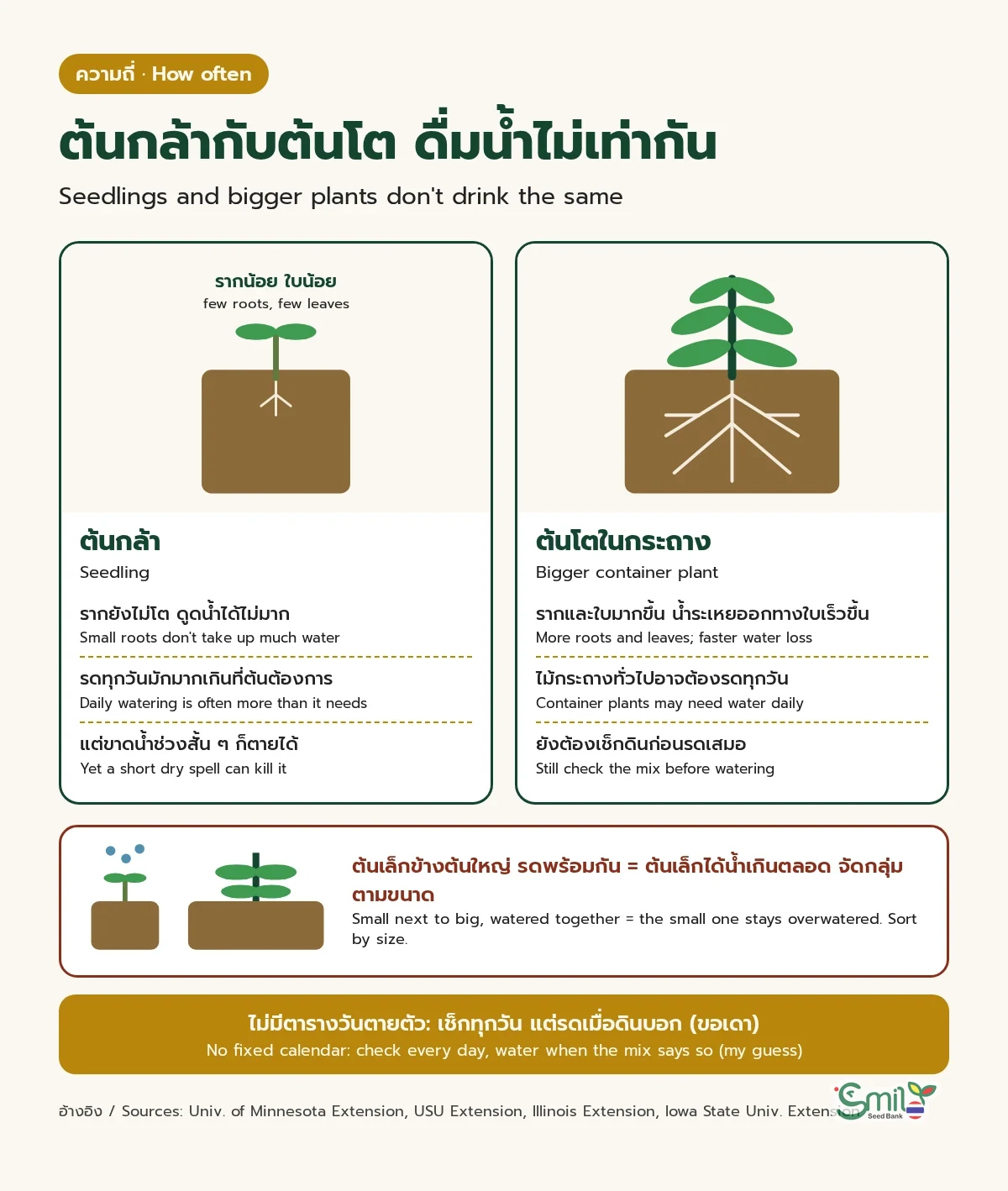
My guess: I don't think "how many days between waterings?" has a fixed answer. None of the sources we read gives a calendar; they all give ways to check instead. If there's one rule, I think it's "check every day, but water when the mix tells you to".
Pots, drainage holes and saucers
Water until it drains. Illinois says to apply enough water that it starts to drip from the drainage holes, so the whole root ball is moistened and some salts are leached out. Clemson also says to stop when water runs out of the bottom.
Don't leave water sitting in the saucer. USU says heavy bottom watering without discarding the drainage water is one cause of white salt crust, and suggests periodic overhead watering to flush salts.
Fill cells evenly and keep trays level. Iowa State says underfilled cells hold less water and dry out faster, and trays that aren't level hold less water, so more runs off before it soaks in.
Don't jump to a much bigger pot. RHS says a large volume of fresh compost stays wet for a long time, reducing air around the roots so they rot instead of growing out, and that affected plants are often mistakenly watered more, not less.
Source: Illinois Extension · Clemson HGIC – Starting Seeds Indoors · USU Extension (PDF) · Iowa State University Extension · RHS – Overpotting
Rescuing an overwatered plant
Stop watering and let the mix tell you. RHS advises that if a plant is in an oversized pot, water extremely carefully, only when the compost shows signs of drying.
If it doesn't improve, size the pot down. RHS suggests gently tipping the plant out, letting loose compost fall away, and replanting into a container only just larger than the root ball, then watering sparingly until it recovers.
Remove collapsed seedlings. UMD says that if damping-off infects plants, dispose of them along with their growing medium.
Accept that some roots are gone. Purdue says just a few days of waterlogging can cause permanent root damage. Not sure how well different seedlings recover; our sources don't say.
Source: RHS – Overpotting · UMD Extension – Care of Vegetable Seedlings · Purdue Extension – HO-341
For a seedling that has dried out and wilted, USU suggests bottom watering by setting the tray in 1–2 inches of water. Clemson says to let it soak for 3 to 10 minutes and then put it back. USU warns that a short time without enough water can kill young seedlings, so don't leave it long.
Source: USU Extension (PDF) · Clemson HGIC – Starting Seeds Indoors
My guess: If you use Super soil, or soil that has been through บ่มดิน (cook), I think a mix rich in organic matter usually holds water longer than an airy seed-starting mix, so you may need longer gaps between waterings than you're used to, and seedlings are better started in a lighter Base soil first (more in our Super soil recipe article). I haven't found a source that measures this directly; lifting and comparing pots is the clearest test.
Our seasons change the question
Thailand's Meteorological Department expects heavy, widespread rain in the South from mid-October to early January. For the North and Northeast, from mid-October to mid-November, it expects cool weather with thunderstorms over only 10–20% of the area.
Source: Thai Meteorological Department – Seasonal forecast (winter 2026–27, in Thai)
Thailand's Highland Research and Development Institute also warns that damping-off often hits seedlings in beds with standing water, and recommends good drainage and airflow.
Source: HRDI – Vegetable diseases to watch in the rainy season (in Thai)
My guess: At the same time of year, growers in the South and the North may be meeting different twins. In the South, too much water from rain and humidity seems the bigger risk. In the cooler, drier North, I think the mix may dry more slowly in cool weather but faster on windy days. I'm not sure which wins; lifting the tray is the best check.
Myths worth dropping
Myth 1: If it wilts, water it.
Not always. Iowa State, Clemson and UMN all say overwatered plants can wilt too, and watering more can make it worse. Check the mix first.
Source: Iowa State University Extension · Clemson HGIC – Indoor Plants: Watering
Myth 2: Watering every day is good care.
UMN says daily watering is often more water than seedlings need. Iowa State says plants benefit from drying out a little so oxygen can reach the root zone.
Source: University of Minnesota Extension · Iowa State University Extension
Myth 3: Water a lot at once so you don't have to water often.
Iowa State says that may not be best for the plants, and if you water to saturation, the mix takes much longer to dry out.
Source: Iowa State University Extension
Myth 4: A big pot is safer because more soil won't dry out.
RHS says an oversized pot stays wet for a long time and roots can rot. It suggests a pot about 2.5–5 cm wider than the last one.
Source: RHS – Overpotting
FAQ
Q1: How often should I water seedlings?
None of our sources gives a fixed number. Iowa State says there are many variables and suggests combining several methods: watching the plant, the colour of the mix, squeezing it and lifting the pot.
Source: Iowa State University Extension
Q2: Should I wait for a slight wilt before watering?
The sources disagree. Clemson says to water transplants when they are slightly wilting. USU says not to let seedlings get so dry that they start to wilt. Illinois says to water preferably before plants wilt severely. My guess: for very small seedlings I'd lean towards USU, because a short dry spell can kill them.
Source: Clemson HGIC – Starting Seeds Indoors · USU Extension (PDF) · Illinois Extension
Q3: Is bottom watering better?
USU and Clemson call it a good option, and UMD says you can let the mix wick water up from a shallow pan. USU recommends watering from above now and then to flush out salts.
Source: USU Extension (PDF) · UMD Extension – Care of Vegetable Seedlings
Q4: Do I need a moisture meter?
Illinois says meters are no substitute for watching the plant and feeling the soil with your finger. Not sure how accurate different meters are in small seed-tray cells.
Source: Illinois Extension
Q5: Will an overwatered plant recover?
Not sure. It depends on how much root was lost. Purdue says a few days of waterlogging can cause permanent root damage. RHS suggests watering very carefully and, if that doesn't help, moving to a smaller pot, then watching new leaves for signs of recovery.
Source: Purdue Extension – HO-341 · RHS – Overpotting
The twist: which twin is more dangerous?
By now, "too much water" might look like the villain. But put these two sentences side by side.
Purdue, writing about field vegetables, says deep-rooted crops may recover quickly from extended drought once water returns, but a few days of waterlogging can cause permanent root damage. USU, writing about seedlings, says a short time without enough water can kill young seedlings.
Source: Purdue Extension – HO-341 · USU Extension (PDF)
My guess: I think the more dangerous twin may swap places as the plant ages. While it's small with few roots, a short dry spell may be worse. Once it's bigger with deeper roots, waterlogging may be worse. Where that switch happens, I haven't found a source that says.
If you weigh your tray before and after watering for a couple of weeks and notice when your seedlings start coping with dry spells better, tell us what you find.
Sources
Vos, R. (2025). Watering Plants in Containers and Plug Trays. Iowa State University Extension and Outreach, Yard and Garden (4 Apr 2025). https://yardandgarden.extension.iastate.edu/article/2025/04/watering-plants-containers-and-plug-trays
Crump, W., Beddes, T., Caron, M., & Oliveira, M. (2025). Starting Vegetable Seeds Indoors: IV. Seedling Culture and Transplanting. Utah State University Extension. https://extension.usu.edu/yardandgarden/research/starting-vegetable-seeds-indoors-seeding-culture-and-transplanting.pdf
University of Minnesota Extension. Troubleshooting seedling issues (Fruit & Vegetable IPM blog, Apr 2020). https://blog-fruit-vegetable-ipm.extension.umn.edu/2020/04/troubleshooting-seedling-issues.html
Shaughnessy, D., & Pertuit, A. Indoor Plants – Watering. Clemson Cooperative Extension HGIC. https://hgic.clemson.edu/factsheet/indoor-plants-watering/
Clemson Cooperative Extension HGIC. Starting Seeds Indoors. https://hgic.clemson.edu/factsheet/starting-seeds-indoors/
University of Illinois Extension. Container Gardens: Watering. https://extension.illinois.edu/container-gardens/watering
Purdue University Extension. HO-341: Water Management for Vegetable Crops on Small Farms. https://ag.purdue.edu/department/hla/extension/extension-publications-library/ext-pubs/ho-341-w.html
Royal Horticultural Society. Overpotting. https://www.rhs.org.uk/prevention-protection/overpotting
University of Maryland Extension. Care of Vegetable Seedlings. https://www.extension.umd.edu/resource/care-vegetable-seedlings
Highland Research and Development Institute (Public Organization). Vegetable diseases to watch in the rainy season (in Thai). https://hkm.hrdi.or.th/Knowledge/detail/697
Thai Meteorological Department (2026). Winter 2026 seasonal outlook for Thailand (in Thai, issued 9 Oct 2026). https://www5.tmd.go.th/forecast/seasonal
This article is for education and general information about raising seedlings only. Information is based on the sources listed as of the time of writing and may change.