Why Are My Seedlings Leggy? Putting the "Short Winter Days" Theory on Trial
Why Are My Seedlings Leggy? Putting the "Short Winter Days" Theory on Trial
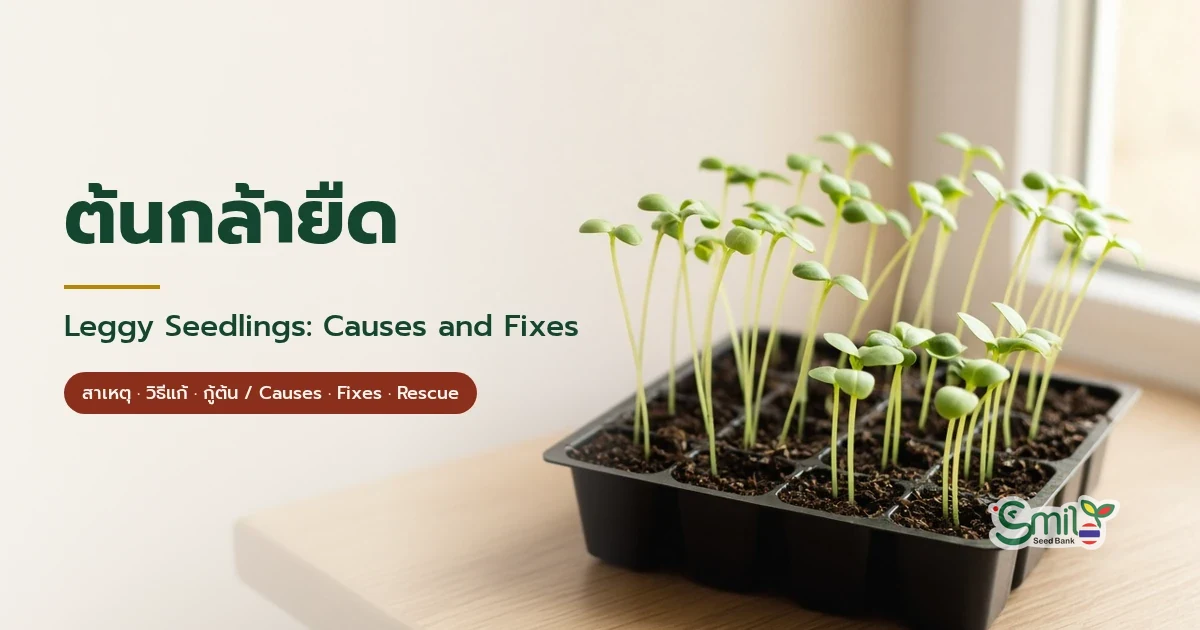
For a few days the tray looked great: everything was shooting up fast. Then one morning you notice the seedlings are tall but not strong. The stem below the seed leaves is long and thin like a giraffe's neck, paler than it should be, and the whole tray leans towards the window. Every time you water, they wobble.
The explanation you hear most at this time of year is "it's the cool season, the days are shorter, so they stretch." It sounds reasonable. This article puts that claim on trial for Thailand, then works through the likelier suspects: light, heat, crowding, water and fertiliser, and a lack of wind or touch. It ends with how to rescue seedlings that have already stretched: what works, and what doesn't.
A leggy seedling isn't sick. It's escaping shade
Before fixing it, it helps to know what the seedling is "thinking". UNH Extension explains that when a seed germinates in low light, the seedling "thinks" it is under a canopy of competing leaves, so it elongates its stem to try to reach the sun. In seedlings this looks like stretched, thin plants with lots of space between the leaves.
Source: UNH Extension – Growing Seedlings Under Lights
Scientists call this shade avoidance. Casal's (2012) review explains that at the seedling stage, shade light signals promote extension of the hypocotyl (the stem below the seed leaves), lifting the cotyledons higher, and that light gradients between bright and shaded areas bend the stem towards the illuminated side. That is why a windowsill tray leans one way.
Source: Casal (2012) – Shade Avoidance, The Arabidopsis Book (PMC)
One thing to know from the start: UNH Extension says that once a stem has stretched, adding light will not shrink it back down, but it may prevent further stretch. So this article has two goals: stop more stretching, and get the stretched seedlings through safely.
Source: UNH Extension – Growing Seedlings Under Lights
Quick check: is it really leggy, or something else?
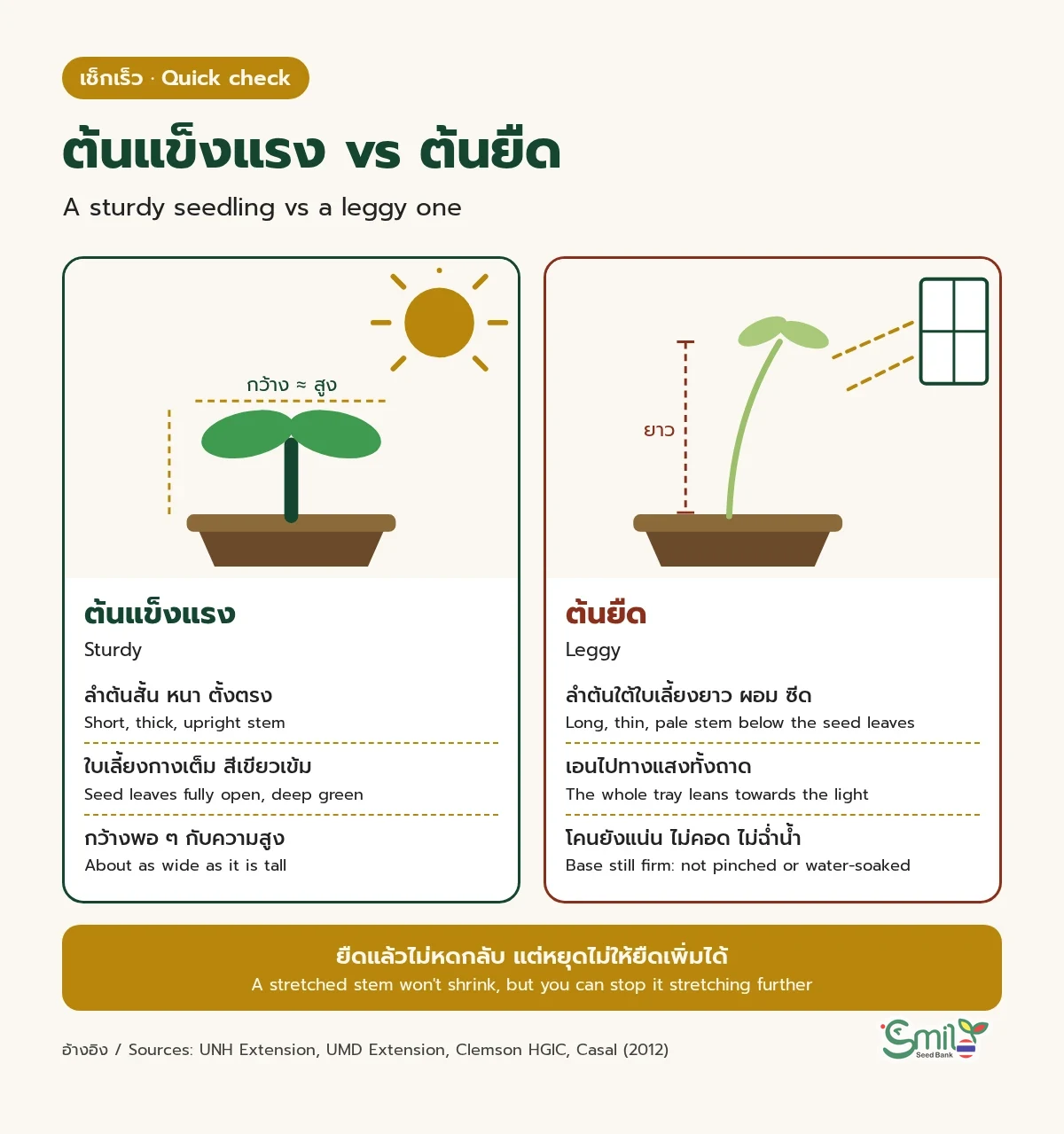
UMD Extension gives a simple picture of a good transplant: about as wide as it is tall. It says window light is seldom enough, so stems usually stretch and lean towards the light. Clemson Extension adds that under low light, seedlings become leggy, weak, and tend to topple over when they are a few inches tall.
Source: UMD Extension – Care of Vegetable Seedlings · Clemson HGIC – Starting Seeds Indoors
A short checklist:
The stem below the seed leaves is longer than it should be, thin and pale
The whole tray leans the same way, towards the light
Seed leaves are small and not fully open
A little water or a breeze knocks them over
Be careful with the last one, because a leggy seedling that falls over and one killed by disease can look alike. If the stem is pinched, water-soaked and brown at the soil line, and seedlings fall in groups that spread to their neighbours, that's not just legginess. It's likely damping-off, which we cover in detail in our damping-off article. A seedling that is leggy from low light still has a firm stem; it's just too thin and too tall.
On trial: "Short cool-season days make seedlings stretch"
The case for the prosecution
The days are getting shorter. Thai PBS, citing Thailand's National Astronomical Research Institute (NARIT), reports that from September the sky gets dark earlier and earlier until the winter solstice, the shortest day of the year. In Bangkok the sun rises at about 06:36 and sets at about 17:55, about 11 hours 19 minutes of daytime.
Source: Thai PBS Sci & Tech – Winter solstice 21 Dec 2025 (NARIT data, in Thai)
The case for the defence
Compare that with the equinox, when day and night are equal, as NARIT explains in a Thai science ministry news item: roughly 12 hours of daytime. Putting those two figures side by side, Bangkok's shortest day is less than an hour shorter than the equinox (that comparison is ours, from the two sources).
More importantly, UNH Extension explains that what a seedling needs is the total amount of light per day (the Daily Light Integral), not just the number of hours. A tomato seedling may fill its daily light need in about five hours of full sun, but might need about 22 hours under fluorescent lights, because the sun puts out far more light. UNH also says daylength mostly relates to flowering and isn't terribly important for producing most seedlings.
Source: UNH Extension – Growing Seedlings Under Lights
The verdict (for now)
My guess: shorter days are probably not the main cause of leggy seedlings in Thailand. The day shortens by less than an hour, while the gap between open sun and a spot indoors is far bigger. The likelier suspects are where the tray sits and how overcast it is. The Thai Meteorological Department expects heavy rain in the South to continue into early January, and Thailand's Highland Research and Development Institute (HRDI) notes that under overcast skies plants photosynthesise less and become weaker.
Source: Thai Meteorological Department – Seasonal outlook (cool season 2026–27) · HRDI – Vegetable diseases to watch in the rainy season (in Thai)
The likelier suspects: five dials you can turn
Iowa State Extension lists the factors behind tall, spindly transplants: insufficient light, excessive watering, high temperatures, excessive fertilisation and crowding. UConn Extension says much the same: leggy transplants can come from low light, overwatering, over-fertilising, or being held longer than planned. So think of it as five dials.
Source: Iowa State Extension – Tall, spindly seedlings · UConn Extension – Managing Plant Height of Vegetable Transplants
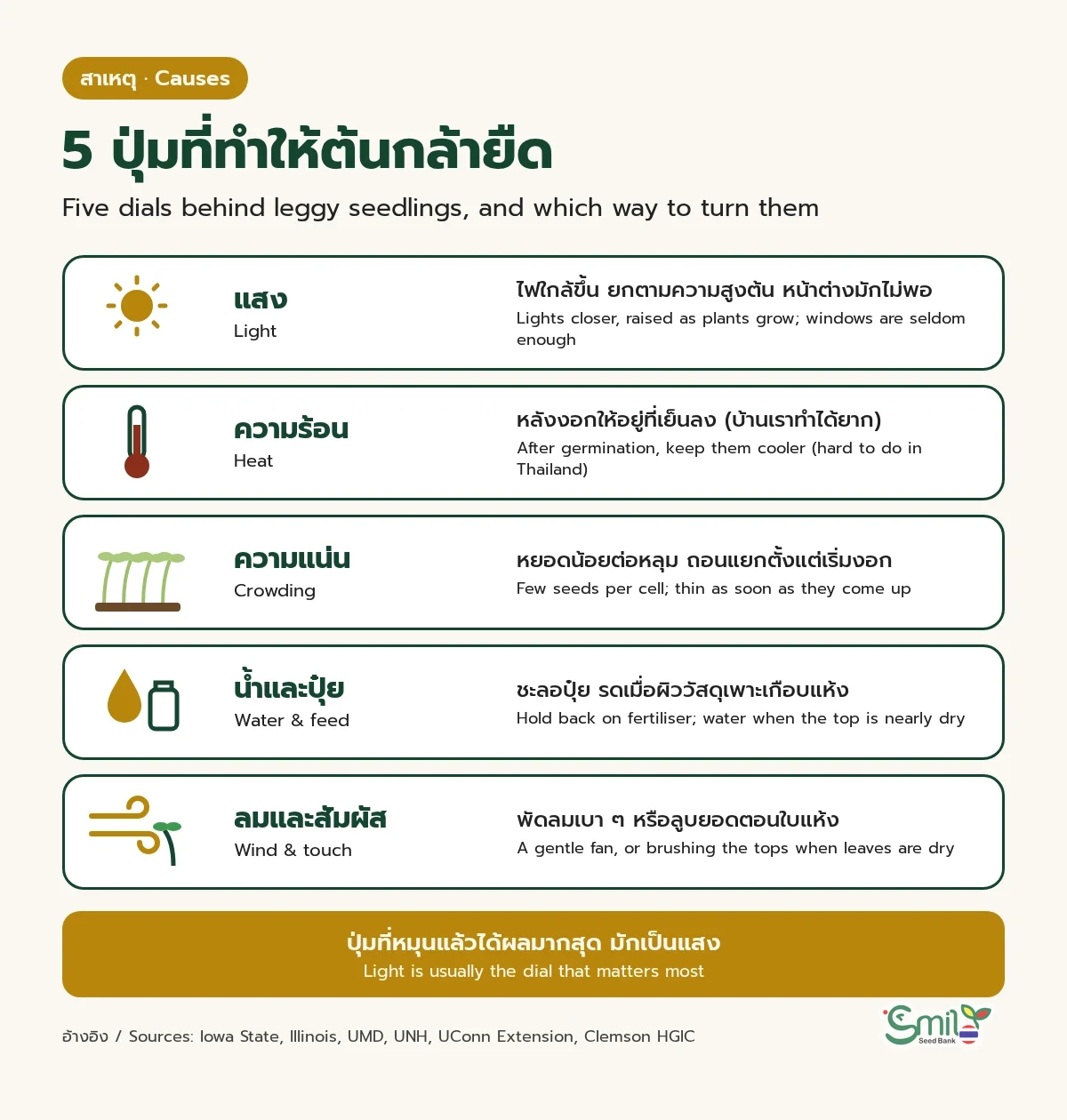
Dial 1: Light (strong enough? close enough?)
Illinois Extension says insufficient light, in both duration and intensity, is the most common cause. If you use lights and seedlings still stretch, check the lights aren't too far away, and remember that fluorescent tubes lose brightness as they age. UMD Extension says window light is seldom enough for good, strong seedling growth.
Source: Illinois Extension – What's wrong with my seedlings? · UMD Extension – Care of Vegetable Seedlings
UNH Extension stresses that light intensity drops rapidly as the source moves away. One LED light bar it tested needed about eight hours a day mounted 8 inches above the crop, but about 16 hours mounted 20 inches above. Keeping lights close and raising them as plants grow gets the most out of a fixture.
Source: UNH Extension – Growing Seedlings Under Lights
So how close, and for how long? We read several sources and found that the numbers don't agree.
Source | Light type discussed | Distance above seedlings | Hours per day |
|---|---|---|---|
UMD Extension | Fluorescent | 1–2 in (about 2.5–5 cm) | 14–16 |
Illinois Extension | Fluorescent | 2–4 in (about 5–10 cm) | Not stated |
Clemson Extension | Fluorescent (natural plus artificial light) | 2–4 in (about 5–10 cm) | 16–18 |
Iowa State Extension | Fluorescent | No more than 4–6 in (about 10–15 cm) | 12–14 |
UNH Extension | One tested LED light bar (example) | 8 in vs 20 in | About 8 vs about 16 (same daily light) |
Source: UMD Extension – Care of Vegetable Seedlings · Illinois Extension – What's wrong with my seedlings? · Clemson HGIC – Starting Seeds Indoors · Iowa State Extension – Tall, spindly seedlings · UNH Extension – Growing Seedlings Under Lights
What they all agree on: lights need to be closer than most people think, and the farther away they are, the longer they must run. Most of these figures are for fluorescent tubes in the US; LEDs vary a lot by model. Without a light meter, UNH says to let the plants tell you: if they're still stretching, they need more light. My guess: with an LED, start from that model's maker guidance and watch the seedlings, rather than relying on this table.
Source: UNH Extension – Growing Seedlings Under Lights
Dial 2: Heat
Iowa State Extension counts high temperatures among the causes and advises moving seedlings somewhere cooler right after germination. UMD Extension gives figures: after germination, about 55–60°F at night (about 13–16°C) and 65–70°F by day (about 18–21°C).
Source: Iowa State Extension – Tall, spindly seedlings · UMD Extension – Care of Vegetable Seedlings
Basic research points the same way. A review in The Plant Cell sums it up: higher light intensity inhibits hypocotyl elongation, while warmer temperatures promote it. A review in Stress Biology explains that in the model plant Arabidopsis, raising the temperature from about 22°C to 28°C is enough to trigger hypocotyl elongation. Not sure whether the vegetables and other plants we sow respond as strongly as Arabidopsis; this work is on a lab model.
Source: Li, Liang & Liu (2021) – The Plant Cell (PMC) · Wang & Zhu (2022) – Stress Biology (PMC)
Dial 3: Crowding
Illinois Extension explains that when many seedlings share a cell or pot, they compete for light and stretch, so sow only a few seeds per cell and thin once they germinate. UConn Extension adds that giving plants enough space helps prevent a drop in light levels.
Source: Illinois Extension – What's wrong with my seedlings? · UConn Extension – Managing Plant Height of Vegetable Transplants
Dial 4: Water and fertiliser
UMD Extension says to hold back on fertilising, since most potting mixes already contain enough to grow a seedling for a while, and to water when the top of the mix is nearly dry. UConn Extension says withholding some nutrients can also limit stretch, and that professional growers use cycles of letting the mix dry to manage height, but warns it needs close monitoring because plants can die if wilting goes too far. It's a technique for experienced growers.
Source: UMD Extension – Care of Vegetable Seedlings · UConn Extension – Managing Plant Height of Vegetable Transplants
My guess: if you use a rich mix like Super soil, I wouldn't sow straight into it. Let the Super soil go through บ่มดิน (cook) first, and raise seedlings in a lighter layer such as Base soil or an airy seed mix. That's my own link from the "hold back on fertiliser" advice above; no study has tested this recipe against legginess directly. (More in our Super soil recipe article.)
Dial 5: Wind and touch
A seedling that is never touched grows "too comfortably". UConn Extension explains that mechanical stress such as wind, shaking or brushing reduces stem elongation and improves stem strength, with brushing more effective than wind or shaking. It advises brushing when foliage is dry to reduce disease spread, and warns that tender species such as peppers may be damaged. UMD Extension also suggests gently brushing seedling tops with your hand or a wooden stick to control height. Clemson Extension suggests a fan near the seedlings for a gentle sway once they have two true leaves, while watching moisture because the fan dries them faster.
Source: UConn Extension – Managing Plant Height of Vegetable Transplants · UMD Extension – Care of Vegetable Seedlings · Clemson HGIC – Starting Seeds Indoors
UConn also notes that brushing very small plants increases the chance of damage. Not sure when to start at the seed-leaf stage. For beginners, a gentle fan that isn't aimed straight at the seedlings is probably safer than brushing early on (my guess).
Already stretched: how much can you rescue?
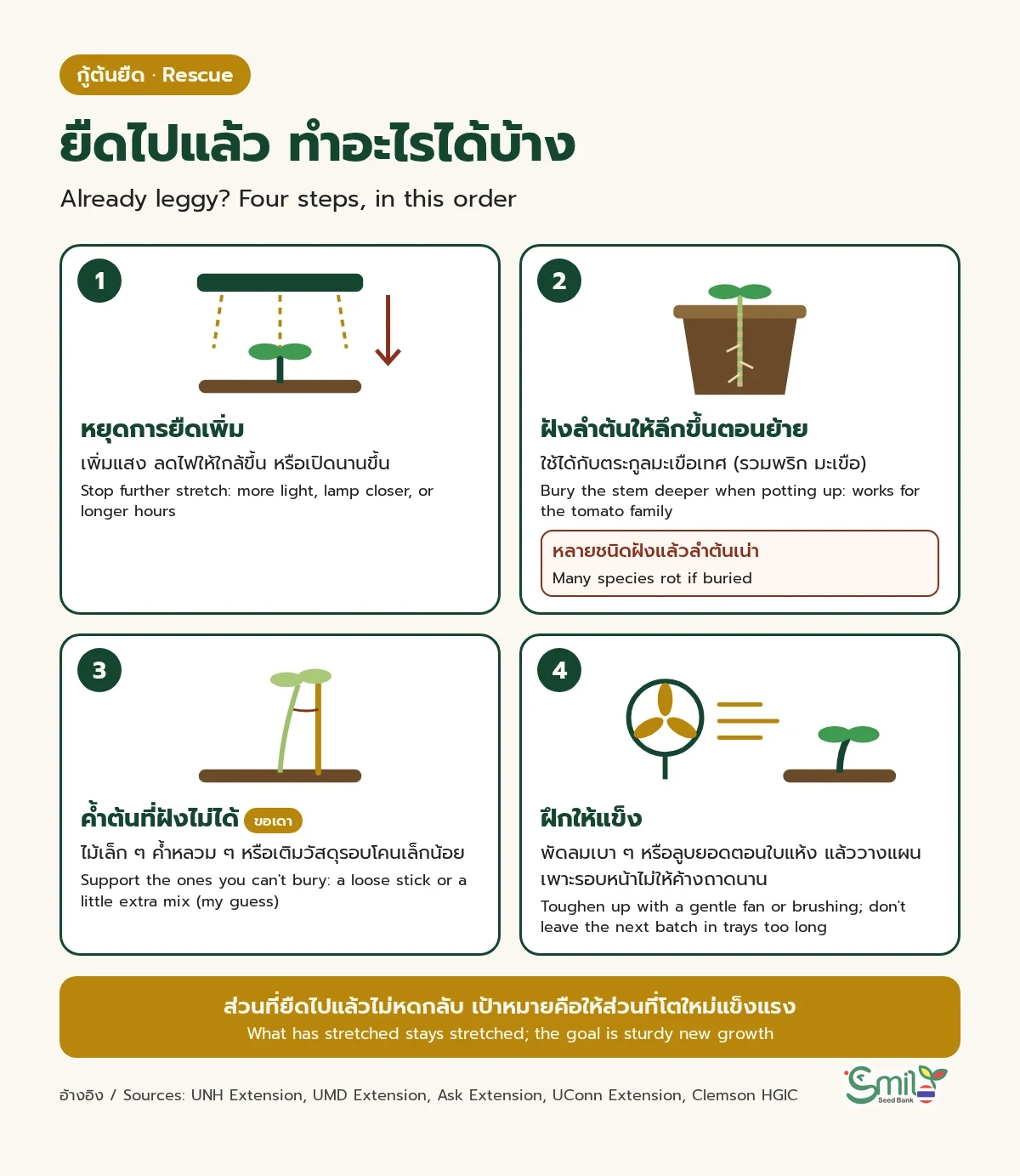
Step 1: Stop further stretching first
As UNH says, stretched length won't shrink, but more light can stop further stretch. Its options: a better lamp, a stronger lamp, more lamps, lowering the lamp closer, or running it longer. On a windowsill, UMD says acceptable growth usually only happens in south-facing bay windows or sunrooms.
Source: UNH Extension – Growing Seedlings Under Lights · UMD Extension – Care of Vegetable Seedlings
Step 2: Bury the stem deeper when potting up (some plants only)
UMD Extension advises that when moving seedlings from the tray into bigger pots, set them so the leaves and growing point sit only slightly above the soil line; most of the stem can be buried. Handle seedlings by their leaves, not their delicate stems. An Ask Extension expert answer says tomato-family plants, including peppers and eggplant, grow new roots from a buried lower stem, but many species can't tolerate it and their buried stems will rot. Stretched seedlings are more fragile and need extra care.
Source: UMD Extension – Care of Vegetable Seedlings · Ask Extension – Leggy Eggplant Seedlings
Not sure which group your plant belongs to? Try burying a few deeper first and watch them for a while (my guess). And because a buried stem in wet mix is exactly where damping-off fungi thrive, I'd use fresh, free-draining mix and avoid soaking after potting up (my guess, linking from our damping-off article).
Step 3: Support the ones you can't bury
My guess: for seedlings that can't be buried deeper, a small stick tied loosely, or a little extra mix around the base so they can stand, should keep them upright while new growth firms up. The sources we read don't test this directly.
Step 4: Toughen them up, and rethink the next sowing
Once light is sorted, a gentle fan or brushing (Dial 5) helps new growth firm up. UConn also warns that starting seeds too early, so plants sit in trays longer than planned, gives overgrown, leggy transplants, and UMD says one of the most common mistakes is leaving seedlings in the seed flat too long.
Source: UConn Extension – Managing Plant Height of Vegetable Transplants · UMD Extension – Care of Vegetable Seedlings
My guess: if a whole tray has stretched so far that it's falling over, and there's still time to sow again, restarting after fixing the light may be quicker than trying to save every seedling.
Common beliefs (that aren't always true)
"Fast and tall means healthy"
Not necessarily. UMD's ideal transplant is as wide as it is tall, not the tallest. A tall, thin, pale seedling is escaping shade.
Source: UMD Extension – Care of Vegetable Seedlings
"Add more light and they'll shrink back"
They won't. UNH is clear that a stretched stem won't shrink; more light only stops further stretch.
Source: UNH Extension – Growing Seedlings Under Lights
"You can bury any leggy stem"
Not every species. Ask Extension says tomato-family plants root from buried stems, but many species rot if buried.
Source: Ask Extension – Leggy Eggplant Seedlings
"Thailand is sunny, so seedlings can't lack light"
The sun is strong outdoors, but a seedling indoors, on a windowsill or under the eaves gets a very different amount of light. UMD says window light is seldom enough, and HRDI notes plants get limited light under overcast skies. (And Thai heat? That's for the ending.)
Source: UMD Extension – Care of Vegetable Seedlings · HRDI – Vegetable diseases to watch in the rainy season (in Thai)
FAQ
Q1: Can a leggy seedling still grow into a good plant?
In some cases. UNH says more light stops further stretch, and Ask Extension says tomato-family plants can be buried deeper when potted up. But stretched seedlings are more fragile and need more care. Not sure whether they catch up with seedlings that never stretched; it depends on the plant and conditions.
Source: UNH Extension – Growing Seedlings Under Lights · Ask Extension – Leggy Eggplant Seedlings
Q2: How far above seedlings should a light be?
Sources give different figures (see the table above). For fluorescent tubes they range from about 1 to 6 inches, and all of them say to raise the light as the plants grow. LEDs vary widely by model; UNH suggests watching the plants: if they're still stretching, they need more light.
Source: UMD Extension – Care of Vegetable Seedlings · Iowa State Extension – Tall, spindly seedlings · UNH Extension – Growing Seedlings Under Lights
Q3: Does a fan really make stems stronger?
UConn says wind, shaking and brushing reduce stretch and strengthen stems, with brushing the most effective. Clemson suggests a fan for a gentle sway once seedlings have two true leaves, and watching that the mix doesn't dry out too fast.
Source: UConn Extension – Managing Plant Height of Vegetable Transplants · Clemson HGIC – Starting Seeds Indoors
Q4: How is a leggy seedling different from damping-off?
A leggy seedling is thin, long and pale, but its base is firm. With damping-off the base is pinched, water-soaked and brown, and seedlings tend to collapse in spreading groups. Clemson notes leggy seedlings can topple on their own, so always check the base (more in our damping-off article).
Source: Clemson HGIC – Starting Seeds Indoors
Q5: When does a seedling need support?
The sources we read don't give a clear rule. My guess: if seedlings start falling over when you water, or can't be buried deeper because they aren't tomato-family plants, it's time for a loose support, while also fixing the light, since support doesn't stop stretching.
An ending that isn't finished: what if the light is fine, but it's hot?
By now, the "short days" charge looks weak. But there's another suspect we can't clear yet: heat.
US sources suggest nights of about 13–16°C for seedlings. The Thai Meteorological Department expects this cool season's average minimum in upper Thailand to be about 22–23°C, about 2°C above normal and less cold than last year. So even in the cool season, most of our nights are warmer than cold-climate guides recommend, and basic research says warmth promotes stretching.
Source: UMD Extension – Care of Vegetable Seedlings · Thai Meteorological Department – Seasonal outlook (cool season 2026–27) · Li, Liang & Liu (2021) – The Plant Cell (PMC)
And there's a twist. UConn Extension explains DIF, the difference between day and night temperatures. When days are much warmer than nights (positive DIF), plants stretch more; when days are cooler than nights (negative DIF), they stay more compact, and some growers get a similar effect with a brief cool drop at dawn. So a northern Thai cool season, with warm days and cooler nights, could be good news (cooler nights) and bad news (a wider day-night gap) at the same time.
Source: UConn Extension – Managing Plant Height of Vegetable Transplants
I don't know which force wins in Thai homes, and I haven't found a study that measures this in home seed trays here. If you'd like to help find out, try a small experiment: sow the same seed in two cups, put one in the brightest spot you can find and the other indoors, and photograph them side by side every few days. Are your seedlings stretching because it's "dark", or because it's "hot"? Send us your photos. The answer for our climate might be on your balcony.
Sources
University of Maryland Extension. Care of Vegetable Seedlings (updated 20 Feb 2023). https://www.extension.umd.edu/resource/care-vegetable-seedlings
Johnson, K. University of Illinois Extension. What's wrong with my seedlings? Troubleshooting seed starting problems (25 Feb 2022). https://extension.illinois.edu/blogs/good-growing/2022-02-25-whats-wrong-my-seedlings-troubleshooting-seed-starting-problems
Iowa State University Extension and Outreach, Yard and Garden. The flower and vegetable plants that I started indoors getting tall and spindly. Why? (updated 26 Feb 2022). https://yardandgarden.extension.iastate.edu/faq/flower-and-vegetable-plants-i-started-indoors-getting-tall-and-spindly-why
Clemson Cooperative Extension HGIC. Starting Seeds Indoors. https://hgic.clemson.edu/factsheet/starting-seeds-indoors/
University of New Hampshire Extension. Growing Seedlings Under Lights [Fact Sheet]. https://extension.unh.edu/resource/growing-seedlings-under-lights-fact-sheet
Pundt, L. UConn Extension IPM. Managing Plant Height of Vegetable Transplants (2018, revised 2024). https://ipm.cahnr.uconn.edu/managing-plant-height-of-vegetable-transplants/
Ask Extension. Leggy Eggplant Seedlings. https://ask.extension.org/kb/faq.php?id=312010
Casal, J. J. (2012). Shade Avoidance. The Arabidopsis Book. https://pmc.ncbi.nlm.nih.gov/articles/PMC3350169/
Li, X., Liang, T., & Liu, H. (2021). How plants coordinate their development in response to light and temperature signals. The Plant Cell. https://pmc.ncbi.nlm.nih.gov/articles/PMC8894937/
Wang, Q., & Zhu, Z. (2022). Light signaling-mediated growth plasticity in Arabidopsis grown under high-temperature conditions. Stress Biology. https://pmc.ncbi.nlm.nih.gov/articles/PMC10441904/
Thai PBS Sci & Tech (NARIT data). Winter solstice, 21 Dec 2025 (in Thai). https://www.thaipbs.or.th/sciandtech/tech/3477
Thai Ministry of Higher Education, Science, Research and Innovation (NARIT data) (2018). Vernal equinox: day and night equal (in Thai). https://iptv.mhesi.go.th/site/news/detail/314
Thai Meteorological Department (2026). Cool-season outlook for Thailand 2026 (issued 9 Oct 2026, in Thai). https://www5.tmd.go.th/forecast/seasonal
Highland Research and Development Institute (2024). Vegetable diseases to watch in the rainy season (in Thai). https://hkm.hrdi.or.th/Knowledge/detail/697
This article is for education and general information about raising seedlings only. It is based on the sources cited at the time of writing, and the information may change.