Indica vs Sativa vs Hybrid: Is There a Real Difference?
Where did Indica, Sativa and Hybrid labels come from, and how much does science trust them? Here's what beginner growers should really read on a seed label.
Picture this: you're scrolling a seed shop, and every listing shouts "Indica!", "Sativa!", "Hybrid!" You squint and wonder, "Are these real categories, or just stickers that sound cool?" Good news: you're in excellent company. Scientists have been arguing about this for years.
In this guide we'll trace where the words came from, what modern genetics says, and what beginner growers should actually read on a seed label to plan a grow.
Where Did "Indica" and "Sativa" Come From?
An 18th-century botany story
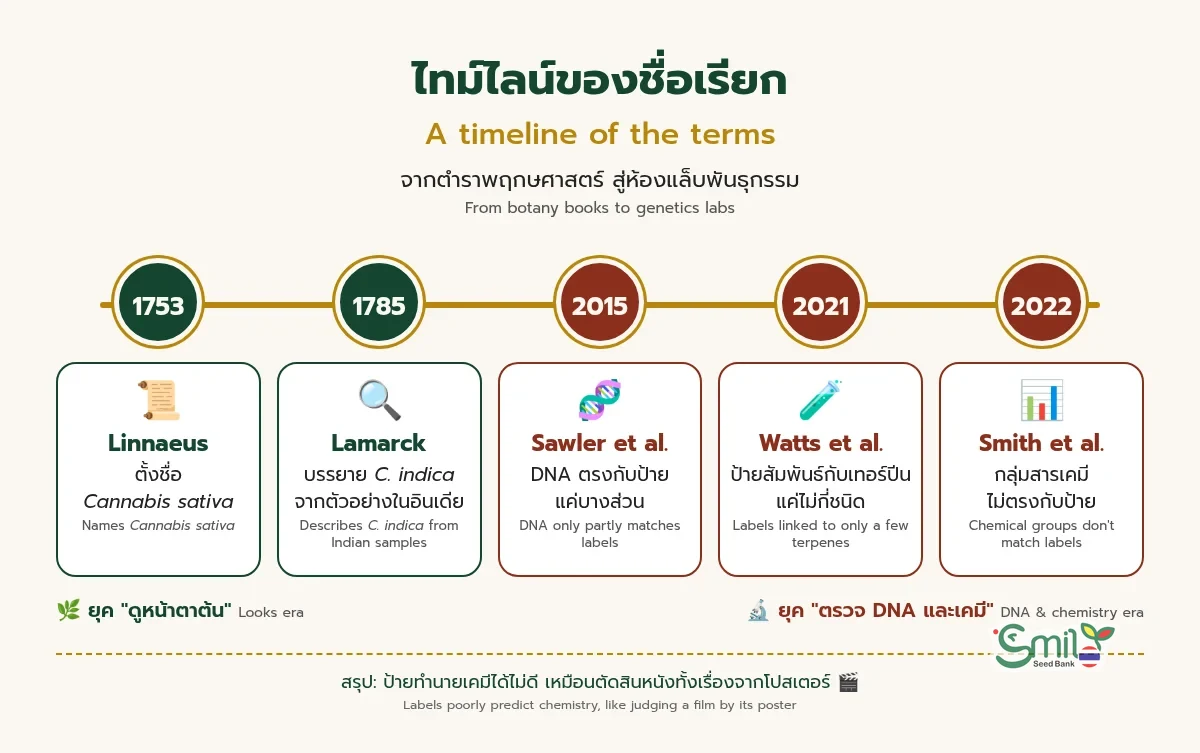
Linnaeus named Cannabis sativa in 1753. In 1785, Lamarck described plants collected in India as Cannabis indica, because they looked different from the hemp grown in Europe, in overall form and leaf shape (McPartland, 2018; Pollio, 2016).
In short: the words started as descriptions of what plants looked like, not what was inside them.
How the meanings drifted
Botanists still debate whether Cannabis is one variable species or several. Meanwhile, growers adopted "Indica/Sativa" with their own meanings, so today's labels no longer match the original botanical split (McPartland, 2018). Think of it like "artisan bread": a useful word, but you still have to check the recipe.
The Classic Picture: Traditional Growth Traits
This table summarises the traditional grower stereotypes. These are general tendencies only; real cultivars often break the rules.
Trait | Indica (traditional) | Sativa (traditional) | Hybrid |
|---|---|---|---|
Leaflets | Broad, short, darker green | Narrow, long, lighter green | In between, depends on parents |
Height / structure | Short, compact, bushy | Tall, stretchy, wider node spacing | Varies widely |
Flowering length | Often shorter | Often longer | Varies widely |
Traditional origin climate | Cooler, mountainous regions (e.g. Central/South Asia) | Tropical, near-equatorial regions | Human-made crosses |
Planning fit | Limited space, low ceilings | Tall spaces, patience required | Check cultivar-specific data |
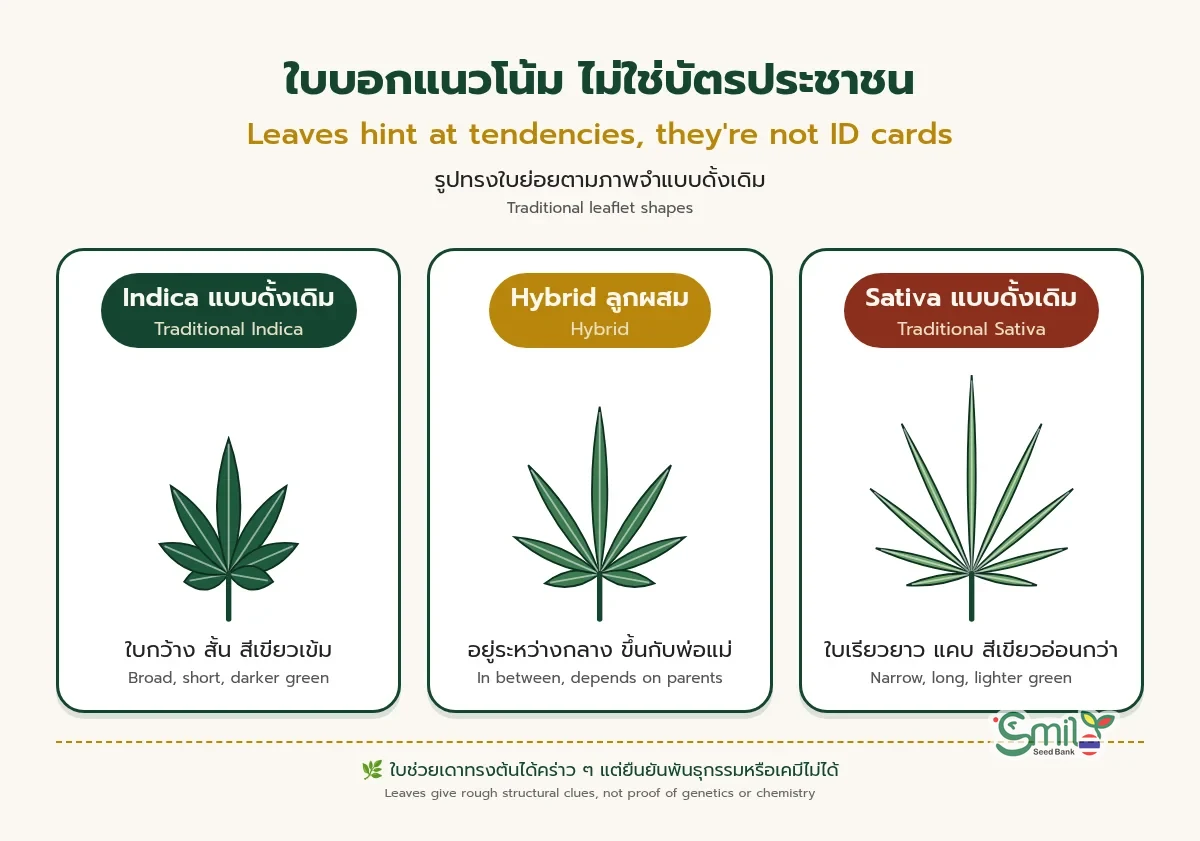
💡 Quick Tip: Use this table as a rough map, never as a substitute for the breeder's actual cultivar data.
What Modern Science Says
DNA doesn't always agree with the label
Sawler et al. (2015) genotyped many Cannabis samples. Hemp and marijuana-type plants separated clearly, but commercial "Sativa" and "Indica" labels matched genetic ancestry only partially, and samples sharing a name could differ genetically (Sawler et al., 2015).
Labels poorly predict chemistry
Watts et al. (2021) studied a large set of commercial samples and found Indica/Sativa labels were associated with only a handful of terpenes and did not reliably reflect overall chemical makeup. They recommend describing plants by measured chemistry instead (Watts et al., 2021).
Smith et al. (2022) analysed lab data from commercial US Cannabis and found samples grouped into a small number of chemical profiles that did not line up with the Indica/Sativa/Hybrid labels attached to them (Smith et al., 2022).
The chemistry is complicated
Cannabis produces a remarkable range of compounds, including cannabinoids, terpenes and more (Andre et al., 2016). Summing that up with one word is like reviewing a whole film from its poster.
So Why Do Growers Still Use These Words?
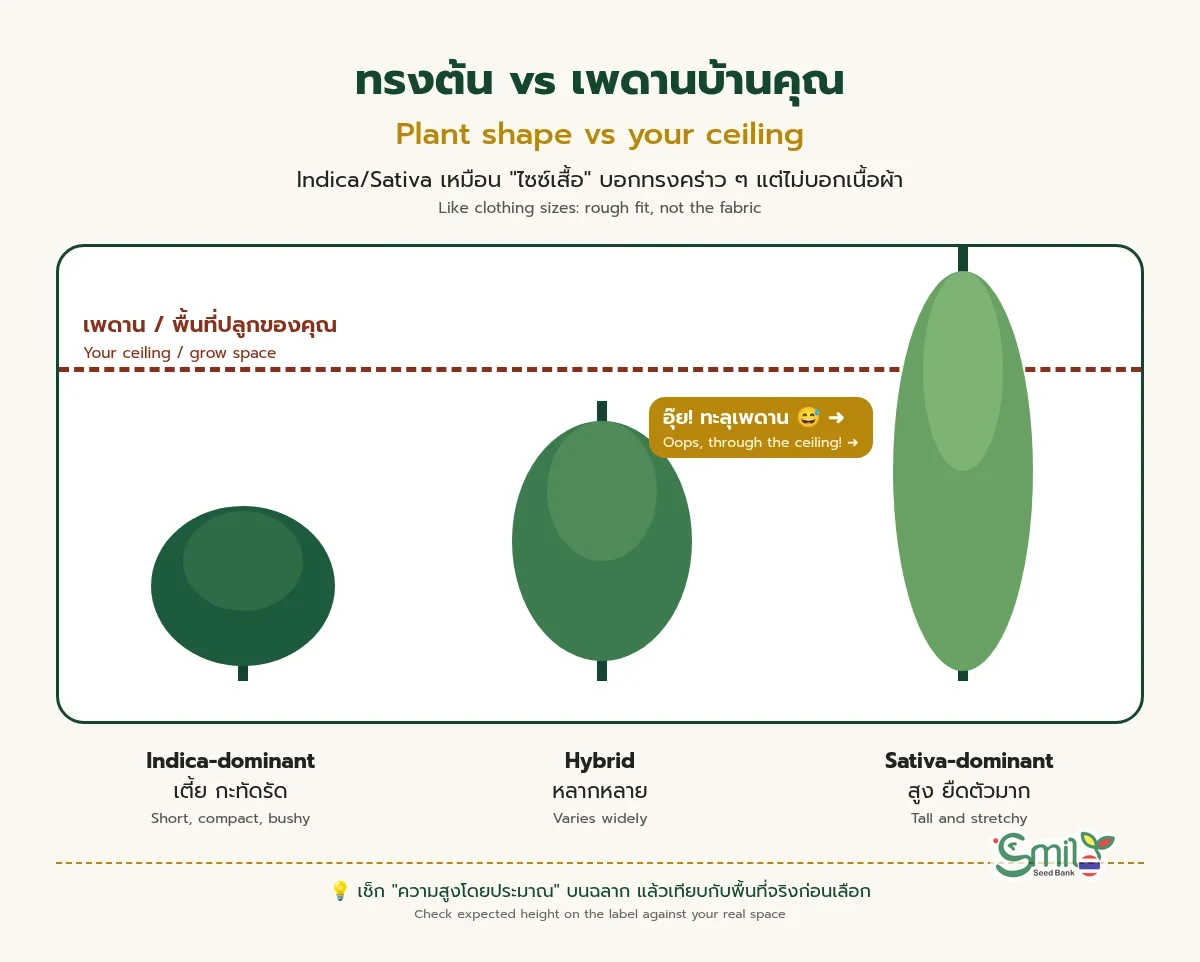
Because for growing, they still hint at structure. A cultivar marked "Indica-dominant" has often been selected for compact growth; a "Sativa-dominant" one tends to stretch taller and flower longer. That helps you plan space, ceiling height and training.
Bottom line: the terms are handy for talking about plant shape, not for predicting chemistry.
💡 Quick Tip: Treat Indica/Sativa like clothing sizes: they tell you the rough fit, not the fabric.
Hybrids Rule: Why Most Modern Cultivars Are Crosses
Breeders have been crossing lines for decades, so most commercial cultivars now carry mixed ancestry (Sawler et al., 2015; McPartland, 2018). Even "pure" labels usually hide a mixed family tree. "Hybrid" isn't an exact midpoint; it's a broad spectrum.
What to Actually Read on a Seed Label
Instead of stopping at the three-word label, check:
Flowering time for scheduling your grow cycle
Expected height compared with your real space and ceiling
Indoor / outdoor suitability and preferred climate
Seed type: photoperiod or autoflower, feminized or regular
Chemical/terpene info, if the breeder provides it; it tells you more than Indica/Sativa
Genetics / lineage to estimate structural tendencies
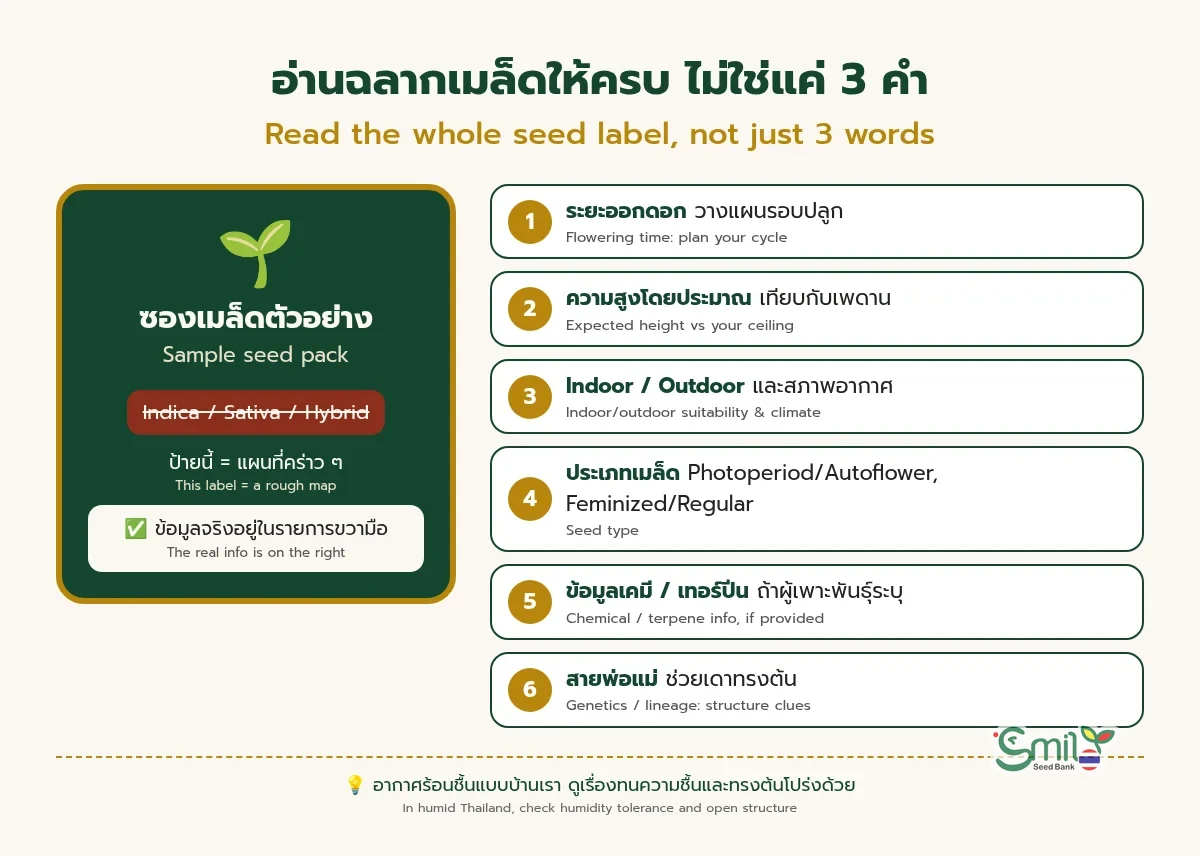
💡 Quick Tip: In a hot, humid climate like Thailand's, look for notes on humidity tolerance and an open structure that lets air move.
Common Misconceptions (We've All Been There)
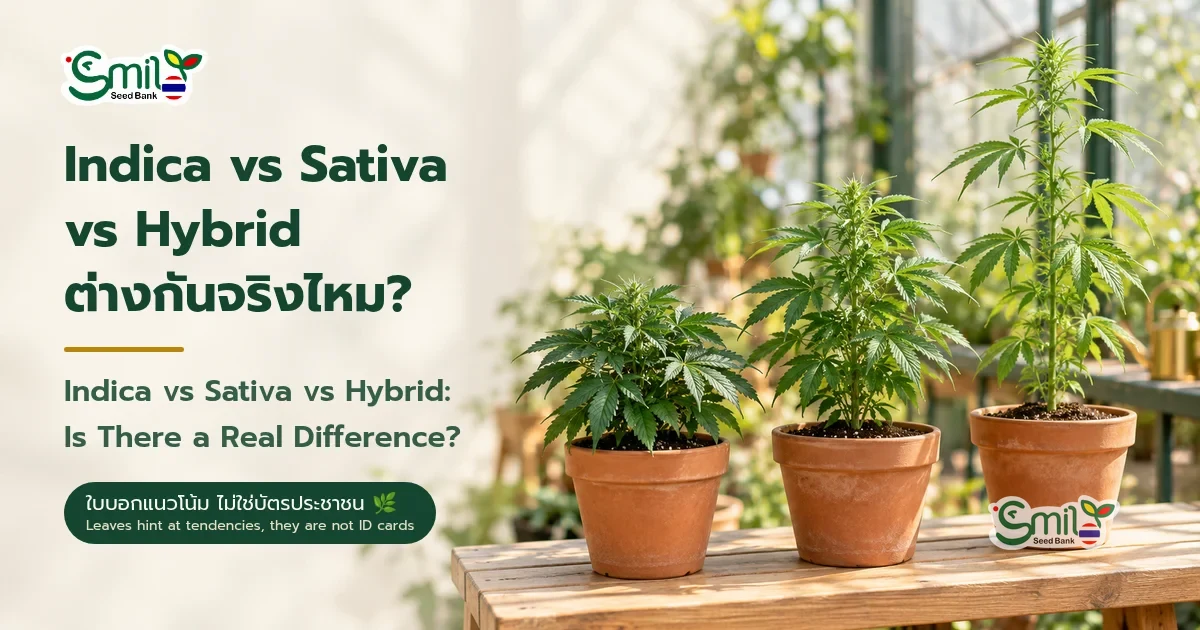
"Broad leaves = 100% pure Indica." Leaves hint at tendencies, not pedigree. Plants don't carry ID cards.
"The label tells you the effect." Commonly claimed effects are not reliably predicted by labels, according to the research above.
"Hybrid always means 50/50." Nope. It can lean either way or be layered so many times that splitting it is meaningless.
"Same name = same plant everywhere." Research found same-named samples from different sources can differ genetically (Sawler et al., 2015).
FAQ
1. Are Indica and Sativa separate species?
Still debated. Many botanists treat Cannabis as one highly variable species (McPartland, 2018).
2. Can I identify the type from the leaves?
You can see rough structural tendencies, but not confirm genetics or chemistry.
3. Should a beginner choose Indica, Sativa or Hybrid?
Start from your space and time, then read height and flowering time on the label rather than relying on the three labels.
4. What does "Sativa-dominant" mean?
A hybrid the breeder describes as leaning toward Sativa-type traits, such as taller growth and longer flowering. Check the other label data too.
5. Why is terpene info on a label useful?
It's closer to real chemical data than a category label, helping you compare cultivars botanically and for collecting.
Summary
Indica and Sativa began as botanical descriptions of plant appearance. Today they still help with conversations about structure and space planning, but modern genetics shows they predict chemistry poorly, and most cultivars are hybrids anyway. Read the whole label: flowering time, height, indoor/outdoor suitability and chemical info, and you'll choose with far more confidence.
Sources
McPartland, J. M. (2018). Cannabis Systematics at the Levels of Family, Genus, and Species. Cannabis and Cannabinoid Research. https://pmc.ncbi.nlm.nih.gov/articles/PMC6225593/
Pollio, A. (2016). The Name of Cannabis: A Short Guide for Nonbotanists. Cannabis and Cannabinoid Research. https://pmc.ncbi.nlm.nih.gov/articles/PMC5531363/
Sawler, J. et al. (2015). The Genetic Structure of Marijuana and Hemp. PLoS ONE. https://journals.plos.org/plosone/article?id=10.1371/journal.pone.0133292
Watts, S. et al. (2021). Cannabis labelling is associated with genetic variation in terpene synthase genes. Nature Plants. https://www.nature.com/articles/s41477-021-01003-y
Smith, C. J. et al. (2022). The phytochemical diversity of commercial Cannabis in the United States. PLoS ONE. https://journals.plos.org/plosone/article?id=10.1371/journal.pone.0267498
Andre, C. M. et al. (2016). Cannabis sativa: The Plant of the Thousand and One Molecules. Frontiers in Plant Science. https://www.frontiersin.org/articles/10.3389/fpls.2016.00019/full
⚠️ Disclaimer: Smile Seed Bank seeds are sold for collection and educational purposes only, to customers aged 20 and over. Buyers are responsible for checking the laws in their own location. The shop accepts no responsibility for any unlawful use. This article is for general educational information only.