How to Germinate Cannabis Seeds: 3 Beginner Methods and the Myths That Trip People Up
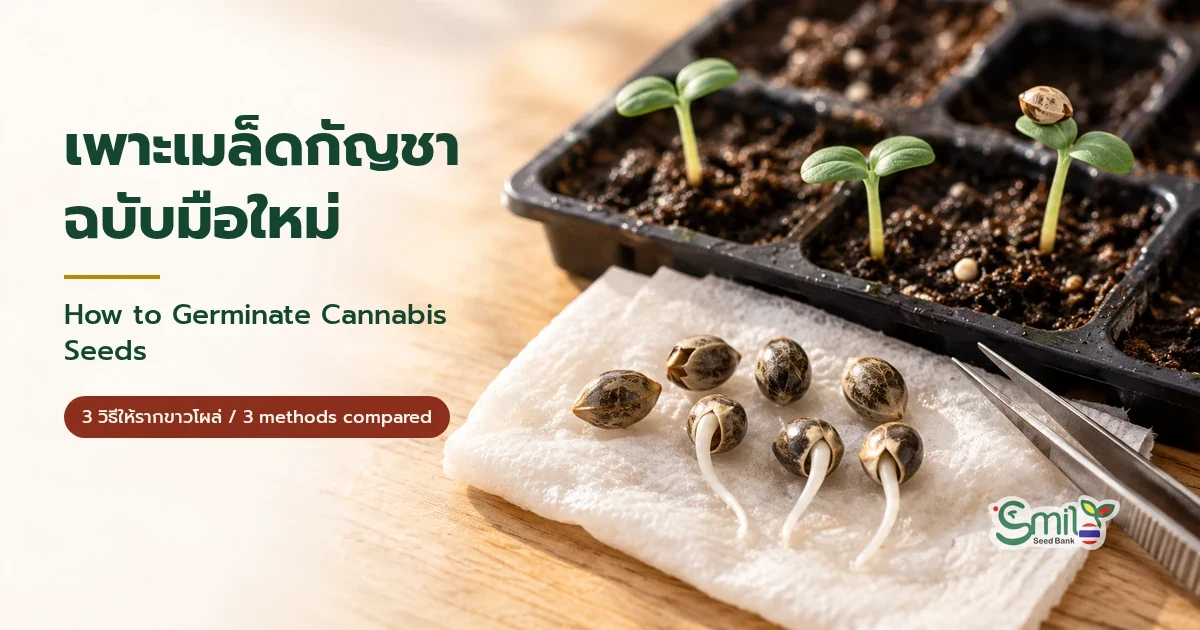
A cannabis seed isn't much bigger than a peppercorn. It's hard, dry and completely still, as if nothing were alive inside. Yet curled up in there is a tiny embryo, root and seed leaves included, waiting. The interesting part is that it doesn't "wake up" because we tell it to. It wakes up only when it gets the right signals.
So what are those signals? Why do some people put seeds on a paper towel and see a white root within a few days, while others wait a week and get nothing but mould? Let's peel this back one layer at a time, using what research papers and university guides actually say, and keeping a clear line between the evidence and my own guesses.
Before you start: always check current Thai law
Thailand's cannabis rules have changed several times. This section summarises the cited sources as of the date I checked them, 17 October 2026, and the rules may change again. Before you do anything, check the current regulations directly with the government agencies.
The 2025 Ministry of Public Health notification: The Division of Medical Cannabis at the Department of Thai Traditional and Alternative Medicine (DTAM) summarises that the Ministry of Public Health Notification on Controlled Herbs (Cannabis) B.E. 2568 (2025) makes only the "inflorescence" (flower) of cannabis a controlled herb. It repeals the earlier 2022 notification, requires a licence for research, export or commercial processing, and bans sales through electronic channels and vending machines.
Source: DTAM Division of Medical Cannabis – MOPH Notification on Controlled Herbs (Cannabis) B.E. 2568
Thai PBS reported that the notification was published in the Royal Gazette on 25 June 2025 and took effect on 26 June 2025.
On growing: The Division of Medical Cannabis FAQ page (which refers to the new 2026 ministerial regulation) answers the question "Do I need permission to grow cannabis plants?" for members of the public: no permission is needed, regardless of the number of plants, but a grower who intends to sell cannabis flowers must first obtain a licence to sell or process.
Source: DTAM Division of Medical Cannabis – FAQ (Thai)
What may change: Thai PBS reported that on 22 September 2026 the Cabinet approved a draft Cannabis Control Act, which will go to the House of Representatives. The Minister of Public Health said it would regulate from the cultivation site onwards, with growing sites required to register, and with clearer penalties.
Source: Thai PBS – Cabinet approves draft cannabis act, tightening cultivation sites and penalties (Thai)
Not sure: At the time of writing, this draft is not yet law. I'm not sure how the final version will treat home growing, or when it would take effect. If you plan to germinate seeds, please check again with DTAM (in Bangkok) or your Provincial Public Health Office.
The rest of this article is pure germination biology. Let's go.
What a seed needs before it "wakes up"
Water: the first switch
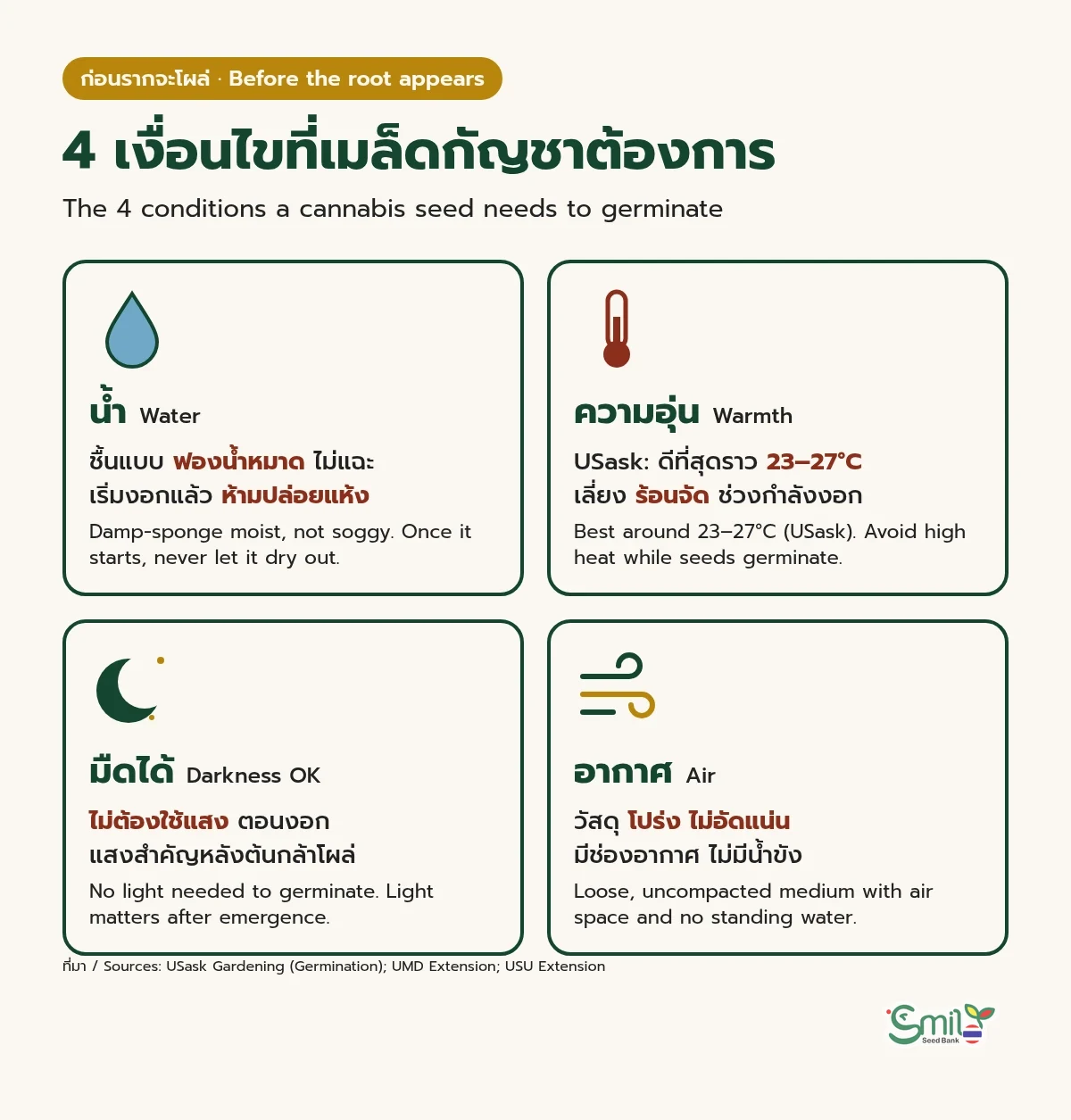
USask (College of Agriculture and Bioresources, University of Saskatchewan) explains that cannabis germination happens when the seed opens and the first root, the radicle, emerges. This becomes the taproot, which grows down into the medium and starts producing secondary roots and root hairs. Water is required to start germination, because hormones and enzymes in the seed need to absorb water to become active, and once germination has begun, the seed must not dry out.
Source: USask Gardening – Germination (cannabis)
The moisture level USask recommends is "moist but not soaking wet, like a damp sponge", so the roots get enough water without drowning.
Source: USask Gardening – Germination (cannabis)
Warmth: steady, not scorching
USask states that cannabis seeds germinate best at about 23–27°C.
Source: USask Gardening – Germination (cannabis)
A University of Kentucky study of two industrial hemp (Cannabis sativa) cultivars found the optimal germination range to be roughly 19–30°C. Even more interesting was a seedling-tray experiment: seeds sown and held at 35°C from the start produced fewer emerged seedlings, but seeds held at a favourable temperature for two days before moving to 35°C did not. The authors concluded that germination itself, rather than seedling growth, was the stage most sensitive to high temperature. They also noted that temperature responses may vary between cultivars.
Source: Geneve et al. (2022), Crops – Temperature Limits for Seed Germination in Industrial Hemp · Full text (PDF)
My guess: in Thai homes, I suspect the more common problem is "too hot" rather than "too cold", for example a germination box left by a window that catches the afternoon sun, or a room shut up all day in the hot season. I don't have measurements to confirm this.
Dark or light: seeds don't need light to germinate
USask is clear that light is not required for cannabis seeds to germinate. If they are viable, they will germinate regardless of light. That's why the paper-towel method uses a warm, dark place. Once seeds are planted in the medium, keep light low to moderate until the seedlings emerge.
Source: USask Gardening – Germination (cannabis)
Air: seeds breathe too
UMD Extension explains that seeds need both air and moisture to germinate, and that compacted or crusted soil can prevent germination and emergence. USU Extension warns, for the seedling stage, that keeping roots too wet deprives them of oxygen.
Source: UMD Extension – Poor Germination of Vegetable Seeds · USU Extension – Seedling Culture and Transplanting
3 ways to germinate cannabis seeds
Method 1: Soaking in water
USask suggests soaking seeds in water for 12–16 hours (start in the evening and they're ready by morning) and not longer than 24 hours, as this can damage the seedling. After soaking, plant them about 1 cm deep. If any radicles have already emerged, take extra care not to damage them and point them downwards. Cover, place under moderate light, and keep the medium near the seed moist until the seedling emerges.
Source: USask Gardening – Germination (cannabis)
My guess: I see soaking as a "first step" rather than a complete method, because the sources above soak first and then plant or move on to a paper towel. None of them suggest leaving seeds in water until the root is long.
Method 2: The paper-towel method
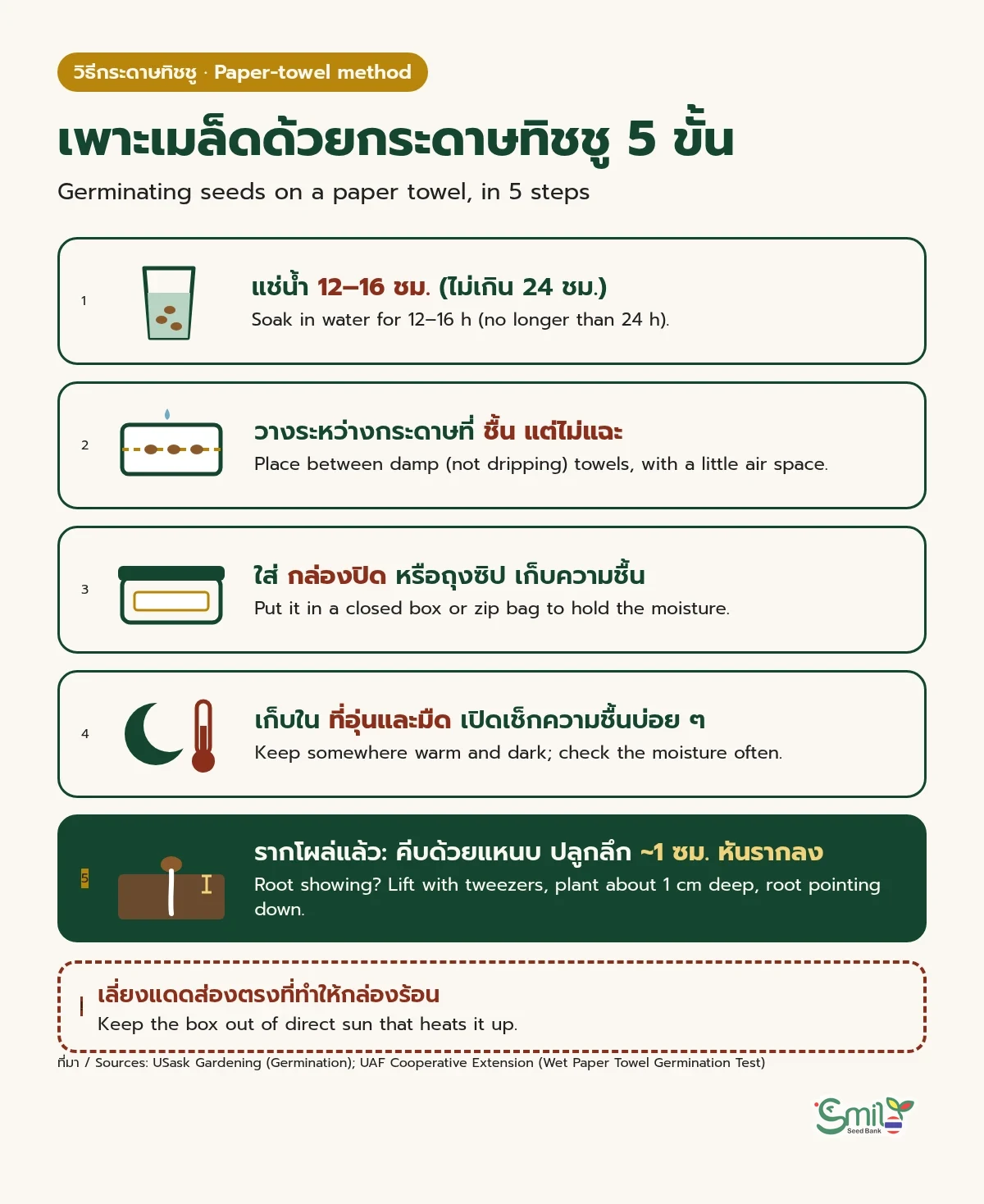
USask describes this as a common way to confirm seeds are viable before planting, much like a baker proofs yeast before making bread. The steps:
Soak the seeds as in Method 1.
Place them between folded paper towel and moisten it, but don't soak it.
Put it in a closed container or zip-lock bag (two dinner plates on top of each other also work).
Keep it somewhere warm and dark, checking often so the towel stays damp but not wet.
When the taproot appears, pick the seed up gently with tweezers and plant it about 1 cm deep, taproot pointing down. Cover, place under low to moderate light, and water lightly, keeping the medium moist but not soaked until emergence.
Source: USask Gardening – Germination (cannabis)
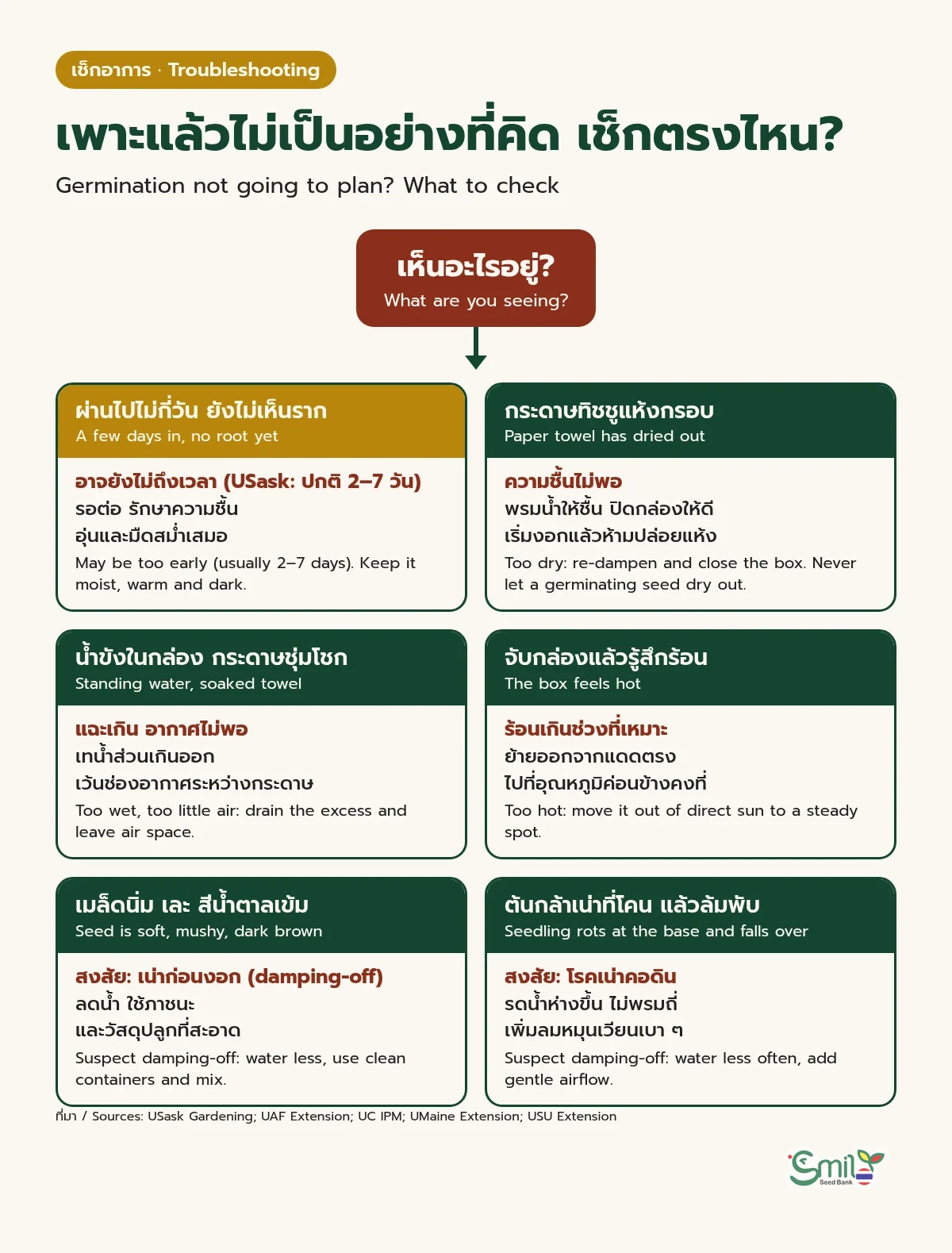
UAF Extension's wet-paper-towel germination test (written for seeds in general) adds useful detail: dampen the towel thoroughly but not to the point of runoff or dripping; there should be air space between the two towels, and if there isn't, remove the excess water; keep the container somewhere with a fairly stable temperature, avoiding direct sunlight that heats it; and unwrap carefully, because the shoots are fragile.
Source: UAF Cooperative Extension – Procedures for the Wet Paper Towel Germination Test
One hemp study (using seeds with the pericarp removed, from low-germinating lots) found that seeds first germinated on rolled towels for 2–3 days produced more normal seedlings after transplanting than those started in Petri dishes, and that a dish wetted with more water produced a dramatic increase in abnormal seedlings.
My guess: that result comes from lab conditions and de-hulled seeds, so it can't be applied directly to whole seeds at home. Still, I read it as consistent with "moist, not soggy" and "seeds need air".
Method 3: Direct to soil or plug
USask recommends placing seeds about 1 cm deep in your prepared medium, covering lightly and watering conservatively so the medium stays consistently moist but not soaking wet, then placing it under moderate light, which also helps warm the soil. Keep moisture and light steady until the seedling emerges.
Source: USask Gardening – Germination (cannabis)
The obvious upside is that you never touch the root. The downside is that you can't see what's happening underground. The USask author admits to spending many days waiting for non-viable seeds to emerge from soil, which is why many people check with a paper towel first.
Source: USask Gardening – Germination (cannabis)
The 3 methods side by side
Method | How (short version) | Upside | Watch out for |
|---|---|---|---|
Soaking | Soak 12–16 h, then plant about 1 cm deep | Simple; just a glass of water | Don't soak longer than 24 h; if a root has emerged, point it down and don't damage it |
Paper towel | Between damp towels in a closed container, somewhere warm and dark | You see the root and know the seed is viable before planting | Towel drying out or too wet; move seeds while the root is short and handle gently |
Direct to soil / plug | Sow about 1 cm deep, damp-sponge moist, under moderate light | No root handling, no extra transplant | You can't see progress; avoid soggy, compacted or on-off dry medium |
Source: USask Gardening – Germination (cannabis) · UAF Cooperative Extension – Wet Paper Towel Germination Test · UMD Extension – Poor Germination of Vegetable Seeds
Handling the taproot without breaking it
The white root that emerges is the most fragile part of the whole process. USask's guidance:
Use tweezers and pick up the seed, not the root.
Plant about 1 cm deep with the taproot pointing down.
Once root hairs start growing from the taproot, USask says the seedling should be planted immediately.
Once germination has begun, don't let it dry out.
Source: USask Gardening – Germination (cannabis)
My guess: I always make the hole in the medium before opening the paper towel, so a sprouted seed never sits in the open air for long, and I don't press the soil down hard over the root. That's my own habit, not something from the sources.
After emergence: transplant gently
Once the two round seed leaves (cotyledons) are above the soil, the next job is caring for the seedling and moving it to a bigger pot when the time comes.
Hold the leaves, never the stem: UMaine Extension advises handling seedlings by the leaves only when transplanting. Their stems are very delicate: a seedling can lose part or all of a leaf and survive, but not a bruised or broken stem.
Source: UMaine Extension – Bulletin #2751, Starting Seeds at Home
Lift the dome and move the air: USU Extension recommends removing the humidity dome once a good share of the seeds under it have germinated, and using a small fan for air circulation, which helps deter fungi and other pathogens that harm seedlings. Too much direct airflow, though, can damage them.
Source: USU Extension – Seedling Culture and Transplanting
Water by observation: USU suggests feeling the weight of a fully watered pot and watering again once it gets noticeably lighter. Both extremes matter: a short time without enough water can kill young seedlings, but roots that stay too wet are deprived of oxygen.
Source: USU Extension – Seedling Culture and Transplanting
Nutrients: USask states that germination does not require any nutrients; only clean water is needed.
Source: USask Gardening – Germination (cannabis)
My guess: if you use a rich organic mix such as Super soil, I would let it finish the บ่มดิน (cook) step first, and start seeds or seedlings in a lighter layer such as Base soil. I'm connecting this myself from the point that germination needs no nutrients and from UC IPM's warning that excess nitrogen and unfinished compost promote damping-off. I don't have a study that tests it directly.
Source: UC IPM – Damping-off Diseases in the Garden
Common mistakes
1. Soaking too long
USask warns against soaking for more than 24 hours, as this can damage the seedling.
Source: USask Gardening – Germination (cannabis)
2. Overwatering
UMaine Extension calls overwatering "the most frequent mistake growers make" when raising seedlings, and warns that frequent sprinkling keeps the soil surface too moist and promotes fungal growth.
Source: UMaine Extension – Bulletin #2751, Starting Seeds at Home
3. Not recognising damping-off
UC IPM explains that damping-off doesn't only kill emerged seedlings; it can also rot seeds before they germinate. Such seeds are soft, mushy and dark brown when dug up. It's most common in compacted, wet, cool soil. Prevention includes clean containers and mix, and not overwatering. UMaine adds that the fungi behind it thrive in warm, moist soil, the same conditions seeds need to germinate, and that infected seedlings develop a dark rot at the base of the stem, then shrivel and fall over.
Source: UC IPM – Damping-off Diseases in the Garden · UMaine Extension – Bulletin #2751, Starting Seeds at Home
4. Too much heat or direct sun
The University of Kentucky study found germination to be more sensitive to high temperature than seedling growth, and UAF advises keeping germination containers out of direct sunlight that heats them.
Source: Geneve et al. (2022), Crops – Temperature Limits for Seed Germination in Industrial Hemp · UAF Cooperative Extension – Wet Paper Towel Germination Test
5. Holding the stem, or handling the root
Seedling stems are very delicate and won't survive bruising or breaking, so hold a leaf instead, and use tweezers on the seed rather than touching the root.
Source: UMaine Extension – Bulletin #2751, Starting Seeds at Home · USask Gardening – Germination (cannabis)
Common beliefs (that aren't always true)
"Seeds need light to germinate"
Not cannabis seeds. USask states light is not required for germination; light matters once the seedling has emerged.
Source: USask Gardening – Germination (cannabis)
"Fertiliser or rooting hormone will help seeds germinate"
USask says germination requires no nutrients, and although some growers use hormones or other products to encourage germination, little data exists to substantiate these claims. Clean water is enough.
Source: USask Gardening – Germination (cannabis)
"The hotter it is, the faster they sprout"
Not necessarily. The hemp study found germination speed declined sharply above the optimal range, and sowing at 35°C from the start reduced seedling emergence.
Source: Geneve et al. (2022), Crops – Temperature Limits for Seed Germination in Industrial Hemp · Full text (PDF)
"With hydrogen peroxide, stronger is better"
One research group developed a way to germinate cannabis seeds in hydrogen peroxide (H₂O₂) solution for sterile laboratory tissue-culture work. A 1% solution worked best in that study, higher concentrations did worse, and the authors describe the 10% solution as toxic to the seeds. So "stronger" doesn't mean "better", and this is a lab protocol, not a home recipe.
Frequently asked questions (FAQ)
Q1: How long do cannabis seeds normally take to germinate?
USask says germination usually takes between two and seven days for most healthy, viable seeds, and with the paper-towel method viable seeds often start after a day or two. Temperature affects the speed as well.
Source: USask Gardening – Germination (cannabis)
Q2: Do I need a light on while seeds germinate?
Not during germination; a warm, dark spot is fine. Once planted in the medium, USask recommends low to moderate light until the seedling emerges.
Source: USask Gardening – Germination (cannabis)
Q3: What can I do with old, hard-shelled seeds?
USask describes scarification: put seeds in a small box lined with medium-grit sandpaper and shake, then soak as usual. This helps the shell absorb water faster, which is especially useful for older seeds, whose shells tend to be harder and drier than fresh ones. My guess: I'd keep it gentle, since the goal is to let water in, not to crack the seed.
Source: USask Gardening – Germination (cannabis)
Q4: Can I use tap water?
USask says that if your tap water is high in total dissolved solids (TDS) or electrical conductivity (EC), purified water such as distilled or reverse-osmosis (RO) water may be a better option. Not sure: tap water varies across Thailand, and I don't have data on where it's high enough to matter. If you have a TDS or EC meter, it's worth measuring.
Source: USask Gardening – Germination (cannabis)
Q5: Do I currently need permission to grow cannabis at home in Thailand?
As of the date checked (17 October 2026), the Division of Medical Cannabis FAQ says members of the public don't need permission to grow, but must obtain a licence before selling flowers. However, the Cabinet approved a draft Cannabis Control Act on 22 September 2026 that includes registration of cultivation sites, so this answer may change. Please check with the authorities before you start.
Source: DTAM Division of Medical Cannabis – FAQ (Thai) · Thai PBS – Cabinet approves draft cannabis act (Thai)
So is water friend or foe?
By now the rules look clear: soak, but not for more than 24 hours; keep it moist, never soggy. Yet that same H₂O₂ study tells a different story. In the lab, cannabis seeds stayed fully submerged in liquid for four days, through sterilisation, germination and early seedling development, and germinated faster than the plain-water group, while the seeds germinated in plain water ran into contamination once moved onto agar.
Source: Sorokin et al. (2021), Bio-protocol (PMC)
So perhaps what harms a seed left too long in water isn't the water itself but what comes with still water. My guess: I suspect a lack of oxygen plus microbes, and that H₂O₂ may help on both counts, but I'm not sure, and the study didn't test that question separately. What do you think: between water and air, which one really decides when that first white root appears?
Sources
Boucher, C. (2026). Germination – Stage one: pop those seeds! Gardening at USask, College of Agriculture and Bioresources, University of Saskatchewan. https://gardening.usask.ca/articles-and-lists/articles-cannabis/articles-growth-cycle/germination.php
Geneve, R. L., Janes, E. W., Kester, S. T., Hildebrand, D. F., & Davis, D. (2022). Temperature Limits for Seed Germination in Industrial Hemp (Cannabis sativa L.). Crops, 2(4), 415–427. DOI: 10.3390/crops2040029. Record: https://scholars.uky.edu/en/publications/temperature-limits-for-seed-germination-in-industrial-hemp-cannab/ · Full text (PDF): https://pdfs.semanticscholar.org/9374/a3c3a58340aa8ad95e68f8e0fb9e91883497.pdf
Tan, J. W., Kester, S. T., Su, K., Hildebrand, D. F., & Geneve, R. L. (2022). Seed Priming and Pericarp Removal Improve Germination in Low-Germinating Seed Lots of Industrial Hemp. Crops, 2(4), 407–414. DOI: 10.3390/crops2040028. Record: https://scholars.uky.edu/en/publications/seed-priming-and-pericarp-removal-improve-germination-in-low-germ
Sorokin, A., Yadav, N. S., Gaudet, D., & Kovalchuk, I. (2021). Development and Standardization of Rapid and Efficient Seed Germination Protocol for Cannabis sativa. Bio-protocol, 11(1), e3875. DOI: 10.21769/BioProtoc.3875. https://pmc.ncbi.nlm.nih.gov/articles/PMC7952943/
University of Alaska Fairbanks Cooperative Extension Service. Procedures for the Wet Paper Towel Germination Test. https://www.uaf.edu/ces/publications/database/gardening/procedures-wet-towel-germ.php
University of Maine Cooperative Extension. Bulletin #2751, Starting Seeds at Home. https://extension.umaine.edu/publications/2751e/
Utah State University Extension (2025). Starting Vegetable Seeds Indoors: IV. Seedling Culture and Transplanting. https://extension.usu.edu/yardandgarden/research/starting-vegetable-seeds-indoors-seeding-culture-and-transplanting
UC Statewide IPM Program. Damping-off Diseases in the Garden. https://ipm.ucanr.edu/home-and-landscape/damping-off-diseases-in-the-garden/
University of Maryland Extension. Poor Germination of Vegetable Seeds. https://www.extension.umd.edu/resource/poor-germination-vegetable-seeds
Division of Medical Cannabis, Department of Thai Traditional and Alternative Medicine. MOPH Notification on Controlled Herbs (Cannabis) B.E. 2568 (summary, in Thai). https://med-cannabis.dtam.moph.go.th/law/2418/
Division of Medical Cannabis, Department of Thai Traditional and Alternative Medicine. Frequently Asked Questions (in Thai). Accessed 17 October 2026. https://med-cannabis.dtam.moph.go.th/q-and-a-faq/
Thai PBS (25 June 2025). Royal Gazette publishes ministry notification controlling cannabis flowers, effective 26 June 2025 (in Thai). https://www.thaipbs.or.th/news/content/353622
Thai PBS (22 September 2026). Cabinet approves draft cannabis act, tightening cultivation sites and penalties (in Thai). https://www.thaipbs.or.th/news/content/558360
>
Educational note: This article is for educational and general-information purposes only, covering the biology of seed germination. It is based on the cited sources at the time of writing (17 October 2026), and the relevant rules may change.
Always follow the Thai law currently in force.