Damping Off: Why Seedlings Suddenly Collapse and How to Prevent It
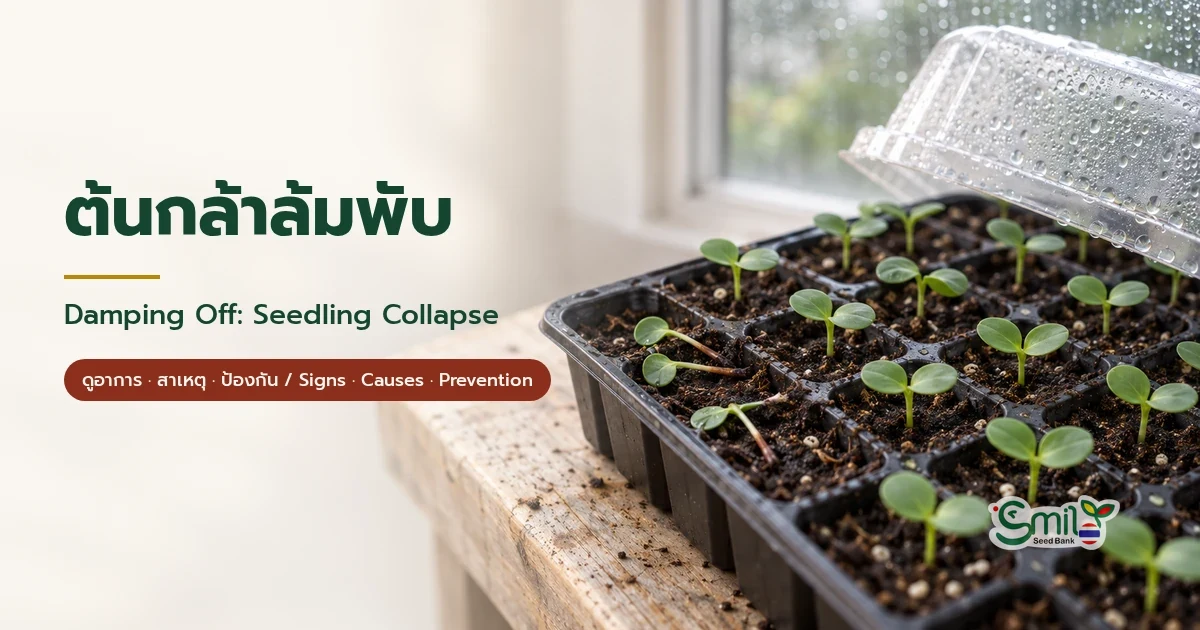
Last evening the seedlings stood in neat rows like pupils at morning assembly, each one holding up its two round seed leaves. This morning you lift the cover, find it beaded with condensation, and one corner of the tray is lying flat on the soil, even though the leaves are still green.
If that picture is familiar, you're not alone. It has a name: damping-off, known in Thai as ต้นกล้าล้มพับ or โรคเน่าคอดิน (literally "rot at the soil collar"). Right now southern Thailand is still getting heavy rain, and much of the country is moving into cool, misty mornings, so it's a good moment to get to know it before it visits your own tray. This article covers what the real thing looks like, what only looks like it, what causes it, and how three basics prevent it: clean mix, careful watering and moving air.
What damping-off is (and why it's not one germ)
UC IPM explains that damping-off isn't a single disease but a group name for seedling diseases caused by several organisms. It shows up in three ways: seeds rot before they germinate, shoots decay before they break the surface, or stems rot at the soil line and the seedling topples. Pythium species are the most common culprits, followed by Rhizoctonia, Fusarium and Phytophthora. The key point is that these pathogens are present in virtually all soils. They live on dead organic matter and wait for the right conditions.
Source: UC IPM – Damping-off Diseases in the Garden
MSU Extension adds that the groups attack in different places. Fusarium and Rhizoctonia usually hit seedlings at the soil line after they emerge, while Pythium commonly attacks below the soil line, and Pythium seed decay is common.
Source: MSU Extension – Damping-off in Vegetables
In Thailand, the Highland Research and Development Institute (HRDI) lists damping-off among the vegetable diseases to watch in the rainy season. It describes a water-soaked, brown patch at the base of the stem right at soil level, followed by rot, and seedlings snapping over before their first true leaves.
Source: HRDI – Vegetable diseases to watch in the rainy season (Thai)
Reading the signs: 5 clues from the tray
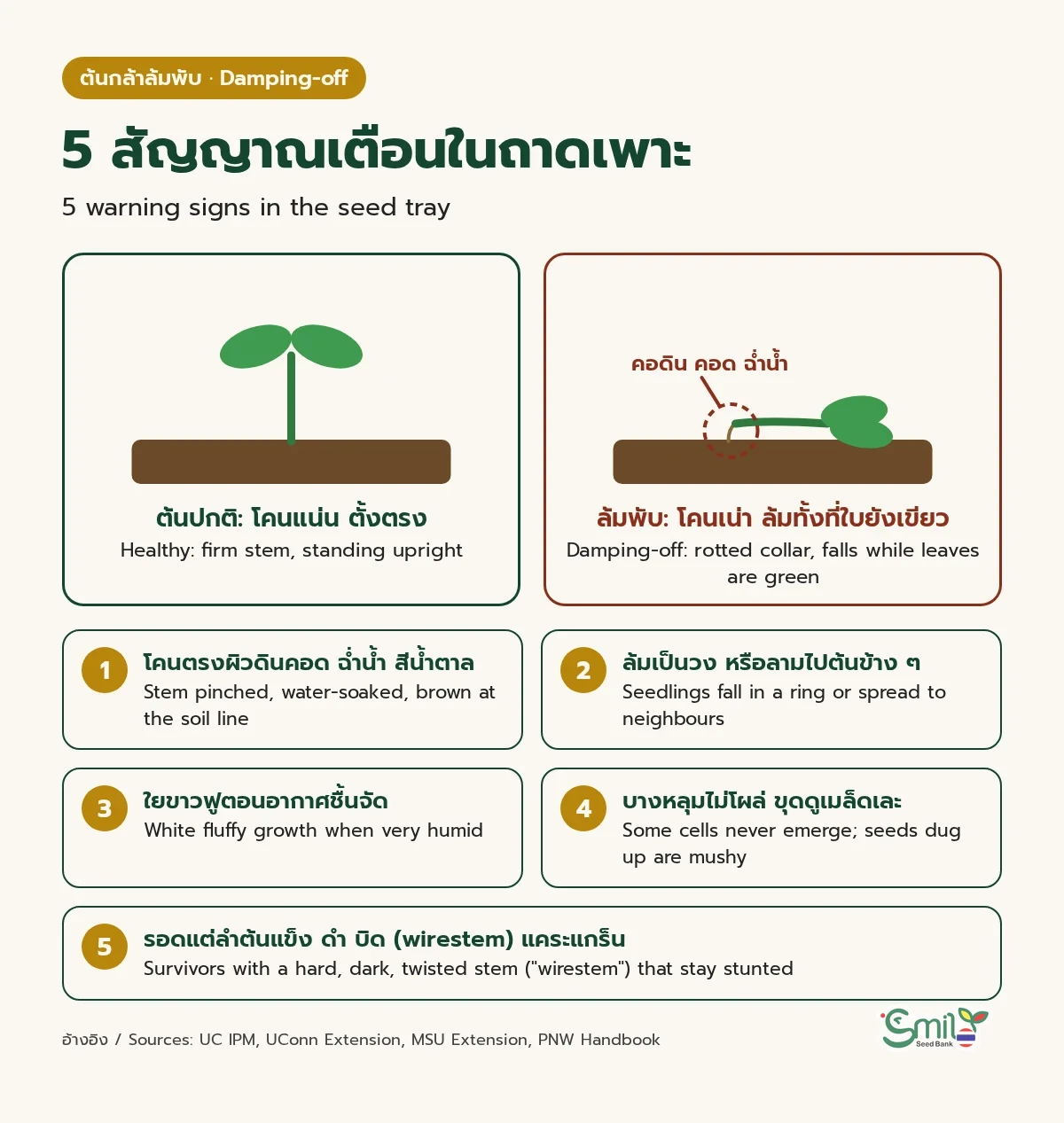
1. A pinched, water-soaked collar, and a fall while the leaves are still green
This is the classic picture. UC IPM says that when seedlings are attacked after emerging, the stem near the soil line decays and weakens, usually causing them to topple and die. The PNW Handbook adds that the lower stem often withers before the upper stem and leaves, so the seedling falls over onto the soil. UConn Extension describes the stem lesion as water-soaked, or dark, dead and sunken at the soil line.
Source: UC IPM – Damping-off Diseases in the Garden · PNW Handbook – Pythium Seed Rot, Damping-off, and Root Rot · UConn Extension – Damping-off of Ornamental and Vegetable Seedlings
2. Dying in a circle, or in scattered spots
UConn Extension notes that in open flats the pathogens spread outward from a starting point, so seedlings die in a circular pattern. In plug trays, affected plants may be scattered more randomly because the pathogens travel in splashing water. The PNW Handbook warns that the disease can move very fast and spread to healthy neighbours.
Source: UConn Extension – Damping-off of Ornamental and Vegetable Seedlings · PNW Handbook – Pythium Seed Rot, Damping-off, and Root Rot
3. White fluff when it's very humid
MSU Extension says that in high humidity, white, fluffy growth of the pathogen may appear on infected tissue. The PNW Handbook also mentions white, cottony growth on seedlings and on the soil surface in very moist conditions. If you see this when you lift the cover in the morning, treat it as a warning.
Source: MSU Extension – Damping-off in Vegetables · PNW Handbook – Pythium Seed Rot, Damping-off, and Root Rot
4. Cells where nothing ever came up
Sometimes the disease works quietly underground. UC IPM says the first visible sign is often seeds that never emerge. Dug up, they're soft, mushy and dark brown, sometimes with soil clinging to them because fine threads of the pathogen run through it. (We covered the other reasons seeds fail in our article on why seeds don't germinate.)
Source: UC IPM – Damping-off Diseases in the Garden
5. Survivors with a hard, dark, twisted stem ("wirestem")
A seedling that stays upright isn't necessarily safe. UConn Extension describes "wirestem": the stem shrivels and turns dark and woody. The plant may not collapse, but it stays stunted and can die after transplanting.
Source: UConn Extension – Damping-off of Ornamental and Vegetable Seedlings
Damping-off, or just a lookalike?
Before you blame a pathogen, rule out the impostors. UConn Extension warns that tender seedlings can also die from over-fertilising (roots shrivel from salt injury), heat stress, hot water, lack of water or chemical spray injury. UC IPM points out that cutworms, earwigs, snails and slugs also damage seedlings. And Clemson Extension explains that seedlings short of light become leggy and weak and tend to topple over.
Source: UConn Extension – Damping-off of Ornamental and Vegetable Seedlings · UC IPM – Damping-off Diseases in the Garden · Clemson HGIC – Starting Seeds Indoors
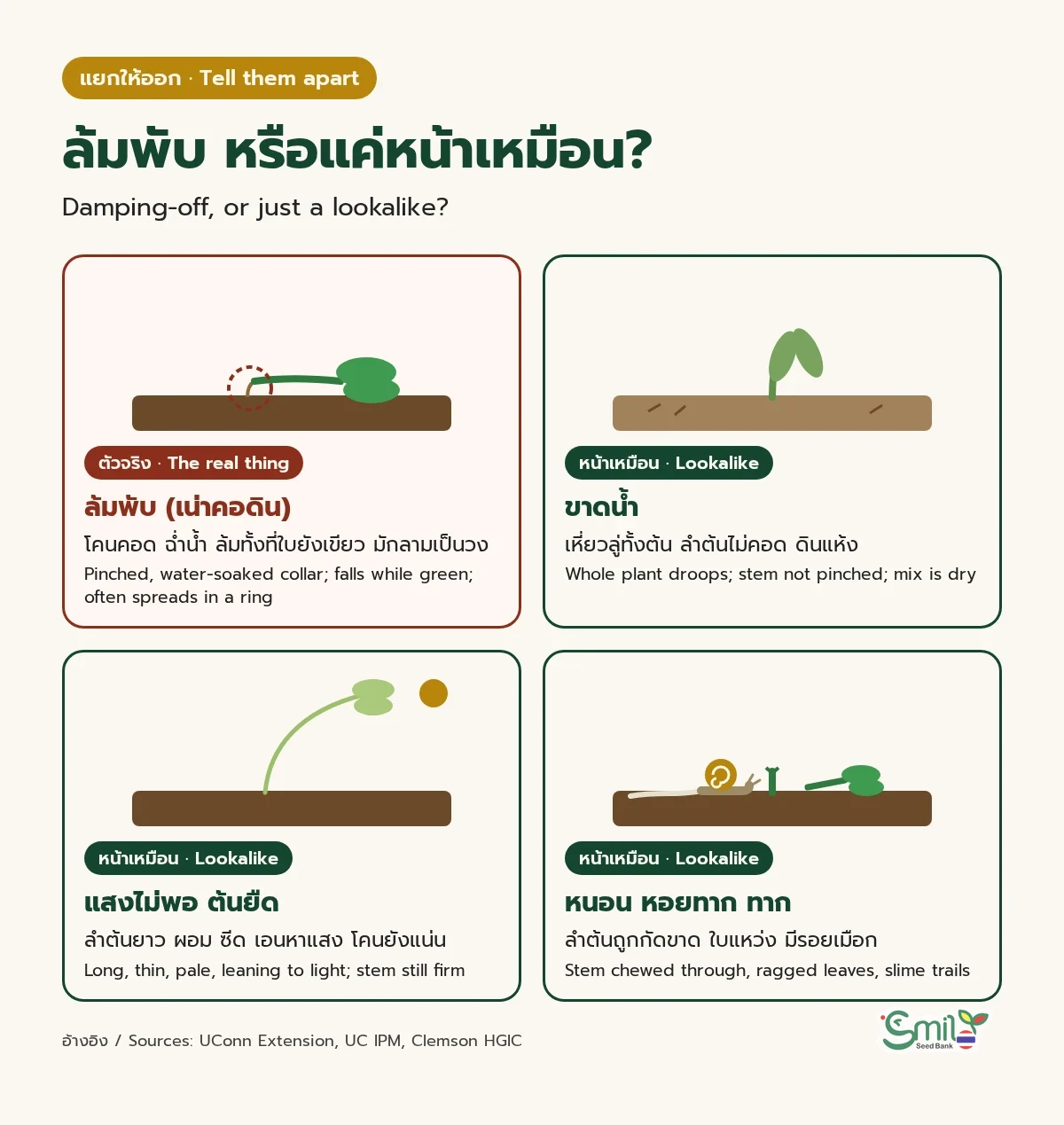
What you see | Likely cause | How to check |
|---|---|---|
Stem pinched, water-soaked and brown at the soil line; seedling falls over while leaves are still green | Damping-off | Has the mix stayed wet for long? Are seedlings falling in a ring or spreading to neighbours? |
Whole seedling droops, but the stem isn't pinched or rotten; mix is dry | Lack of water | Touch the mix and check the stem base is still firm (my guess: if it stands back up after watering, it was probably just thirsty) |
Long, thin, pale stem leaning toward the light | Too little light (leggy seedling) | Check the stem is firm, not water-soaked, then add light |
Stem chewed through, leaves ragged, slime trails | Cutworms, snails, slugs or insects | Look for chew marks and slime around the tray (my guess: many feed at night, so check after dark) |
Roots shrivelled and dry right after feeding | Too much fertiliser (salt build-up) | Did you just feed, or use a strong, rich mix? |
Source: UConn Extension – Damping-off of Ornamental and Vegetable Seedlings · UC IPM – Damping-off Diseases in the Garden · Clemson HGIC – Starting Seeds Indoors · PNW Handbook – Pythium Seed Rot, Damping-off, and Root Rot
Why this time of year calls for extra care
Thailand's Meteorological Department (TMD) forecast, issued 9 October 2026, says southern Thailand will keep getting heavy, widespread rain from mid-October to early January, especially on the east coast from Chumphon south. Upper Thailand is expected to enter the cool season around the third week of October, and many regions, Bangkok included, will have morning fog at times.
Source: TMD – Seasonal outlook, cool season 2026–27 (Thai)
Why does that matter for seedlings? HRDI explains that in the rainy season, overcast skies cut photosynthesis, so plants are weaker and disease gets in more easily, and it advises against overwatering in humid, rainy spells. UC IPM says seedlings growing slowly in cold, wet soil are more likely to be infected. UConn Extension warns that condensation dripping onto the growing mix also promotes damping-off.
Source: HRDI – Vegetable diseases to watch in the rainy season (Thai) · UC IPM – Damping-off Diseases in the Garden · UConn Extension – Damping-off of Ornamental and Vegetable Seedlings
My guess: humid mornings and evenings are when the surface of a tray dries slowest. Water in the evening, close the cover overnight, and the mix may stay wet right through to morning. That's my own reading of the advice above; I haven't found a source that measured it in Thai homes.
The real cause: the pathogen is already there; what matters is how strong the seedling is
If the pathogens are in almost every soil, why do some trays survive and others collapse? UC IPM explains that the young tissue of emerging seedlings is the most susceptible part. Vigorously growing seedlings pass through that stage fairly quickly, and established plants resist the pathogens better. A second UC IPM page notes that vigorous seedlings grown under ideal light and temperature may survive even when the fungi are present, while weak seedlings succumb under poor conditions.
Source: UC IPM – Damping-off Diseases in the Garden · UC IPM – Damping-Off (Floriculture and Ornamental Nurseries)
Penn State Extension lists the conditions that favour the disease: excessive soil moisture and too much overhead misting, cool soil before germination (below about 20°C), hot soil after emergence (above about 25°C), and overcrowded flats.
Source: Penn State Extension – Damping Off
The pathogens get into a tray in several ways. UConn Extension says soil-borne fungi generally don't produce airborne spores; they arrive on tools, hose ends, splashing water and hands. The PNW Handbook adds that Pythium survives in dust, growing media and soil particles on floors, flats and pots.
Source: UConn Extension – Damping-off of Ornamental and Vegetable Seedlings · PNW Handbook – Pythium Seed Rot, Damping-off, and Root Rot
Three pillars of prevention: clean mix, careful watering, moving air
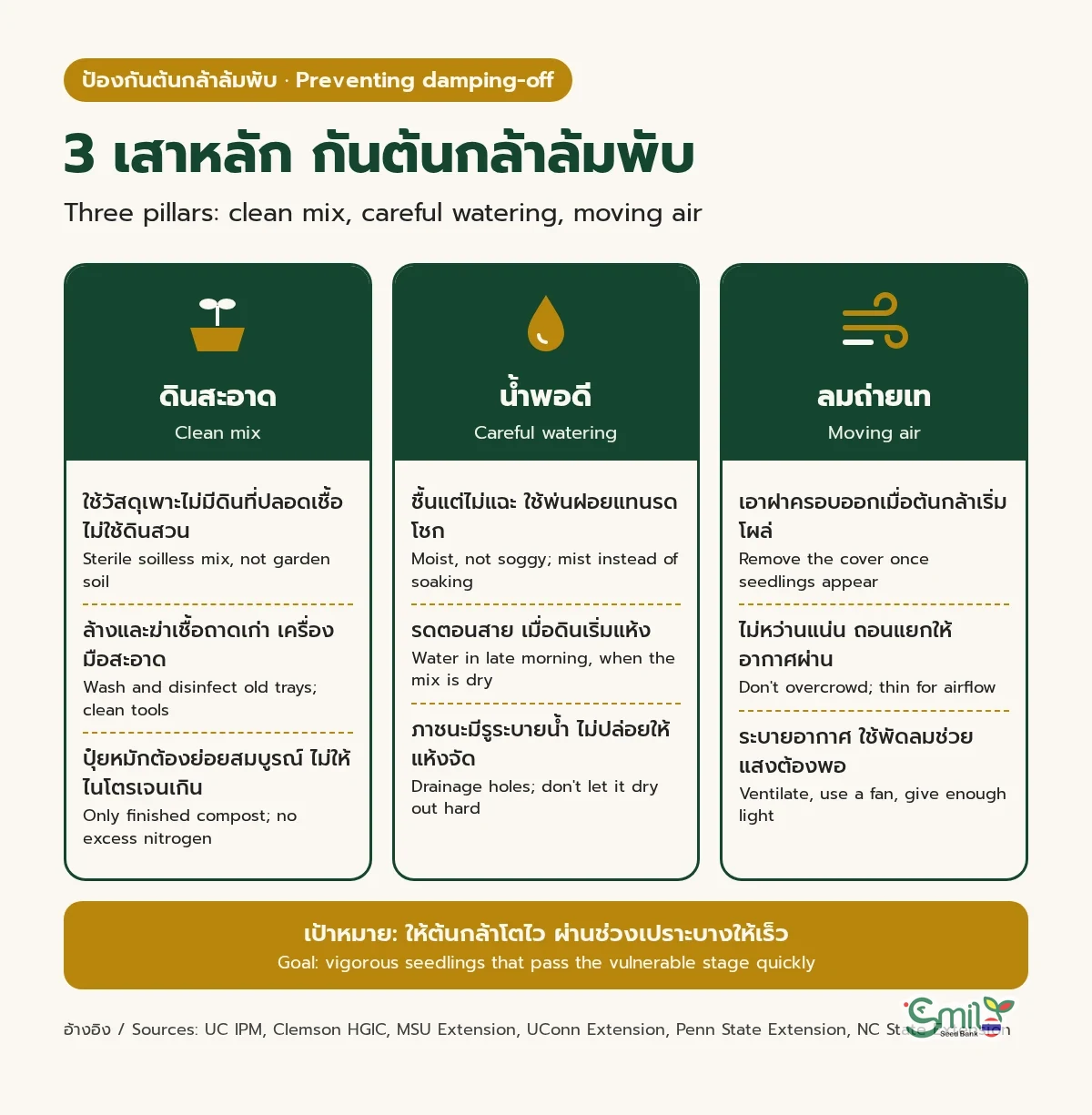
Pillar 1: clean mix, clean trays, clean hands
Clemson Extension recommends starting seeds in a well-drained, well-aerated, sterile soilless mix, because soilless mixes reduce soil-borne diseases such as damping-off. It advises against bagged topsoil and vegetable garden mixes for seed starting. Penn State Extension notes that most commercial soilless mixes are free of damping-off fungi.
Source: Clemson HGIC – Starting Seeds Indoors · Penn State Extension – Damping Off
If you reuse trays, UC IPM says to wash off every bit of old mix, soak them in a 10% bleach solution for 30 minutes, then let them air dry. Penn State warns against setting clean trays or pots on dirty floors or benches, or using dirty tools.
Source: UC IPM – Damping-off Diseases in the Garden · Penn State Extension – Damping Off
On organic mixes, UC IPM warns that unfinished compost holds water and promotes disease, and that too much nitrogen produces tender growth that's easily infected. UConn Extension recommends checking that compost is finished before using it.
Source: UC IPM – Damping-off Diseases in the Garden · UConn Extension – Damping-off of Ornamental and Vegetable Seedlings
My guess: if you use Super soil, I wouldn't sow seeds straight into it. Let the Super soil go through บ่มดิน (cook) until the organic matter has broken down well, and start seeds in a lighter layer such as Base soil or an airy seed mix. I'm connecting this myself from the warnings about unfinished compost and excess nitrogen above; no study has tested this exact approach. (More on Super soil in our Super soil recipe article.)
Pillar 2: water to "moist, not soggy", and pick your moment
UC IPM recommends keeping the mix moist but not saturated, and gently misting the surface after the first watering instead of soaking it. MSU Extension says it's best to water in late morning and when the soil is dry, adjusting the amount to what the plants need. Clemson Extension stresses that containers need drainage holes.
Source: UC IPM – Damping-off Diseases in the Garden · MSU Extension – Damping-off in Vegetables · Clemson HGIC – Starting Seeds Indoors
But don't swing to the other extreme. The PNW Handbook explains that Pythium enters roots damaged by soluble salts, from over-fertilising or from letting the mix dry out, even briefly, and that cold irrigation water slows growth after each watering, which stretches out the susceptible period. Penn State also recommends keeping moisture even through germination and the seedling stage.
Source: PNW Handbook – Pythium Seed Rot, Damping-off, and Root Rot · Penn State Extension – Damping Off
Pillar 3: moving air, enough light, no crowding
Clemson Extension says that if you cover containers with a plastic bag to hold moisture, remove it when the seedlings begin to appear. UConn Extension explains that sowing too densely reduces airflow around seedlings and raises the humidity around them, and UC IPM recommends thinning after emergence to improve air circulation.
Source: Clemson HGIC – Starting Seeds Indoors · UConn Extension – Damping-off of Ornamental and Vegetable Seedlings · UC IPM – Damping-off Diseases in the Garden
MSU Extension recommends ventilation and fans to keep air moving in enclosed growing spaces, and making sure plants get enough light. NC State Extension says proper seeding rates help avoid thick stands, poor air movement and low light. Clemson adds that once seedlings have two true leaves, a fan placed nearby to make them sway gently is useful, but watch moisture, because the fan dries them out faster.
Source: MSU Extension – Damping-off in Vegetables · NC State Extension – Damping-off in Flower and Vegetable Seedlings · Clemson HGIC – Starting Seeds Indoors
My guess: if you start seeds in a room or on a balcony during a long rainy spell, a small fan on low, not pointed straight at the seedlings, probably helps the surface dry on sunless days. I'm not sure whether it should run from the seed-leaf stage, though, since the source above talks about the two-true-leaf stage.
Found it. Now what?
Honestly, prevention is much easier than cure. UConn Extension says damping-off is difficult to stop once symptoms appear, and recommends discarding whole infected flats, because healthy-looking seedlings may carry infected mix and develop wirestem or root rot later.
Source: UConn Extension – Damping-off of Ornamental and Vegetable Seedlings
If you want to try to save the rest, NC State Extension says spread can be slowed by making conditions drier: more air circulation and ventilation, less frequent watering, better drainage and more light. UC IPM and HRDI both advise pulling out and discarding diseased plants.
Source: NC State Extension – Damping-off in Flower and Vegetable Seedlings · UC IPM – Damping-off Diseases in the Garden · HRDI – Vegetable diseases to watch in the rainy season (Thai)
What about fungicides? MSU Extension notes that fungicides sold for home vegetable gardens typically aren't labelled for damping-off, so home growers should focus on cultural and environmental practices.
Source: MSU Extension – Damping-off in Vegetables
Common beliefs (that aren't always true)
"It fell over because it was thirsty; water it and it'll stand back up"
Not necessarily. A thirsty seedling droops all over, but if the collar is pinched and water-soaked, more water just feeds what the pathogen likes. UC IPM says not to overwater, and UConn notes that overwatering, with the mix staying wet too long, promotes the disease.
Source: UC IPM – Damping-off Diseases in the Garden · UConn Extension – Damping-off of Ornamental and Vegetable Seedlings
"Good, crumbly garden soil is fine for sowing seeds"
Soil that's great in a bed isn't necessarily right for a seed tray, because these pathogens are in nearly all soils. That's why Clemson recommends a sterile soilless mix.
Source: UC IPM – Damping-off Diseases in the Garden · Clemson HGIC – Starting Seeds Indoors
"Feed them well so they're strong enough to fight it off"
The opposite. UC IPM says excess nitrogen causes tender growth that's susceptible to infection, and the PNW Handbook says roots injured by fertiliser salts are an entry point for Pythium.
Source: UC IPM – Damping-off Diseases in the Garden · PNW Handbook – Pythium Seed Rot, Damping-off, and Root Rot
"It only happens when it's cold"
This is the one that stopped me. More at the end.
FAQ
Q1: Can a seedling that has damped off be saved?
None of the sources we read offer a way to revive a seedling that has collapsed from damping-off. UC IPM says seedlings attacked at the stem base usually topple and die, and advises removing diseased plants; UConn recommends discarding the whole flat. What you can do is change conditions to slow the spread to the others.
Source: UC IPM – Damping-off Diseases in the Garden · UConn Extension – Damping-off of Ornamental and Vegetable Seedlings
Q2: Can I reuse mix from a tray that had damping-off?
MSU Extension recommends new mix where possible; if you must reuse it, sterilise it with steam or heat first, because some pathogens persist from season to season in mix, pots and trays. UConn advises against reusing plug trays that held diseased plants, because it's very hard to get all the organic matter out of small cells.
Source: MSU Extension – Damping-off in Vegetables · UConn Extension – Damping-off of Ornamental and Vegetable Seedlings
Q3: When should I water in the rainy season?
MSU Extension recommends late morning, when the soil is dry. HRDI advises against overwatering in humid, rainy weather. My guess: on a day of steady rain when the surface is still damp, skipping a watering may be better than sticking to the schedule. Touch the mix or lift the tray to feel its weight first.
Source: MSU Extension – Damping-off in Vegetables · HRDI – Vegetable diseases to watch in the rainy season (Thai)
Q4: When should the dome or plastic bag come off?
Clemson Extension says to remove it when the seedlings begin to appear. UConn warns that condensation dripping from plastic promotes the disease. If the cover is beaded with water every morning, the tray is very humid.
Source: Clemson HGIC – Starting Seeds Indoors · UConn Extension – Damping-off of Ornamental and Vegetable Seedlings
Q5: When are seedlings past the danger zone?
There's no fixed date. UC IPM says that as seedlings grow into established plants, they become less susceptible. MSU adds that beyond the seedling stage, the same pathogens are usually said to cause crown, root or stem rot instead. Not sure how long that takes for any given plant, since it depends on how fast seedlings grow in your conditions.
Source: UC IPM – Damping-off Diseases in the Garden · MSU Extension – Damping-off in Vegetables
An ending that isn't one: is the enemy "cool and wet" or "hot and wet"?
Most of what we read comes from US extension services, and they agree the disease loves cool, wet soil, so the advice is to warm things up. Dig a little deeper, though, and there's another side. UC IPM writes that some Pythium species favour cool, wet conditions, but Rhizoctonia and other Pythium species can cause disease in drier, warmer conditions; NC State and MSU say much the same. Penn State lists "hot soil after emergence" among the favourable conditions, and the PNW Handbook says growing media warmer than about 25°C favour some Pythium species such as P. aphanidermatum.
Source: UC IPM – Damping-Off (Floriculture and Ornamental Nurseries) · NC State Extension – Damping-off in Flower and Vegetable Seedlings · MSU Extension – Damping-off in Vegetables · Penn State Extension – Damping Off · PNW Handbook – Pythium Seed Rot, Damping-off, and Root Rot
So in Thailand, where a "cold" season is still warmer than much of the world and a covered tray can bake by midday, does cold-climate advice to "keep it warm" carry over as is? I'm honestly not sure, and I haven't found research on home seed trays in Thai conditions. What seems to hold on both sides are the same three pillars: clean mix, careful watering, moving air.
If damping-off has hit your seedlings, did it follow a cool, damp night, or a hot, stuffy day under the cover? Tell us. The answer for our climate might be sitting in your tray.
Sources
UC Statewide IPM Program. Damping-off Diseases in the Garden (Pest Notes, updated 01/2024). https://ipm.ucanr.edu/home-and-landscape/damping-off-diseases-in-the-garden/
UC Statewide IPM Program. Damping-Off (Floriculture and Ornamental Nurseries, Pest Management Guidelines). https://ipm.ucanr.edu/agriculture/floriculture-and-ornamental-nurseries/damping-off/
Mississippi State University Extension. Damping-off in Vegetables (Publication 3747). https://extension.msstate.edu/publications/damping-vegetables
NC State Extension. Damping-off in Flower and Vegetable Seedlings (reviewed 2025). https://content.ces.ncsu.edu/damping-off-in-flower-and-vegetable-seedlings
UConn Extension IPM. Damping-off of Ornamental and Vegetable Seedlings (revised 2024). https://ipm.cahnr.uconn.edu/damping-off-of-ornamental-and-vegetable-seedlings/
Penn State Extension. Damping Off (updated 2023). https://extension.psu.edu/damping-off
Pacific Northwest Plant Disease Management Handbook. Greenhouse Plants, Ornamental – Pythium Seed Rot, Damping-off, and Root Rot. https://pnwhandbooks.org/plantdisease/host-disease/greenhouse-plants-ornamental-pythium-seed-rot-damping-root-rot
Clemson Cooperative Extension HGIC. Starting Seeds Indoors. https://hgic.clemson.edu/factsheet/starting-seeds-indoors/
Highland Research and Development Institute (Public Organization) (2024). Vegetable diseases to watch in the rainy season (in Thai). https://hkm.hrdi.or.th/Knowledge/detail/697
Thai Meteorological Department (2026). Cool-season weather outlook for Thailand 2026 (issued 9 Oct 2026, in Thai). https://www5.tmd.go.th/forecast/seasonal
This article is for education and general information about raising seedlings only. It is based on the sources cited at the time of writing, and the information may change.