What Do Biochar and Microbes Do for Growing Cannabis? A Research Summary
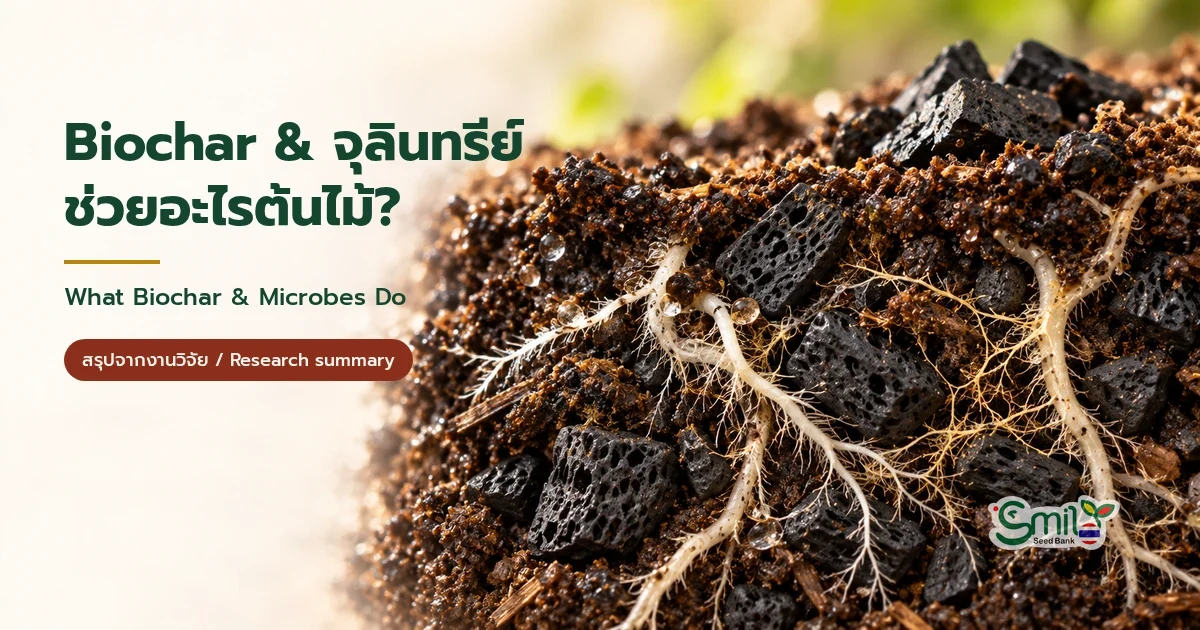
If roots could talk, they would probably ask for just two things: a growing medium loose enough to breathe and hold water, and neighbours that help them find food. The two helpers growers mention most for those jobs are biochar, a porous charcoal that can stay in soil for decades, and the tiny microbes that live around roots.
Open the studies that actually tested them on this plant, though, and the answers are more interesting than expected. Some helpers improved things you can measure. One performed exactly as well as the material it replaced. And one gave completely different results depending only on when it was added.
This article goes area by area: what biochar, mycorrhizal fungi and root-zone bacteria were found to help with, where no benefit was found, and where I am only guessing.
1. Biochar in the growing mix: structure, water and pH
What biochar is
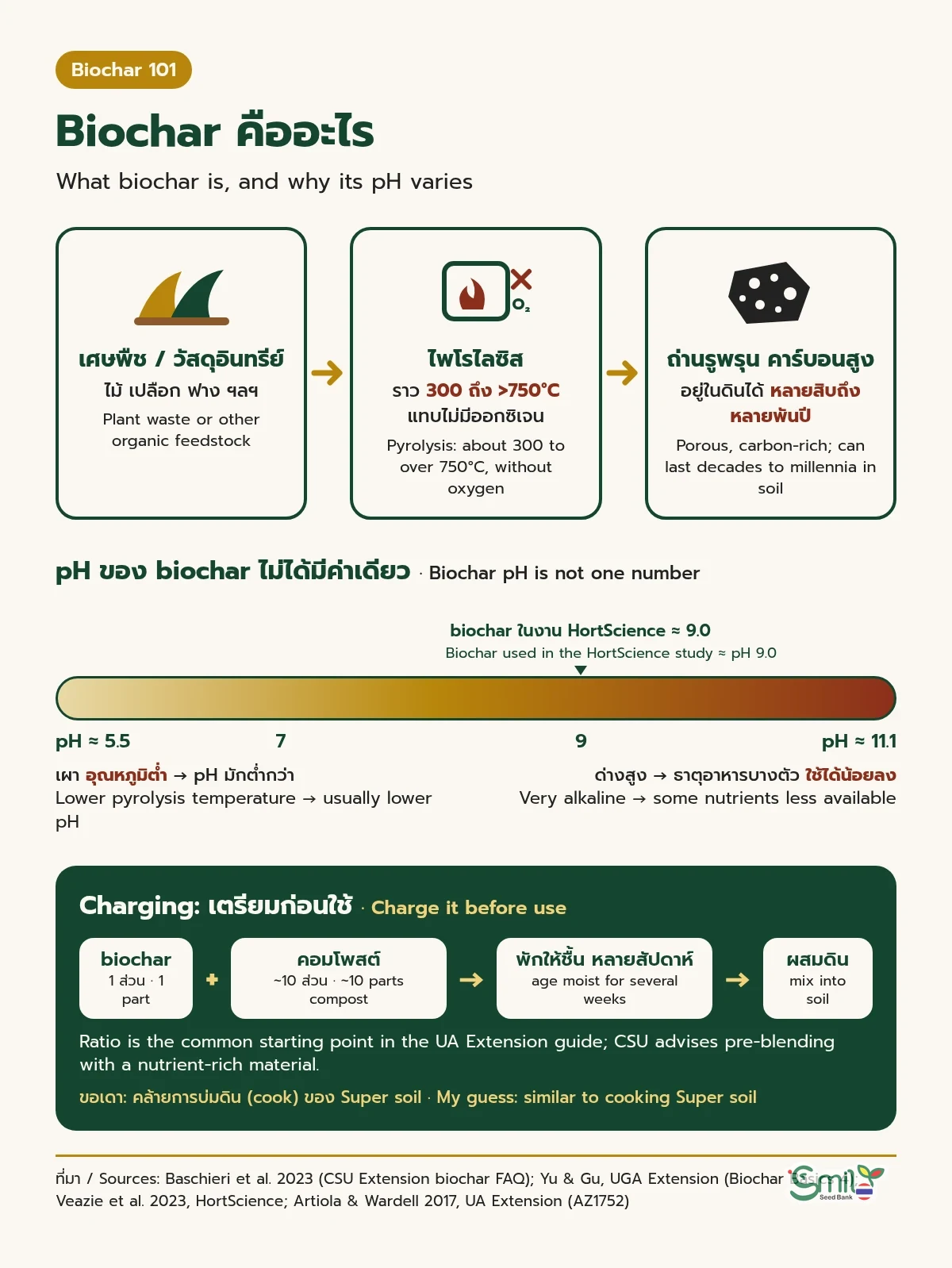
A biochar FAQ published via Colorado State University Extension describes biochar as a solid, carbon-rich material made mainly by pyrolysis: heating organic material at roughly 300°C to over 750°C without oxygen. Most of its carbon is fairly stable and hard for microbes to break down, with estimated persistence in soil from decades to thousands of years depending on the biochar type and how it was made. The same document says biochar is not a silver bullet, but one more tool to combine with other soil management practices.
Source:
Soil structure and water holding
CSU explains that biochar changes a soil's pore-size distribution, which changes water dynamics and aeration. In general, small biochar particles added to coarse soils increase water holding capacity, while larger particles added to fine soils increase how quickly water drains through. Particle size should therefore match the soil and the goal.
Source:
In University of Arizona work, Bermuda grass in soil with 2% biochar by weight recovered about 40–60% after a month without water, and with 4% biochar nearly 100% recovered, while pots without biochar did not recover at all. The authors attribute this to biochar's added water-holding capacity. In the same study, adding up to 4% biochar by weight to a loamy sand doubled romaine lettuce yields.
These results come from grass and lettuce in low-organic desert soil, not from cannabis trials. For container substrates, a University of Georgia Extension publication notes that adding biochar affects air space, container capacity and total porosity variably, depending on the biochar.
Source: Yu & Gu – Biochar Basics 4: Biochar Properties and Making the Right Biochar Mix (UGA Extension, PDF)
pH and EC
CSU gives a wide pH range for biochar, about 5.52–11.10 depending on feedstock and production conditions, and notes that high-pH biochar can replace lime on acidic soils. UGA explains that biochars made at lower temperatures generally have lower pH, that highly alkaline biochar can make some nutrients less available, and that studies have found biochar raising the EC (soluble salt level) of peat-based substrates.
Source: · Yu & Gu – UGA Extension (PDF)
A perlite substitute with equal growth
A 2023 HortScience study grew cuttings of Cannabis sativa 'BaOx' (a high-CBD hemp) in a greenhouse in 12 substrates: peat mixed with an aggregate at 85:15 or 70:30 by volume. The aggregates were coarse perlite, medium wood biochar (<6 mm) or coarse wood biochar (>6 mm), each with or without calcium silicate. Plants grew for 12 weeks (4 vegetative, 8 flowering) with water-soluble fertiliser at every watering. The biochar had a pH of about 9.0, so the team adjusted dolomitic lime rates to reach a target pH of about 6.0.
At weeks 6 and 12, height, width and total biomass did not differ between any substrates. Cannabinoid concentrations were not meaningfully different either: the only significant result was a 0.07% difference in total THC between the two biochar sizes, which the authors considered probably not biologically meaningful. The study also saw no EC increase from the biochar. The conclusion: this biochar can replace perlite at up to 30% by volume with results comparable to peat–perlite mixes.
Source: Veazie et al. (2023), HortScience 58(10)
Put plainly, the benefit this study found was that biochar substituted for perlite without any loss of growth. It did not find increased growth. It was also a soilless, fertigated mix with no added microbes.
2. Mycorrhizal fungi (AMF): growth, and cannabinoids under drought
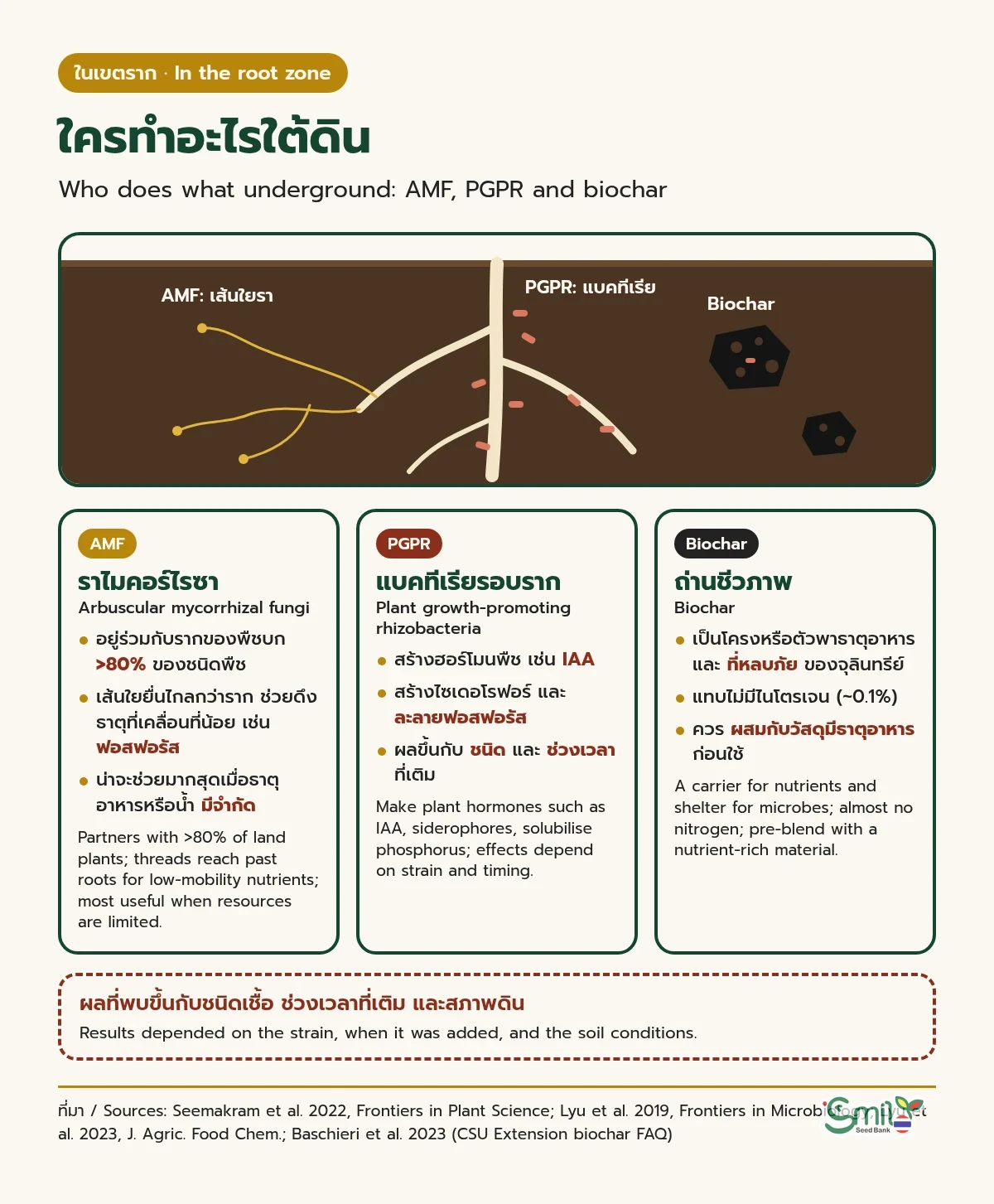
Arbuscular mycorrhizal fungi (AMF) form mutualistic partnerships with the roots of over 80% of land plant species. Their hyphae reach beyond the roots, helping the plant take up nutrients that move slowly in soil and possibly helping with water uptake in dry conditions. The researchers note that AMF are likely to be most beneficial when nutrients or water are limited.
Source: Seemakram et al. (2022), Frontiers in Plant Science (PMC)
Khon Kaen University: biomass and cannabinoids
This work was done at Khon Kaen University's Cannabis Research Institute in Thailand. The team grew KKU05 cuttings in pots of sterilised, low-phosphorus loamy sand and compared four groups of six pots (24 pots in total) for 60 days: no treatment, NPK chemical fertiliser, Rhizophagus prolifer PC2-2, and R. aggregatus BM-3 g3.
Source: Seemakram et al. (2022), Frontiers in Plant Science (PMC)
The BM-3 g3 group had the highest biomass and the highest measured CBD and THC concentrations (for example, CBD at 32.3 mg/g dry weight versus 24.6 mg/g in the untreated group). The PC2-2 group performed about the same as chemical fertiliser. Root colonisation was 21% for BM-3 g3 and 13% for PC2-2. The benefit depended on which fungus was used.
Source: Seemakram et al. (2022), Frontiers in Plant Science (PMC)
Under water stress
A 2025 Crop & Pasture Science greenhouse study used a factorial design with Glomus intraradices and four watering levels (30%, 50%, 70% and 90% of field capacity). The abstract reports that AMF improved growth and leaf water status, lowered oxidative-stress markers, raised antioxidant enzymes, and increased THC by up to 11.7% and CBD by up to 11.2% compared with uninoculated plants.
Source: Qadir et al. (2025), Crop & Pasture Science 76(12) – abstract (BioOne)
The abstract also reports that THCAS gene expression went up, while CBDAS and OLS expression went down, even though measured CBD rose. Gene activity and measured compound levels did not always move together. Not sure: the full paper is paywalled and I could read only the abstract, so I do not know which watering level produced the 11.7%, or whether it is a relative increase or percentage points.
Source: Qadir et al. (2025), Crop & Pasture Science 76(12) – abstract (BioOne)
3. PGPR bacteria: flower weight, terpenes, and timing
How PGPR work
A McGill University review summarises that Pseudomonas and Bacillus are common root-zone bacteria. Reported mechanisms include producing plant hormones such as IAA, producing siderophores (iron-binding compounds) and solubilising phosphorus, and some Bacillus strains release cytokinins. The review's mechanism table does not list nitrogen fixation for these two genera, and it notes that data on PGPR use with this crop are still very limited.
Source: Lyu et al. (2019), Frontiers in Microbiology (PMC)
The McGill growth-room trial
A 2023 Journal of Agricultural and Food Chemistry study was a plant trial in a controlled growth room (not a clinical trial). It used CBD Kush cuttings in 15 cm pots, and three bacteria (Bacillus sp., Mucilaginibacter sp. and Pseudomonas sp.) grown in King's B broth were applied at the base of each plant on day 1 (vegetative stage) or day 36 (early flowering). The trial was run twice, giving 10 plants per treatment.
Source: Lyu et al. (2023), J. Agric. Food Chem. (PMC)
What it found:
Applied in the vegetative stage: Mucilaginibacter raised dry flower weight by 24% (per the abstract) and total THC by 11.6% and total CBD by 11.1% compared with the control. Bacillus and Pseudomonas raised total THC by 4.8% and 5.9%.
Applied at flowering: no effect on THC or CBD, but Mucilaginibacter and Pseudomonas raised total terpenes by about 23% and 18%. The study did not report a terpene increase for Bacillus.
King's B broth alone (no bacteria) also raised dry flower weight by 14.5%. The authors explain that the broth itself contains nutrients.
Source: Lyu et al. (2023), J. Agric. Food Chem. (PMC)
Limits the authors state themselves: terpenes were analysed only once, as a qualitative comparison between treatments rather than a quantitative measurement, because some terpenes can evaporate during sample preparation. They also note that PGPR that work in the lab often colonise roots poorly in the field.
Source: Lyu et al. (2023), J. Agric. Food Chem. (PMC)
Not sure: the abstract gives a 24% rise in dry flower weight for Mucilaginibacter, while the results section gives 27.9%. I don't know which figure is final, so I use the abstract's.
4. Biochar and microbes together
CSU explains that biochar contains very little nitrogen (about 0.1%), so it acts as a backbone or carrier for nutrients and a shelter for microbes. It recommends mixing biochar with a nutrient-rich material before use, because unmixed biochar risks tying up nutrients and showing less benefit.
Source:
The only study I found that tested biochar together with bacteria in hemp is a 2026 Plant Science greenhouse study under salt stress (100 mM NaCl). It used 2% phosphorus-enriched biochar by weight together with the phosphorus-solubilising bacteria Bacillus subtilis or Pseudomonas putida. The abstract reports that, compared with salt stress alone, the combined treatments raised shoot weight by 24–25%, root weight by 28–38%, CBD by 12–13% and THC by 14–16%. It used three replicates (two pots each), and the authors say the results are limited to the greenhouse and need field testing.
Source: Shekari et al. (2026), Plant Science – DOI 10.1016/j.plantsci.2026.113208
Not sure: I could read only this study's abstract. I have not found a study testing biochar together with mycorrhizal fungi in this plant, or a combined treatment in normal, non-saline soil. The explanation often seen online that microbes cause "eustress" that drives large trichome increases is not something I found in any study cited here.
5. Putting it to use: charging and pot percentages
The University of Arizona guide calls pre-treating biochar "charging": mix biochar with compost or manure and keep it moist for several weeks before adding it to soil or a growing mix, so nutrients can exchange and the compost's microbes and worms can adapt to the biochar. Most beginners use about 10 parts compost to 1 part biochar. The guide also found that biochar made from plants grown in salty areas can carry salts, and that repeated soaking in water washes out salts and lowers pH.
Source: Artiola & Wardell (2017) – UA Extension (PDF)
For containers, CSU says biochar at 5–25% by volume still supports good plant growth, and the HortScience study above used up to 30% by volume in a peat substrate without seeing negative effects.
Source: · Veazie et al. (2023), HortScience
If you plan to use a commercial mycorrhizal product, a test of 28 commercial inoculants across three continents is worth knowing about: in non-sterile soil, inoculation did not increase root colonisation and increased biomass in only 1 of 25 cases; in sterile soil, 84% of the products produced no colonisation at all, while lab-grown fungi colonised roots well.
My guess: charging sounds very close to cooking a Super soil (บ่มดิน, cook). If I were trying it, I would mix the biochar in when building the Super soil and let it cook along with everything else, rather than adding raw biochar later, and perhaps add some to the Base soil for a looser texture. No study I found has tested biochar in a cooked Super soil directly.
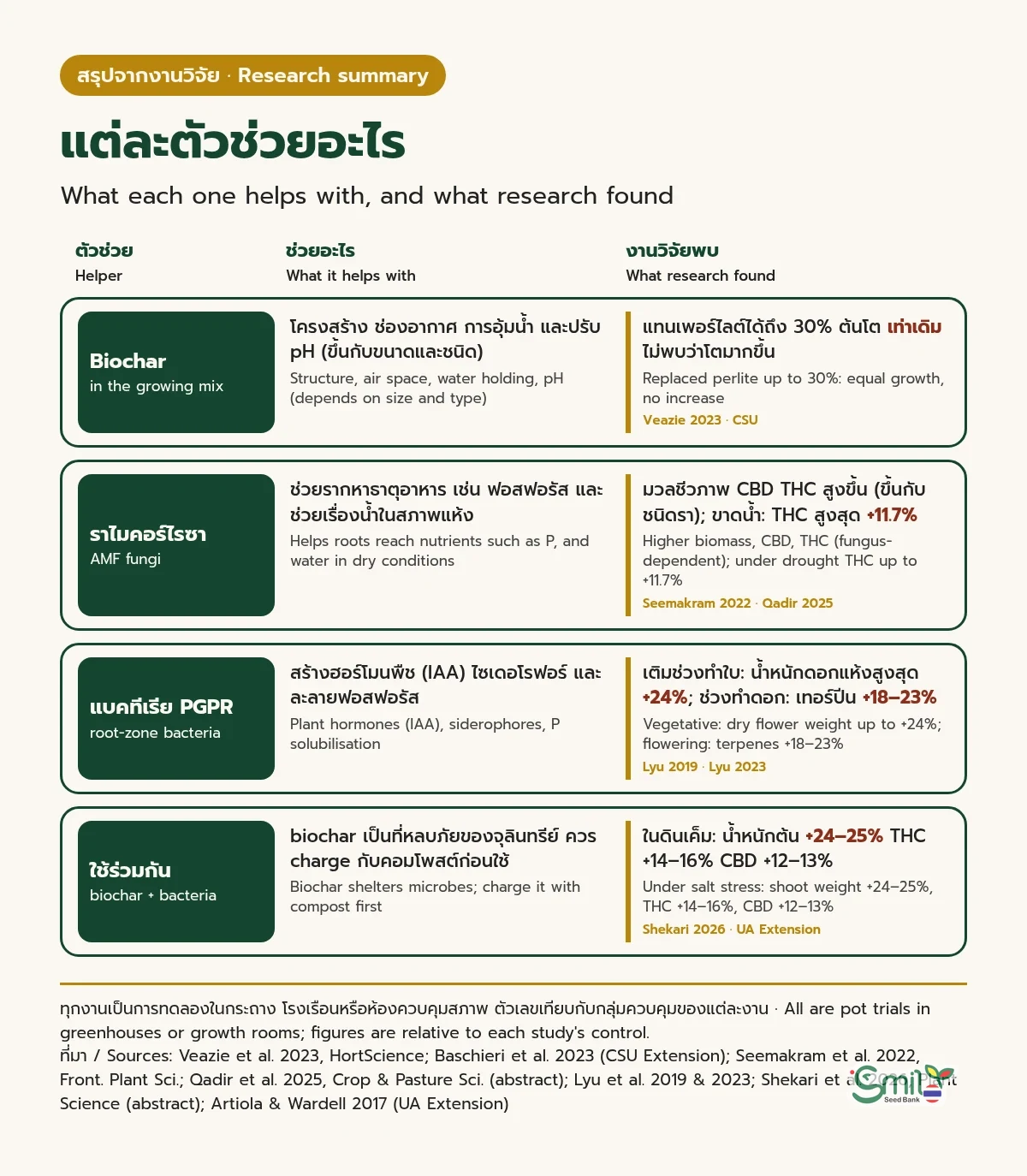
The summary in one table: what each one helps with
Helper | Benefit research found | Not found / still unknown | Trial conditions |
|---|---|---|---|
Biochar in the mix (Veazie et al. 2023) | Replaced perlite at up to 30% with equal growth and cannabinoids | No increase in growth | Greenhouse, peat substrate, fertigated, 12 weeks |
AMF fungi (Seemakram et al. 2022) | R. aggregatus gave the highest biomass, CBD and THC; the other fungus matched NPK fertiliser | Results differ by fungus; sterilised soil | Greenhouse, low-P soil, 60 days, 24 pots |
AMF under water stress (Qadir et al. 2025) | Better growth and leaf water status; THC up to +11.7%, CBD +11.2% | Per-water-level detail (abstract only) | Greenhouse, 4 watering levels |
PGPR bacteria (Lyu et al. 2023) | Vegetative stage: higher dry flower weight, THC, CBD; flowering: terpenes +18–23% | No THC/CBD effect at flowering; field performance | Growth room, 15 cm pots, 10 plants per group |
Biochar + bacteria (Shekari et al. 2026) | Higher shoot and root weight, CBD, THC than salt stress alone | Results in normal, non-saline soil; field performance | Greenhouse, 100 mM NaCl |
Source: Veazie et al. 2023 · Seemakram et al. 2022 · Qadir et al. 2025 · Lyu et al. 2023 · Shekari et al. 2026
Limits and what is still unknown
Common misunderstandings
"Adding biochar must raise yield." The HortScience study found growth equal to the perlite group, and CSU notes that biochar added to already fertile soil is unlikely to produce a noticeable soil response, even though soil organic carbon goes up.
Source: Veazie et al. (2023), HortScience ·
"All biochar is alkaline." Biochar pH ranges from about 5.5 to 11, depending on feedstock and production temperature. The safer approach is to check the producer's data or measure it yourself.
Source: · Yu & Gu – UGA Extension (PDF)
"More gene activity means more of the compound." In the AMF water-stress study, CBDAS expression fell while measured CBD rose.
Source: Qadir et al. (2025) – abstract (BioOne)
"Every microbe works the same way, any time." In the Khon Kaen study, two fungi gave clearly different results, and in the McGill trial results depended on both the bacterium and when it was applied.
Source: Seemakram et al. (2022) (PMC) · Lyu et al. (2023) (PMC)
"A commercial inoculant will match research results." The commercial inoculant evaluation found most products did not increase colonisation in either non-sterile or sterile soil.
Source: Salomon et al. (2022), Applied Soil Ecology
What the research cannot answer yet
Every study here was a pot trial in a greenhouse or growth room, with small plant numbers and one variety per study.
I found no study testing biochar together with mycorrhizal fungi in this plant, and none in a rich organic mix like Super soil.
Every percentage is relative to that experiment's control group and applies only to that variety, growing medium and environment.
Source: Veazie et al. 2023 · Seemakram et al. 2022 · Lyu et al. 2023 · Shekari et al. 2026
Frequently asked questions (FAQ)
Q1: How is biochar different from ordinary cooking charcoal?
CSU says they are chemically similar but differ in feedstock and purpose: charcoal is usually made from wood as a fuel, while biochar can be made from many organic waste materials and is intended for agricultural and environmental uses. Not sure: I have no data on the pH or impurities of charcoal sold locally; measure the pH before using it.
Source:
Q2: How much biochar should go in a pot?
CSU says 5–25% by volume in containers still supports good growth, and the HortScience study found biochar could replace perlite at up to 30% by volume in a peat substrate without negative effects. That biochar had a pH of about 9.0, and the team adjusted lime to reach the target pH.
Source: · Veazie et al. (2023), HortScience
Q3: Do I need to charge biochar before using it?
CSU recommends mixing biochar with a nutrient-rich material before use, since unmixed biochar risks tying up nutrients. The University of Arizona suggests keeping a biochar–compost mix moist for several weeks before use.
Source: · Artiola & Wardell (2017) – UA Extension (PDF)
Q4: When should microbes be added?
In the McGill trial, PGPR applied in the vegetative stage were linked to higher dry flower weight, THC and CBD, while application at flowering had no effect on THC or CBD but was linked to higher terpenes with two of the bacteria. The authors suggest early application supports growth through later stages. Not sure: this is a single growth-room experiment.
Source: Lyu et al. (2023) (PMC)
Q5: Why might garden results differ from research results?
The Khon Kaen study used sterilised, low-phosphorus soil; the commercial inoculant evaluation found inoculation barely increased colonisation in non-sterile soil; and the McGill authors note PGPR often colonise roots less well in the field than in the lab.
Source: Seemakram et al. (2022) (PMC) · Salomon et al. (2022), Applied Soil Ecology · Lyu et al. (2023) (PMC)
The open question
Back to the roots' two requests. The evidence points in a surprisingly consistent direction. The Khon Kaen fungi worked clearly in phosphorus-poor soil. Biochar with bacteria in the 2026 study worked in salty soil. The Arizona grass benefited from biochar during drought. The AMF researchers say the fungi are likely most useful when resources are limited. CSU says already fertile soil rarely responds noticeably to biochar. And a fully fertigated study like the HortScience trial found results that were simply "equal".
Source: Seemakram et al. (2022) (PMC) · Shekari et al. (2026), Plant Science · Artiola & Wardell (2017) – UA Extension (PDF) · · Veazie et al. (2023), HortScience
So in a Super soil that has been fully cooked and is rich in nutrients, is there any work left for biochar and microbes to do? My guess: their benefits may show most when a plant is up against a limit, and less when the soil is already good. But I have not found a study that tests this in a rich organic mix. What do you think: is the best helper one that adds to what is already good, or one that steps in when something is missing?
References
Veazie, P., Balance, M. S., Whipker, B. E., & Jeong, K. Y. (2023). Comparison of Peat–Perlite-based and Peat–Biochar-based Substrates with Varying Rates of Calcium Silicate on Growth and Cannabinoid Production of Cannabis sativa 'BaOx'. HortScience, 58(10), 1250–1256. DOI: 10.21273/HORTSCI17324-23. https://journals.ashs.org/view/journals/hortsci/58/10/article-p1250.xml
Seemakram, W., Paluka, J., Suebrasri, T., Lapjit, C., Kanokmedhakul, S., Kuyper, T. W., Ekprasert, J., & Boonlue, S. (2022). Enhancement of growth and cannabinoids content of hemp (Cannabis sativa) using arbuscular mycorrhizal fungi. Frontiers in Plant Science, 13, 845794. DOI: 10.3389/fpls.2022.845794. https://pmc.ncbi.nlm.nih.gov/articles/PMC9360772/
Qadir, S. A., Shareef, O. H., Mohammed, O. A., Kamal, R. Y., & Hamarashid, S. H. (2025). Regulation of cannabinoid biosynthetic pathways in Cannabis sativa by arbuscular mycorrhizal fungi: a molecular and phytochemical perspective. Crop and Pasture Science, 76(12). DOI: 10.1071/CP25081. (Abstract only.) https://complete.bioone.org/journals/crop-and-pasture-science/volume-76/issue-12/CP25081/Regulation-of-cannabinoid-biosynthetic-pathways-in-Cannabis-sativa-by-arbuscular/10.1071/CP25081.short
Lyu, D., Backer, R., Berrué, F., Martinez-Farina, C., Hui, J. P. M., & Smith, D. L. (2023). Plant Growth-Promoting Rhizobacteria (PGPR) with Microbial Growth Broth Improve Biomass and Secondary Metabolite Accumulation of Cannabis sativa L. Journal of Agricultural and Food Chemistry, 71(19), 7268–7277. DOI: 10.1021/acs.jafc.2c06961. https://pmc.ncbi.nlm.nih.gov/articles/PMC10197126/
Lyu, D., Backer, R., Robinson, W. G., & Smith, D. L. (2019). Plant Growth-Promoting Rhizobacteria for Cannabis Production: Yield, Cannabinoid Profile and Disease Resistance. Frontiers in Microbiology, 10, 1761. DOI: 10.3389/fmicb.2019.01761. https://pmc.ncbi.nlm.nih.gov/articles/PMC6698789/
Shekari, A., Ghanbari Jahromi, M., Ghotbi-Ravandi, A. A., Abdossi, V., & Torkashvand, A. M. (2026). Phosphorus-solubilizing bacteria and phosphorus-enriched biochar enhance growth, cannabinoid content, and essential oil yield in salt-stressed hemp (Cannabis sativa L.). Plant Science. DOI: 10.1016/j.plantsci.2026.113208. (Abstract only.) https://doi.org/10.1016/j.plantsci.2026.113208
Salomon, M. J., Demarmels, R., Watts-Williams, S. J., McLaughlin, M. J., Kafle, A., Ketelsen, C., Soupir, A., Bücking, H., Cavagnaro, T. R., & van der Heijden, M. G. A. (2022). Global evaluation of commercial arbuscular mycorrhizal inoculants under greenhouse and field conditions. Applied Soil Ecology, 169, 104225. DOI: 10.1016/j.apsoil.2021.104225. https://researchnow.flinders.edu.au/en/publications/global-evaluation-of-commercial-arbuscular-mycorrhizal-inoculants/
Baschieri, R., Aller, D., Seman-Varner, R., Trippe, K., Moebius-Clune, B., & Miles, T. (2023). Frequently Asked Questions About Biochar Applied to Soil. Published via Colorado State University Extension. https://www.extension.colostate.edu/wp-content/uploads/2024/01/biochar-FAQ-1.pdf
Artiola, J. F., & Wardell, L. (2017). Guide to Making and Using Biochar for Gardens in Southern Arizona (AZ1752). The University of Arizona Cooperative Extension. https://extension.arizona.edu/sites/default/files/pubs/az1752-2017.pdf
Yu, P., & Gu, M. Biochar Basics 4: Biochar Properties and Making the Right Biochar Mix (C 1292-04). University of Georgia Cooperative Extension. https://fieldreport.caes.uga.edu/wp-content/uploads/2025/08/C-1292-04_1.pdf
Educational note: This article is for education and general information about soil, growing media and plant research only. It is based on the sources cited at the time of writing (17 October 2026) and may change as new research is published.