Autoflower vs Photoperiod Seeds: A Beginner's Guide
The difference is the flowering switch
Before you read: This article is about plant genetics, for educational purposes. Seeds sold by Smile Seed Bank are for collection and education only, and are sold only to people aged 20 and over.
If you've just started getting into seeds, one of the first questions you'll hit is "what's the difference between auto and photo?" Packs from overseas breeders often print Autoflowering or Photoperiod in big letters (sometimes just Auto, Fem or Photo), and if nobody has explained it to you, it's easy to get lost.
Let me walk you through it the way I'd explain it to a friend. We'll start with the botany (how a plant "knows" it's time to flower), move on to the genetics research that has finally pinned down what makes an autoflower tick, and finish with a few honest thoughts on which type a beginner might want to study first.
How a Plant Knows When to Flower: Photoperiod
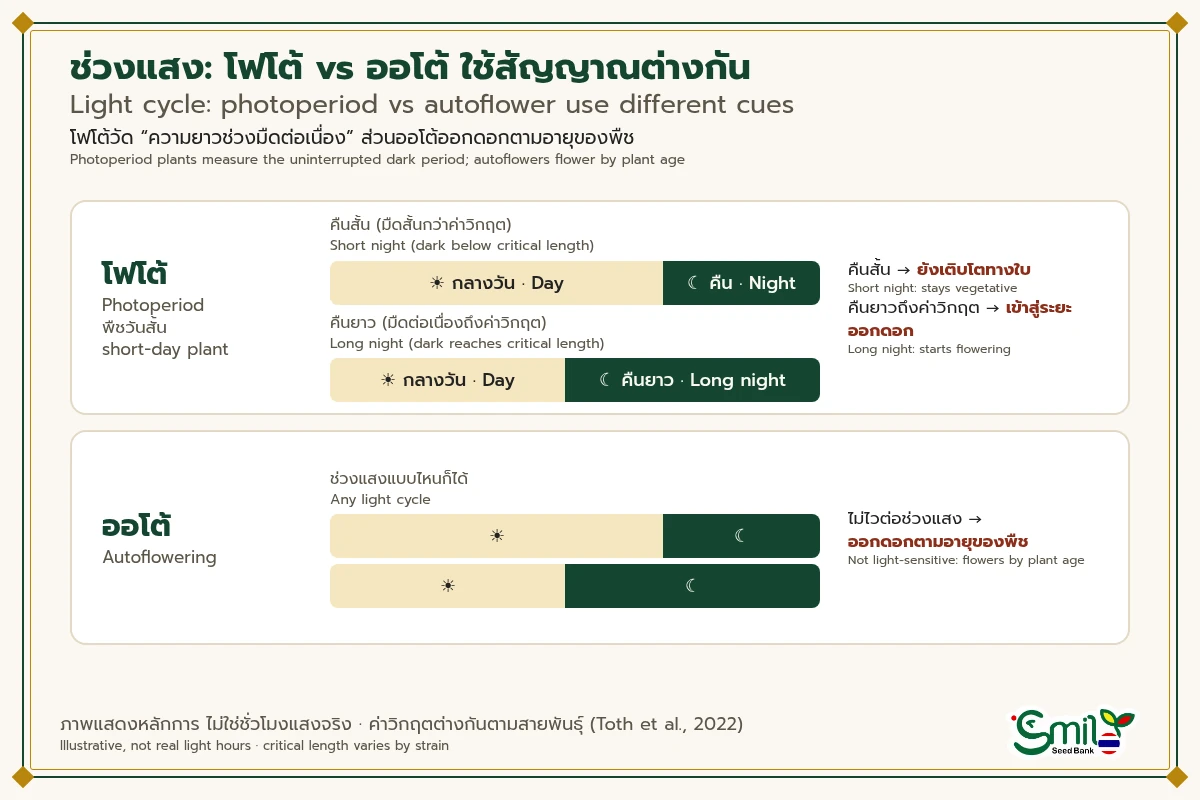
Many plants use the length of day and night as a seasonal clock. Botanists call this photoperiodism.
Cannabis sativa is classed as a short-day plant, though "long-night plant" is more accurate: what the plant really measures is the length of uninterrupted darkness. Once nights reach a critical length, the plant switches from vegetative growth (stems and leaves) to flowering. Toth and colleagues (2022) also showed that this critical night length varies with genetics, which is why some cultivars flower early and others late, even when grown side by side.
Why this matters in Thailand
Thailand sits fairly close to the equator, so day length changes much less over the year than it does in Europe or North America. Cultivars selected abroad may therefore behave differently from what their breeder describes. Understanding photoperiod helps you read the information on a seed pack with a more critical eye.
What Are Photoperiod Seeds?
Photoperiod seeds come from cultivars that still respond to day length, as cannabis naturally does. The plant keeps growing vegetatively as long as the dark period stays short, and moves into flowering when nights get long enough.
What photoperiod genetics offer
You set the pace. Where light can be controlled, the grower decides how long the plant stays in the leafy stage.
Lots of genetic diversity. Most classic cultivars in history are photoperiod, so there's a huge range of traits to study.
Good for studying mother-plant selection. Breeders often work with photoperiod plants when selecting and keeping lines, because the growth stage can be extended.
What to understand about photoperiod
The trade-off is that photoperiod plants depend on correct light management. Even a small light leak during the dark period can disrupt the plant's signal. The overall life cycle is also usually longer, which means more time and attention.
What Are Autoflowering Seeds?
Autoflowering seeds come from cultivars that are photoperiod-insensitive. The plant moves into flowering according to its own age, more or less regardless of how long the nights are.
Where does "Ruderalis" come from?
The word you'll hear most with autoflowers is Ruderalis. The name was published by the Russian botanist D. E. Janischevsky in 1924, based on plants collected in south-eastern Russia (around Saratov). In ecology, "ruderal" describes plants that thrive on disturbed ground, like roadsides and waste land.
Here's the part many people don't know: in current taxonomy, the USDA's GRIN-Global database lists Cannabis ruderalis as a synonym of Cannabis sativa, not a separate species. McPartland's 2018 review also explains how the name "ruderalis" has been used inconsistently for decades. That's why modern genetics papers usually treat autoflowering as a trait within C. sativa, not a different plant.
The genes behind autoflowering
This is the exciting bit if you like genetics.
Autoflower1 is recessive. Toth et al. (2022, Frontiers in Plant Science) mapped a locus called Autoflower1 on chromosome 1. It confirmed what breeders had long observed: autoflowering is inherited as a single recessive trait.
A broken clock gene, CsPRR37. A follow-up study (Leckie et al., a 2023 bioRxiv preprint later published in The Plant Journal in 2024) found a splice-site mutation in CsPRR37, part of the plant's circadian clock. In their samples, the mutation was present in the autoflowering genotypes sequenced and in none of the photoperiod genotypes.
More than one route. Another team (Dowling et al., a 2023 preprint published in The Plant Journal in 2024) found a second locus, Autoflower2, linked to a FLOWERING LOCUS T gene (CsFT1) in hemp. So photoperiod insensitivity in cannabis may have more than one genetic origin.
What "recessive" means in practice
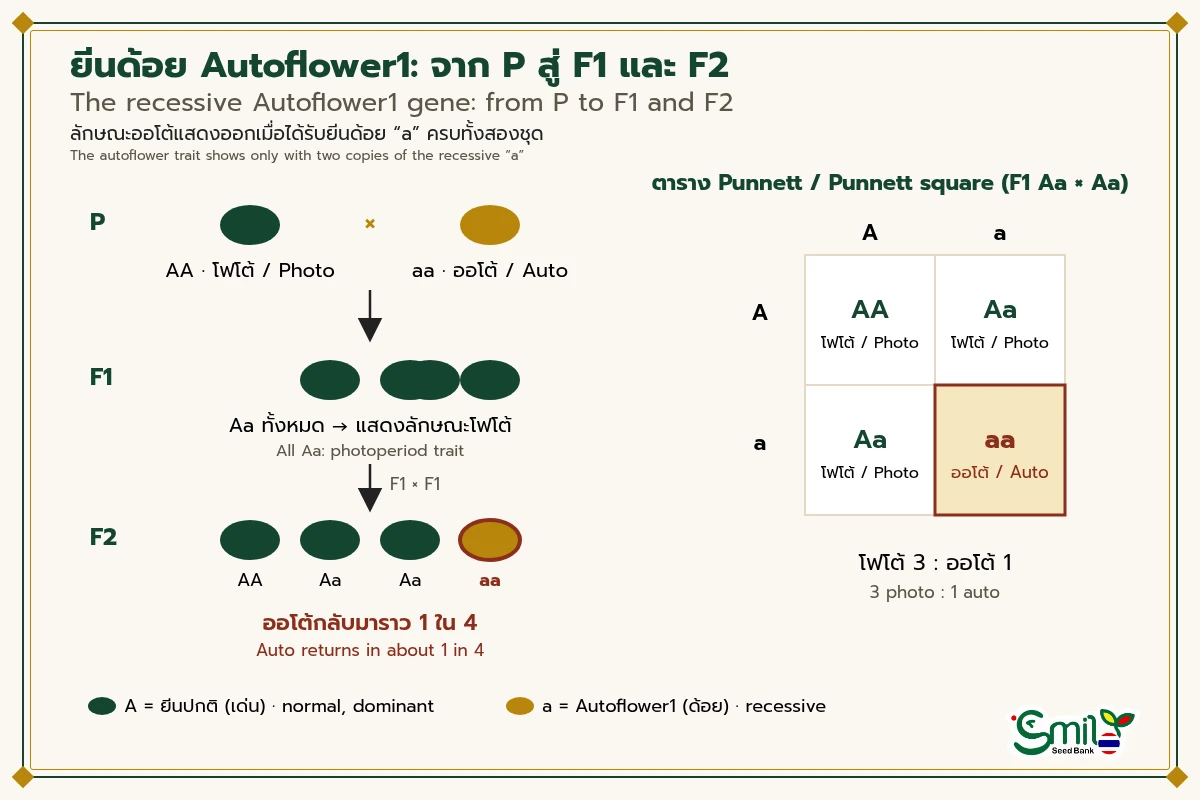
A recessive trait only shows up when the plant carries two copies of it, one from each parent. Cross an autoflower with a photoperiod plant and the first generation (F1) will usually all be photoperiod. The auto trait reappears in the next generation (F2) in roughly 1 in 4 plants, following Mendel's rules. That's why stabilising a new autoflower line takes several generations.
Autoflower vs Photoperiod at a Glance
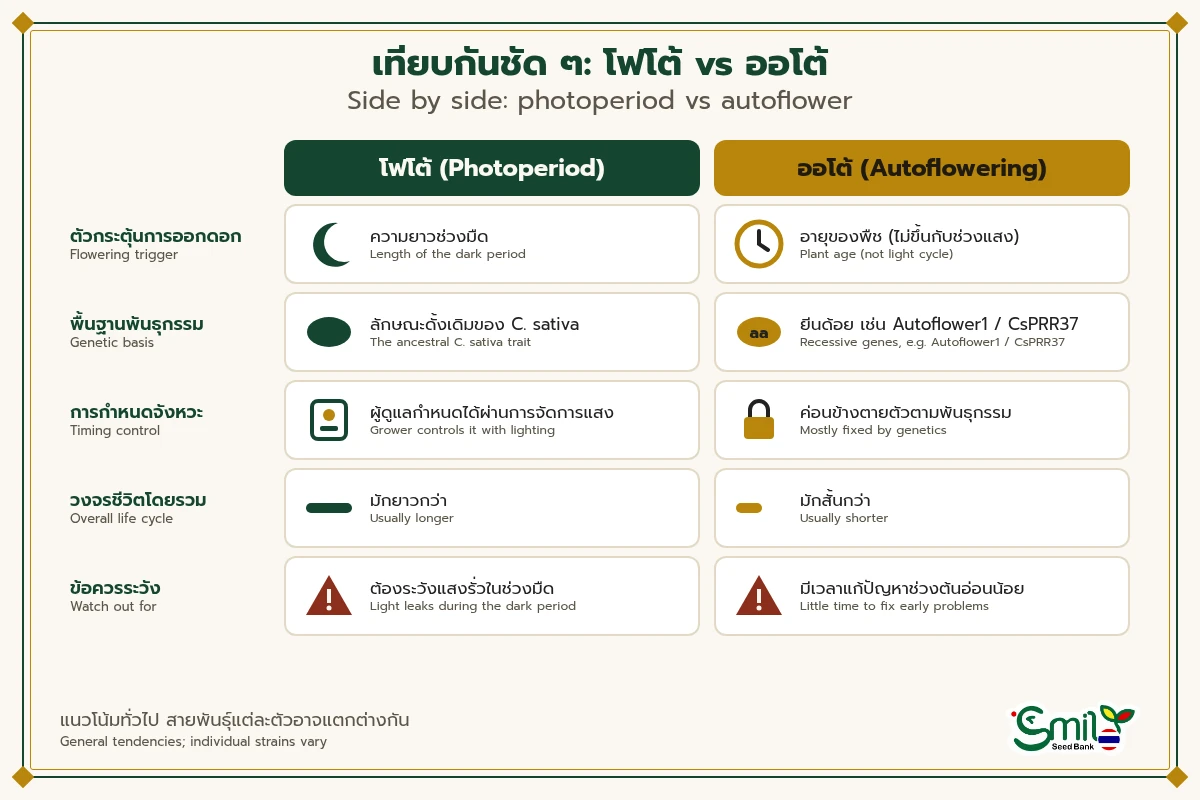
Topic | Photoperiod | Autoflowering |
|---|---|---|
Flowering trigger | Length of the dark period | Plant age (independent of day length) |
Genetic basis | The ancestral C. sativa response | Recessive genes such as Autoflower1 / CsPRR37 |
Control over timing | Grower can set it via lighting | Largely fixed by genetics |
Overall life cycle | Usually longer | Usually shorter |
Room for mistakes | Watch out for light leaks at night | Less worry about light, but little time to recover from problems |
Good for studying | Mother-plant selection, breeding | Recessive inheritance, short life cycles |
Note: these are general tendencies. Individual cultivars vary, and results always depend on the environment.
Which Should a Beginner Study First?
There's no single right answer, but here's what I'd tell a friend.
An autoflower might suit you if…
you want to see a full plant life cycle in a shorter time;
you don't have equipment or space where light can be controlled precisely;
you're curious about recessive genetics and want a real-life example of Mendel at work.
One caution: autoflowers have a limited seedling and vegetative window. If something goes wrong early, there's little time to recover, and that's where many beginners slip up.
A photoperiod might suit you if…
you want to really understand how photoperiod works;
you're interested in selecting a favourite plant to study long-term;
you have time and patience, because the cycle is usually longer.
Three questions to ask yourself
How long can I keep up consistent care?
How much control do I have over light and environment?
Is my goal collecting, studying genetics, or experimenting where the law in my area allows it?
And the most important point before you even think about growing: check the law in your own area or country first. Cannabis rules change often, in Thailand and everywhere else.
Common Myths
"Autoflowers are worse than photoperiods." Not necessarily. Modern autoflowers have been backcrossed with photoperiod lines for many generations. The main difference is the flowering mechanism, not "better or worse".
"Ruderalis is a separate species." As covered above, current taxonomic databases treat it as a synonym of C. sativa.
"Fem means auto." Different things. Feminized means seeds produced to lean towards female plants, and it can apply to both autos and photos. That's why you'll see "Auto Fem" and "Photo Fem" on packs.
"Pick the right type and germination is certain." Germination depends on many factors: seed age, storage and environment. Nobody can promise 100%, and that includes us.
Summary
Autos and photos differ in their "flowering switch". Photoperiod plants listen to the length of the night; autoflowers carry recessive genes that let the switch flip with age instead. Research since 2022 has made that mechanism much clearer at the gene level. For beginners, understanding this before choosing helps you read seed packs correctly and pick what fits your study goals.
Smile Seed Bank shop rules
- Seeds sold by our shop are for collection and educational purposes only.
- We sell only to customers aged 20 and over.
- Buyers must learn and follow the laws of their own area or country before any growing.
- The shop accepts no responsibility for any growing or other activity that breaks local law.
FAQ
Q1: Can you tell autoflower and photoperiod seeds apart by looking at them?
No. The seeds look virtually identical. You can only go by the breeder's information on the original packaging.
Q2: Is Ruderalis a separate species from Cannabis sativa?
GRIN-Global lists Cannabis ruderalis as a synonym of C. sativa, and modern research treats autoflowering as a genetic trait within the same species.
Q3: If you cross an auto with a photo, will the offspring be auto?
Generally the first generation (F1) will be photoperiod, because Autoflower1 is recessive and needs two copies to show.
Q4: Which type should a beginner choose?
It depends on your time, equipment and study goals. Autos have a shorter cycle; photos are more flexible. Either way, check the law in your area first.
Q5: Are feminized seeds the same as autoflowers?
No. Feminized refers to the plant's likely sex; auto/photo refers to the flowering mechanism. They're independent.
Sources
Toth, J. A., et al. (2022). Identification and mapping of major-effect flowering time loci Autoflower1 and Early1 in Cannabis sativa L. Frontiers in Plant Science, 13. https://www.frontiersin.org/journals/plant-science/articles/10.3389/fpls.2022.991680/full (PMC: https://pmc.ncbi.nlm.nih.gov/articles/PMC9533707/)
Leckie, K. M., Sawler, J., Kapos, P., et al. (2023). Loss of daylength sensitivity by splice site mutation in Cannabis. bioRxiv preprint. https://www.biorxiv.org/content/10.1101/2023.03.10.532103v1 (peer-reviewed version: Leckie, K. M., et al. (2024). Loss of daylength sensitivity by splice site mutation in Cannabis pseudo-response regulator. The Plant Journal. https://doi.org/10.1111/tpj.16726)
Dowling, C. A., Shi, J., Toth, J. A., et al. (2023). A FLOWERING LOCUS T ortholog is associated with photoperiod-insensitive flowering in hemp (Cannabis sativa L.). bioRxiv preprint. https://www.biorxiv.org/content/10.1101/2023.04.21.537862v1 (peer-reviewed version: The Plant Journal, 2024. https://doi.org/10.1111/tpj.16769)
USDA ARS GRIN-Global. Cannabis ruderalis Janisch. (taxonomy detail – synonym of C. sativa). https://npgsweb.ars-grin.gov/gringlobal/taxon/taxonomydetail?id=8861
International Plant Names Index (IPNI). Cannabis ruderalis Janisch. https://www.ipni.org/n/60476459-2
McPartland, J. M. (2018). Cannabis Systematics at the Levels of Family, Genus, and Species. Cannabis and Cannabinoid Research, 3(1). https://pmc.ncbi.nlm.nih.gov/articles/PMC6225593/